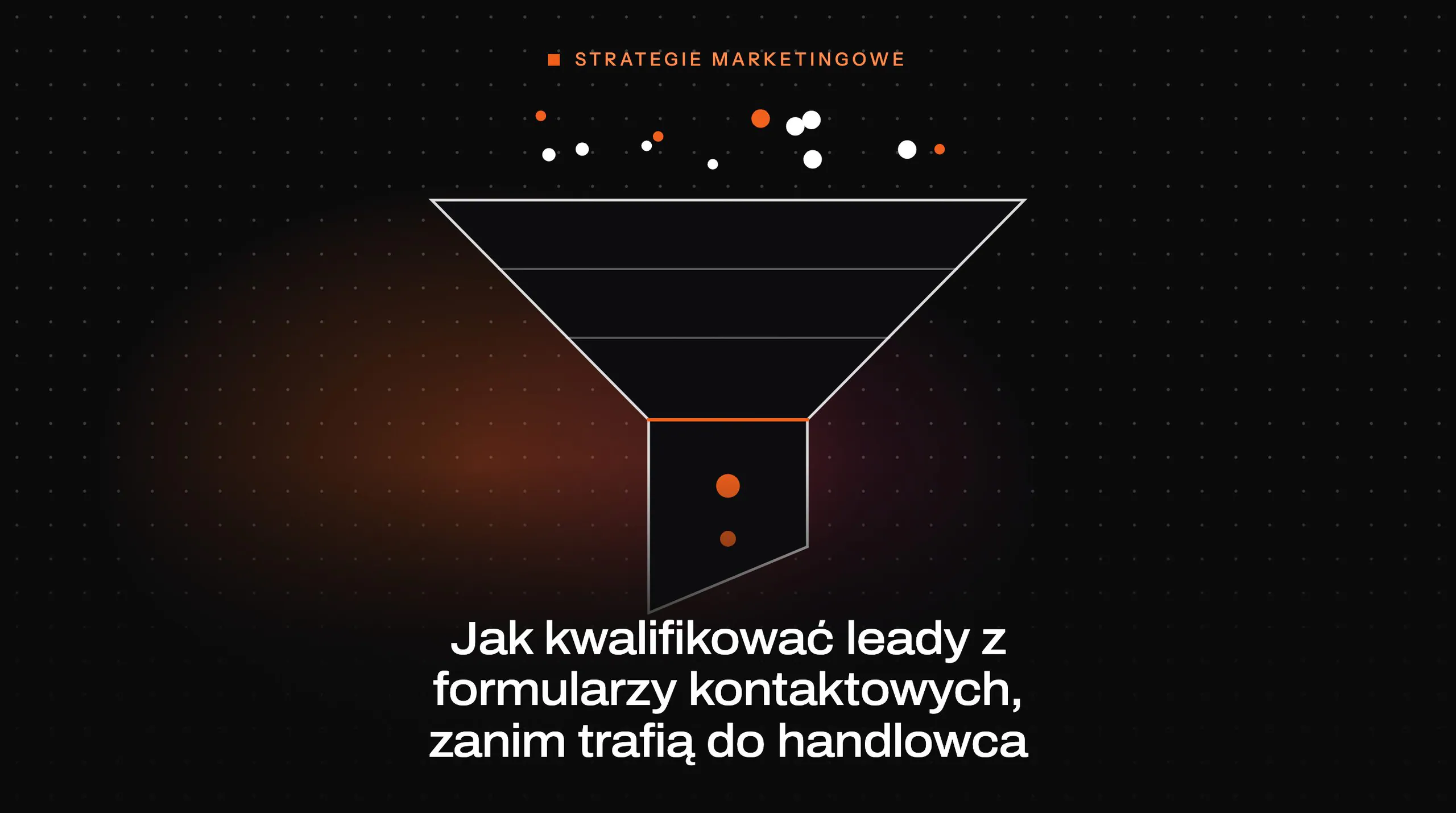

Leads from the form should not land with sales in one unfiltered queue. Well-designed qualification separates genuine sales opportunities from spam, support requests and general enquiries. Most time is lost not because there are no leads, but because of dealing with those that were never a fit for sales in the first place. An effective process starts even before the form, on the page itself, and only then moves on to questions, rules and automation.
The aim of lead qualification and its importance for sales
The aim of lead qualification is to separate sales enquiries from spam, support and general contacts before they reach sales. In practice, this means identifying which contacts are worth a quick conversation and which require a different kind of handling or rejection. This allows sales to work with MQL and SQL leads instead of reviewing the whole mixed queue of submissions.
This directly affects first response time and sales effectiveness. When the team receives fewer random forms, it can get back to people with a real need and a greater readiness to buy more quickly. Marketing, in turn, gains a better view of traffic source quality, because what matters is not the number of leads alone, but how many of them sales accepts.
For this aim to work, MQL and SQL criteria must be set jointly with sales. Otherwise, marketing will see a lead as promising, while sales will treat it as a waste of time. The minimum set of questions then becomes clear: does the company fit the customer profile, is the problem specific, and is there a buying intent?
Lead qualification strategy at website level
A website-level lead qualification strategy means the site itself filters out some mismatched enquiries before the form. It does this through a clear description of the offer, the scope of cooperation and the audience the service is intended for. The fewer gaps in the messaging on the page, the fewer contacts like “please explain what you do”.
The strongest filters are the content pieces that allow the user to assess fit without a conversation. These include precise pricing or at least price ranges, an FAQ about terms of cooperation, and case studies showing typical projects. This often lowers the raw number of forms submitted, but usually improves the quality of the ones that remain.
CTAs and separate contact paths are equally important. If you mix sales, support, recruitment and partnerships on one page, sales will receive submissions they should not see. It is better to clearly direct the user to the right goal, for example a sales conversation or a support form. On offer pages, this selection should be stronger than on a blog, because user intent is usually higher there.
The role of form fields in lead assessment
Form fields determine whether it is possible to quickly assess the sales value of a submission. A form should collect the data needed for an initial decision, not a full project brief. When the questions are random, it is hard to distinguish a lead from a general enquiry. When there are too many of them, the number of valuable submissions drops.
In practice, the best-performing questions are those that show need, context and readiness to act. This is usually simpler than a long form, but it provides better material for qualification.
- choice of service or area of interest, because it makes assessment and routing easier,
- budget range, because it shows whether cooperation is realistic,
- role in the company, because it helps assess influence over the decision,
- description of the problem or goal, because it reveals specific needs,
- planned start date, because it shows purchase urgency.
Only the fields needed for the initial assessment and passing the lead on should be mandatory. The rest is better collected later, once it has been confirmed that the contact makes commercial sense. On offer pages, the form can be richer than on a blog or an educational content page. There, the user is often earlier in the process and will not answer many questions.
Conditional logic or a multi-step form also works well. This means the user sees only the questions related to the selected service or situation. It improves the quality of answers and organises the data for further scoring. Using dropdowns where you need comparable answers also helps.
Assessing lead fit against the Ideal Customer Profile (ICP)
Assessing fit against the ICP means checking whether the company and the enquiry match the customer you really want and can serve effectively. This is about industry, company size, target market, location and alignment with your business model. A lead may have high intent, but still be a poor sales contact. This happens when it does not fit the scope of services or the economics of the cooperation.
In practice, it is worth setting a few clear fit criteria together with sales. If you serve a specific type of company, the form should help identify that straight away. Sometimes a question about the industry and organisation size is enough. In other cases, the market, service language or whether the client operates in a model you can support will matter more.
ICP assessment should not be purely binary. Some leads will be a perfect fit, some partial, and some not at all. This kind of split supports scoring better than a simple “yes or no”. That way, you do not send everything to sales, but you also do not automatically reject less typical, yet potentially valuable, opportunities.
The most common mistake is confusing strong interest with good fit. A detailed description of the problem is not enough if the company does not fall within your customer profile. On the other hand, overly rigid criteria can cut off valuable enquiries outside the standard pattern. That is why, alongside clear rules, it is worth leaving room for manual assessment of borderline cases.
Assessing purchase intent as a key part of qualification
Assessing purchase intent shows whether the contact is only asking questions or is actually moving towards a purchase decision. In practice, this is about spotting the signals that distinguish curiosity from a real need to act. This matters because two leads with similar ICP fit can have completely different value for sales. One requires a quick follow-up, while the other needs more nurturing.
The strongest intent signals are the planned start date, the level of detail in the problem description, the landing page and the traffic source. Someone who lands on an offer or pricing page and provides a specific goal is usually closer to a sales conversation than someone from a general blog post. The website interaction history also helps, because several visits to key subpages often say more than the form submission itself. These signals do not give certainty, but they do organise priorities well.
To assess intent, the form should ask about timing, the scope of the need and the problem to be solved, while passing the rest of the context through hidden session fields. Campaign data, the landing page and the visit source are useful here, because they let you read the enquiry in a broader context. Traffic from AI-generated answers is often less clearly described at source level, so what matters more is which page the user landed on and how they answer follow-up questions. A company email address on its own is only a supporting signal, not proof of purchase readiness.
Scoring and lead segmentation: how it works
Lead scoring and segmentation involve assigning points for fit and intent, and then routing the enquiry to the right path. This means not every form submission reaches sales with the same priority. First, however, you need to filter out spam and check data quality, because an incorrect email address or an incomplete enquiry will undermine any assessment. Only then does the score make operational sense.
In practice, the scoring model combines ICP data and buying signals. Points can be assigned for industry, company size, selected service, budget, role in the company, problem description, start date and visit context. The point is not a perfect mathematical formula, but a predictable rule that marketing and sales understand. A simple scoring model works better than a complex one that the team cannot explain or improve.
Based on the score, the lead is given a status, for example SQL, MQL, Nurture or rejection. SQL should mean a contact ready to be handled by sales, MQL a promising contact, but not yet ready for a sales conversation, and Nurture a lead requiring further marketing communication. Such a division organises the queue and limits the passing of random enquiries to sales. It only makes sense when the thresholds are clear and tied to a real workflow.
Not every segment should be scored in the same way, because different services and markets have different sales dynamics. If one offer requires a higher budget or a longer decision-making process, the SQL threshold can be set differently. That is why it is worth starting with simple if/then rules and then calibrating the scoring based on which leads sales actually accepts. Without that adjustment, scoring quickly becomes a table that looks good only on paper.
Typical mistakes and risks in the lead qualification process
Typical mistakes in lead qualification involve the form collecting too much random data or too little information to make a decision. A form that is too long reduces the number of meaningful enquiries, because the user gives up before submitting it. By contrast, a form with only a first name, email address and a “message” field does not allow you to assess fit or intent. As a result, sales receives contacts that cannot be prioritised quickly.
A common mistake is also the lack of questions about the buying context. If you do not ask about the service, role in the company, start date or problem description, you will not distinguish someone ready for a conversation from a general enquiry. The problem grows when the same form handles sales, support, partnerships and careers. Separate paths for different contact types usually save more time than sorting enquiries manually later.
The second risk is sending everything to sales without initial segmentation. This model looks simple, but in practice it reduces response speed for the best leads. When a salesperson is reviewing spam, support and poor-quality contacts, they respond later to those who actually want to buy. This directly weakens the point of scoring, routing and the agreed SLA.
Just as costly is the lack of a feedback loop from the CRM. If sales does not mark which leads were the right fit, marketing has no way to improve the MQL and SQL thresholds or refine the ICP. Then incorrect rules live for months and produce an apparently organised queue. Externally, the process looks fine, but its quality declines because nobody calibrates the criteria based on real conversations.
The third group of mistakes is excessive qualification, meaning overly rigid rejection of contacts that do not fit the rules perfectly. Not every valuable lead will provide a full budget, a company email address or a very precise brief. If you set the filters too aggressively, you will also cut off non-standard enquiries that could still turn into sales. This is especially important for new services, new markets and traffic from AI search engines, where signals can be less clear.
That is why it is safer to leave an intermediate category rather than split everything into “sales” and “reject”. A lead that does not meet the full SQL criteria can go into nurture or manual review if the problem description looks promising. This approach reduces losses caused by automation based on too little data. Well-designed qualification should protect sales time, but it must not close the door to valuable exceptions.
FAQ
Frequently asked questions
How do you qualify leads from a contact form before they reach sales?
First, you need to filter out spam and enquiries that do not fit sales, and only then assess the lead for ICP fit and purchase intent. A well-designed page, sensible form fields, scoring and clear rules for passing submissions on all help.
Is it worth setting MQL and SQL criteria together with sales?
Yes, because otherwise marketing and salespeople may assess the same lead differently. Shared criteria help you separate contacts ready for a conversation from those that still need nurturing more quickly.
What should a contact form check when qualifying leads?
The form should collect information that shows need, context and readiness to act. Useful fields include service selection, job role, problem description, budget and intended start date.
How do you assess whether a lead fits the ideal customer profile (ICP)?
You need to check whether the company and enquiry match the industry, size, market, location and business model you serve. A lead may show strong interest, but still be a weak fit if it does not match your offer.
Why is a large number of leads on its own not enough to judge performance?
Because what matters is not just volume, but how many of those leads sales actually accept. The best picture of quality comes from the share of contacts that match the ICP and are genuinely ready for a sales conversation.
When should a lead go to sales, and when should it go to nurture?
A contact that is a strong fit and shows clear buying intent should go to sales. A promising lead that is not yet ready for a conversation is better sent to nurture or manual review.