
In SEO optimisation work, an important issue is the intention of the user who has decided to search for specific information and pages. This is known as Search Intent. Below you will find detailed information on this topic.
What is Search Intent and why is it important?
Put simply, Search Intent is the reason for searching. It is about whether the searcher is looking for information, planning to make a purchase or find a favourable offer.
People usually enter phrases or keywords into the search engine that reveal their intent. For example, instead of using the word “pizza”, they use the phrase “simple pizza recipes”. Based on such keywords, you can determine that the user’s intent is to bake a pizza and they are looking for a recipe with instructions on how to do it.
Understanding keyword intent, or why someone is searching for something, allows SEO specialists and strategists to develop SEO content strategy based on keywords. This makes it possible to direct the right users to specific websites. Optimisation for Search Intent is important for improving SERP rankings.
- 01Search Intent (reason)Reason for searching for information.
- 02User intentPlanning a purchase, looking for knowledge.
- 03Keyword analysisPhrases reveal the search goal.
- 04SEO content strategyDirecting the right users to the site.
Key point: Understanding intent allows you to create content that responds to users’ real needs and attracts relevant traffic.
Types of Search Intent
There are many classifications of user intent on the Internet. For example, Semrush divides Search Intent into four different types:
- informational,
- commercial,
- transactional,
- navigational.
Informational intent
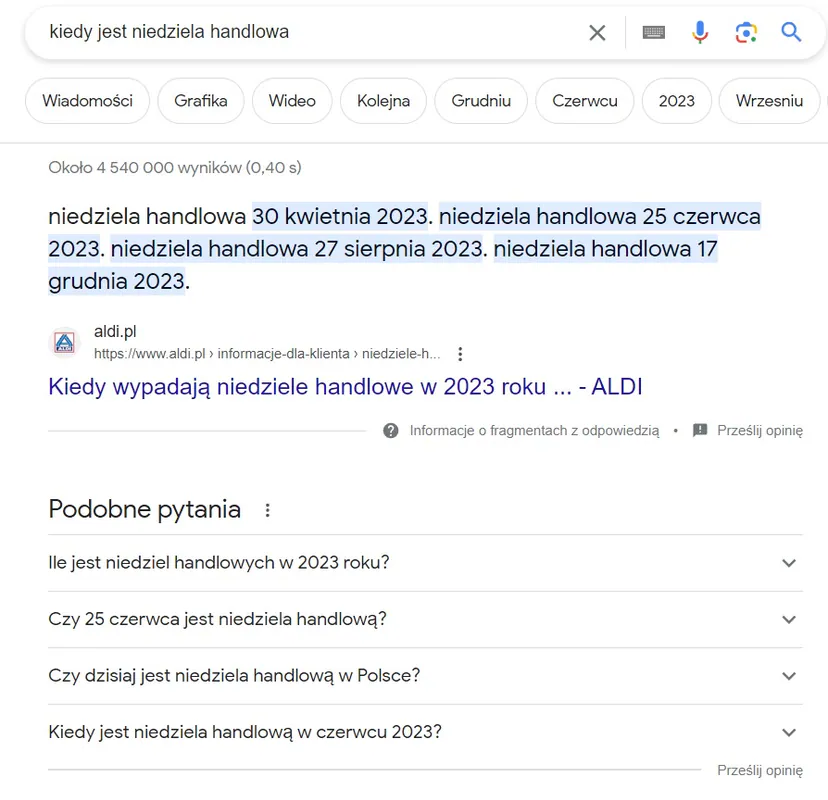
An example might be watching television with family and friends, which turns into a discussion about when the season finale of a series was aired. Such debates often end with someone reaching for their phone and checking it in the search engine. This type of search has informational intent. In other words, its purpose is the desire to obtain information.
Usually, though not always, users with informational intent type questions into the search engine. Such users most often leave the results page once they have found the answer.
When running a commercial website, you might think that this group of visitors is worthless, because their visits are not associated with conversion or purchase.
Even so, it is worth focusing on them. Providing answers for informational intent shows that the site is relevant and proves to Google’s algorithm that the page has “Experience, Expertise, Authoritativeness, and Trustworthiness” (Doświadczenie, Ekspercka wiedza, Autorytatywność, Wiarygodność). This in turn significantly improves ranking positions.
If a given website provides a lot of information, it is worth developing a strategy aimed at users with informational intent. This will make it possible to provide searchers with the information they need and spark their interest in the site.
Examples of informational intent
- How to avoid duplicate content in SEO?
- Why do snakes shed their skin?
- What is the weather in Warsaw?
- When is a Sunday trading day?
- 01Traditional modelSimple, linear funnel
- 02Non-linear journeyJumps between phases
- 03Exploring optionsNew information paths
Key takeaway: The customer’s buying journey is complex and unpredictable, requiring a flexible approach.
Commercial intent
Searchers with commercial intent are looking for products or services, but have not yet decided whether or what they want to buy. Through such searches, they are researching the available options.
Often, commercial-intent searches are aimed at information, opinions and comparisons relating to products. Searchers may type into Google queries such as “best vacuum cleaner” or “Dyson vacuum cleaner or Shark”. Such a search may also be location-based, for example when a user is looking for the best restaurants near them or the best hotels in the place they are going on holiday.
Examples of commercial intent
- Best restaurants near me
- Best hotels in Warsaw
- LG smartphone review
- BMW or Audi?
For the query “best vacuum cleaner”, the initial results include a few ads, but the main content found is material that helps the searcher make a decision.
Commercial-intent searches are highly valuable for SEO because they bring in traffic from potential buyers. Content targeted at this type of intent helps increase brand awareness, build authority and improve credibility.

Transactional intent
When searchers are ready to buy, Google classifies them as having transactional intent. The search engine wants to show such users the best ways to satisfy that intent straight away.
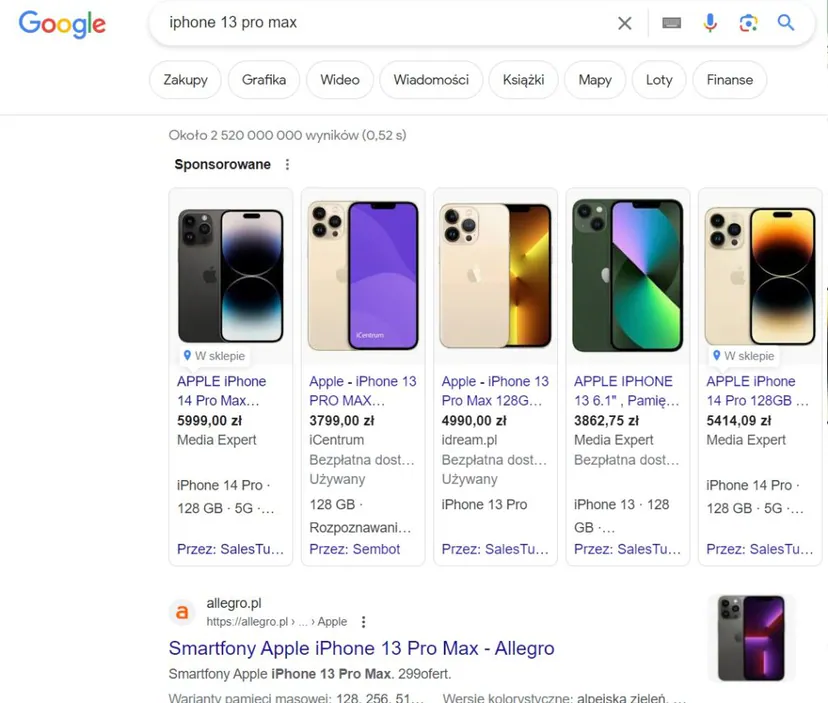
When someone decides to spend money, they are still looking for the best deal. The queries typed into the search engine differ slightly from those typed by people who are only checking what is available on the market. Keywords may include brands or specific sought-after features and characteristics.
Once transactional intent has been identified, everything needed to make a purchase appears on the search results page.
Users with transactional intent are most likely to make a purchase or deliver a conversion. However, to achieve this, the site must have authority and users must trust it, so focusing solely on transactional intent is risky.
Examples of transactional intent:
- Cheap running shoes
- Dog food online
- Continental UltraContact 195/55R16 87 tyres
- Iphone 13 sale
Navigational intent
Navigational intent covers searching for specific websites, services or apps. It may also include searching for local public services, etc. The search engine recognises that the user wants to reach a specific location.
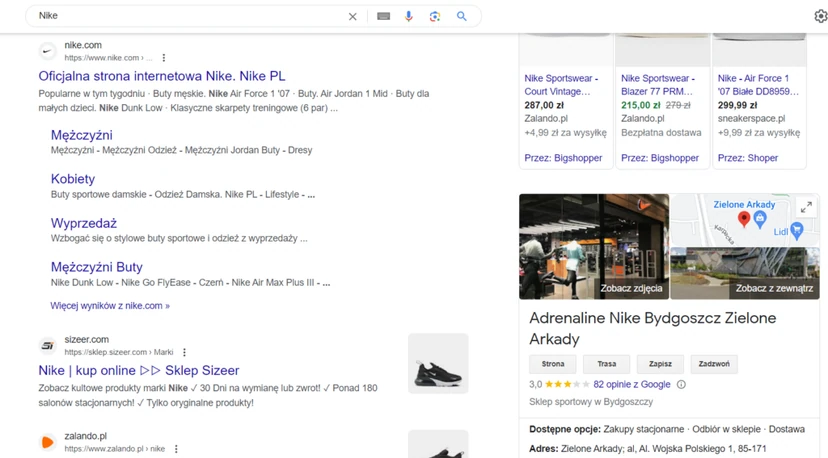
Someone may, for example, want to find a brand’s website, but not know its URL. Users often type the names of specific entities such as “Nike”, “Netflix”, etc. In response, Google provides access to branded websites.
If you have a well-known brand or offer unique services, it is possible that your site will not attract many users with navigational intent. People focused on a specific brand probably have an important reason and are not interested in competitors’ sites (e.g. they want to submit a complaint about something they bought).
On the other hand, if someone is searching for a given company, it is worth making sure they do not end up on one of your competitors’ sites.
Examples of navigational intent
- Nike
- Jagiellonian University
- Solitaire app
- Hospitals near Kraków
For example, after entering the query Nike, Google identifies navigational Search Intent and shows the brand’s website as well as its physical location.
How does Google see Search Intent?
According to information provided by Google, the traditional sales funnel needs to change. Customers do not always move between different phases. As a result, you cannot rely on customers being in a given part of the funnel simply because their last interaction involved an earlier stage.
Let’s assume that someone is looking for a new blender on the market. In the traditional model, such a person would first review the available options, then consider which one is best before making a purchase decision. Because of the large amount of information available to such a person, this model does not always work.
Nowadays, you can start by searching for blenders and come across food processors that also work as blenders. Making a decision based on browsing hundreds of food processors and blenders can take a lot of time. Therefore, it is important to focus on search intent rather than the presumed area of the purchase funnel (purhcase funnel).
Google’s robots and other search engines do this by determining the results shown to that person. Instead of relying solely on someone’s history, Google infers intent based on specific search behaviour, including the keywords or modifiers someone types into the search box.
When analysing intent based on keywords, Google’s results are impressive. You can therefore benefit from analysing SERP results. It is worth looking for keywords related to your own site and checking what the search results page looks like.
If a specific piece of information appears, such as the current exchange rate, for example, Google considers that keyword to have informational intent. If different products appear, Google assigns transactional intent to the keyword. Based on the search results page, you can fairly easily check the type of keyword intent.
How to analyse content for Search Intent?
Analysing and optimising content for Search Intent (search intent) delivers significant SEO benefits. Not only will the site’s position in search results improve, but you will also notice better conversion, a lower bounce rate, increased page views and wider reach.
When targeting informational intent, you can even achieve a Featured Snippet (an expanded answer snippet) above the first result in the SERP.
A Featured Snippet is a type of SERP feature through which Google presents specific content within the search results page. This means that Google sees a given page as an expert on a given topic.
Every subpage optimised for keywords should answer the intent of a specific user. It is worth analysing the Search Intent of keywords and then carrying out the appropriate content optimisation. You can do this in the following way.
1. Determining keyword intent
Every keyword in an SEO plan is aimed at a specific intent. Small changes can lead to a different Search Intent, so you need to be specific and research each phrase.
When creating a keyword list, you need to assign an intent to each one depending on the version of a given phrase. You then need to organise the list by Search Intent and prioritise the right keywords.
You may notice that brand names show navigational intent and Google will present brand sites first. You can then use filters to refine the relevant keywords. For example, you can exclude branded keywords altogether or narrow the results to keywords with transactional or commercial intent.
Websites use various techniques to signal their relevance to Google. They may use images, product ads, local results and other SERP features to achieve higher rankings. It is worth checking what is common and delivers good results for competitors.
2. Carrying out an audit of existing content
An audit should be carried out on important subpages or the entire site. This is to assess how well the SEO content aligns with Search Intent. Pages aimed at keywords with informational intent should answer questions and educate the reader. There is no point promoting special offers and promotions here. We can, if needed, lightly mention the product to the user, for example in the form of internal linking.
Informational content can lead to pages aimed at keywords with commercial and transactional intent. Visitors to the site will benefit because they will get more answers and solutions, and SEO rankings will improve thanks to thoughtful internal linking.
3. Paying particular attention to long-tail keywords
When organising a keyword list based on Search Intent, specialists view long-tail keywords differently. The idea is that you can target different intents using the same main keyword by adding different endings. For example, this keyword is aimed at informational intent: “how to find keywords for YouTube SEO?”, by changing the first words you can move to commercial intent: “best tools to help find keywords for YouTube SEO”.
Another way to use long-tail keywords is to look for synonyms and similar long-tail keywords aimed at the same intent. You can create more content and strengthen your authority on a given topic. The reward from Google will be a higher site ranking.
Search Intent is important when analysing Keyword Gap (keyword gaps). It is a good idea to determine the amount of traffic on the site and check whether there are any Search Intent discrepancies. It is also worth analysing the competition that generates good traffic.
4. Competitor analysis
Collecting data about direct competitors and the industry is standard in marketing research. However, you need to identify your organic competitors in order to achieve higher positions in search results.
In other words, you need to know who you are competing with for traffic in terms of target keywords. Sometimes such sites do not have to be competitors or even represent the industry in question. The reason may be a different Search Intent from the one desired.
You need to make sure who your competitors are and check which keywords they are targeting.
It is worth using key phrases in the alt text of images (alternative text that appears when an image does not load, meta tags and blog content. When adding secondary keywords, it is worth making sure that their intent is the same.
FAQ
Frequently asked questions
What are the main types of Search Intent in SEO?
The article distinguishes four types: informational, commercial, transactional and navigational. Each corresponds to a different user search goal.
Why is informational intent important for an SEO site?
Content that answers users’ questions shows Google that the site is expert and trustworthy. This can significantly improve rankings, even if it does not lead to a purchase straight away.
How does commercial intent differ from transactional intent?
With commercial intent, the user compares options and looks for reviews, but has not yet made a decision. Transactional intent means they are already ready to buy and are looking for the best offer.
How does Google recognise search intent based on keywords?
Google analyses the words entered into the search engine and their modifiers. On this basis, it infers whether the user wants information, a comparison, a purchase or access to a specific page.
What should you check when analysing content for Search Intent?
First you need to establish the intent of the keywords, and then compare it with the existing content. The audit should show whether the subpages meet the right user needs.
When is it worth focusing on long-tail keywords?
When you want to match content to a specific intent and narrow the topic to more precise queries. Long-tail also helps build topical authority and supports keyword gap analysis.