

Google Sandbox is a term known to many marketers, who, however, do not quite understand what it means and why it is so important when creating a new website. More information on the subject can be found below.
Google Sandbox – what is it?
When creating a new website, it is obvious that it will not automatically achieve a top position on the search results page.
However, around 2004, marketing specialists began to notice that it started taking much longer for a website to gain ranking positions than expected, despite using the best SEO actions and techniques.
Even if a site had been indexed and had an appropriate number of backlinks as well as plenty of content with highly rated keywords, it still did not appear in Google Search, even though it was visible in Yahoo or Bing. This effect was named Google Sandbox (sandbox effect) and it is believed to be a filter or part of Google’s algorithm that does not allow new sites to appear on the first page of Google search results.
Many marketers believe that in the first months of a website’s existence (or even for a longer period), Google caches the information and does not include the site in search results above the second page of results.
- 01Start of a new siteDespite good SEO actions
- 02Longer ranking timeVisible in Bing/Yahoo, not in Google
- 03Sandbox filterPart of Google’s algorithm
- 04Final effectNo top positions
Key summary: A filter delaying the ranking of new domains in Google, despite optimisation.
How long does Google Sandbox last?
Because Google Sandbox is an unconfirmed filter, there are no concrete data on how long it lasts. It is commonly believed that the “sandbox” effect lasts for the first few months of a site’s existence, up to even 2 years. On average, it seems that this effect lasts for around 6 months.
During this time, regardless of the intensity of SEO activity on the site, it will not be ranked on the first page of Google search results.
Does Google deny the existence of Sandbox?
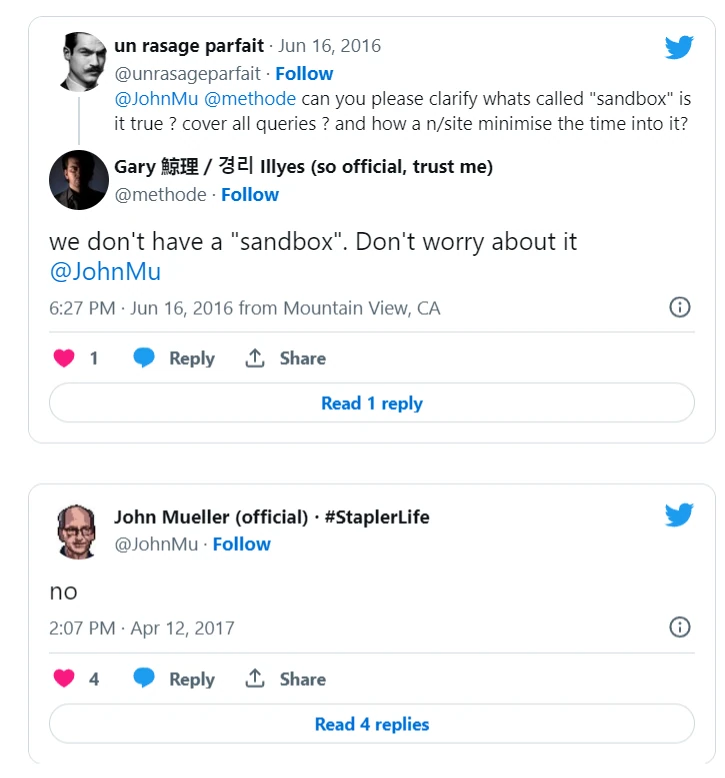
Google has never admitted that the Sandbox filter exists. However, many of its effects seem reasonable in the case of newly created websites.
Google says that the reasons why new sites do not rank highly are related to several other factors:
- High competition – there is considerable competition in many industries and keywords, and the site in question has not yet built the authority needed to outperform competitors.
- Lack of content – a newly created website does not have as much content as more established sites, so it has far less potential to generate organic traffic
- Too few backlinks – backlinks are an important part of building authority in Google’s algorithm, and new sites do not have many of them when they go live.
- Lack of user signals – user signals or actions taken by users, such as clicking pages or bouncing from them, also play a role in the algorithm. New sites do not have enough user signals to achieve high positions on search results pages.
However, some specialists have noticed that even specific keywords with low competition and single site names on new sites will not improve its ranking within the first months after launch, even if it has been indexed.
This leads many people to believe that Sandbox exists even though it has not been officially confirmed by Google.
Regardless of whether Sandbox is a real filter in the algorithm or a factor causing Google to be reluctant to promote sites without authority, the truth remains unchanged: new websites will struggle for some time to achieve suitable ranking positions.
- 01Google deniesDoes not confirm the Sandbox filter.
- 02No authorityNew websites, no history.
- 03SEO observationsLow rankings, even for simple keywords.
- 04Widespread beliefMany people believe it exists.
- 05Practical truthNew websites have to wait.
Conclusion: the effect exists, regardless of the name.
Here is John Mueller’s answer to a question about the sandbox effect from the English Google Webmaster Central office-hours hangout on 23 February 2018.
With regards to sandbox, we don’t really have this traditional sandbox that a lot of SEOs used to be talking about in the years past. We have a number of algorithms that might look similar, but these are essentially just algorithms trying to understand how the website fits in with the rest of the websites trying to rank for those queries.
It’s always kind of tricky in the beginning when we have a new website and we don’t quite know where we should put it.
And sometimes what happens is our algorithms will kind of start at one place and see how that works out and kind of try to get a confirmation through all of the other signals that is actually working out.
Sometimes that results in things going afterwards, which is kind of sandbox that you’re talking about here. Sometimes that results in things dropping down a little bit, which is I think the honeymoon period that people always talk about.
So its always kind of tricky in the beginning when we have a new website and we don’t quite where we should put it.
You kind of seen some changes in search happening there. Because when you have to make some assumptions and figure out, does it make sense to put it here? Are we seeing enough support after a while that is actually the right place? Or should we have ranked it higher? should we have ranked it lower? These things are kind of tricky with new content.
John Mueller, Webmaster Trends Analyst at Google
In 2012, Cutts again spoke on YouTube about Google’s approach to fresh sites
- 01Page indexingA key first step
- 02Submission in GSC & XML sitemapSpeed up the process
- 03Generating trafficAn authority signal
Understanding these strategies and implementing them quickly helps minimise the duration of the Google sandbox effect and accelerate the site’s visibility.
Can an older website end up in the Sandbox?
It is usually new websites that can get stuck in the Sandbox, however it is also possible for this effect to impact older websites.
If a website is inactive for a long time, it may experience the same difficulties in SEO as a new website.
This is one of the reasons why ongoing SEO activities are essential for all brands.
6 ways to prevent the negative impact of Google Sandbox on SEO activities
Now that you understand what Google Sandbox is and why it matters for newly launched or “dormant” websites, it is worth looking at the strategies you can implement to stop the Sandbox from having a negative impact on the site.
1. Fastest possible indexing
The countdown to the sandbox effect will not begin until the website is indexed by Google. Indexing is therefore the most important thing to take care of when launching a website.
Registering your domain in Google Search Console and submitting an XML sitemap to Google can speed up the indexing process.
2. Generating traffic to the site
Traffic is an excellent signal indicating that a website has authority and is relevant to users. By generating high traffic on the site during the first months of its existence, you can get out of the Sandbox faster.
Creating posts about the website on social media and on industry forums can help generate traffic to the site.
3. Creating social media signals
Google pays attention to signals from social media platforms, checking whether a given website is increasing its popularity. This also helps it to get out of the Sandbox more quickly.
So you can place ads on platforms such as Facebook or increase traffic coming from social media portals to improve such signals.
4. Using long-tail keywords
Competition among short, popular keywords is high. If only those are on the website, it will be difficult to outperform competitors.
By using specific long-tail keywords with lower competition, you can reach different audiences and help the site stand out in Google’s eyes.
5. Building authority
Google’s algorithm is geared towards reliable, useful websites that have authority. To get out of the Sandbox quickly, you need to start building your website’s authority immediately.
A significant help in building authority is techniques such as acquiring high-quality backlinks from relevant sites.
6. Focusing on quality rather than quantity
A tempting option is to publish a large amount of content quickly in order to get more links and keywords. However, this can lead Google to regard such actions as spam.
It is therefore worth focusing on quality rather than quantity of content.
What prevents a new site from increasing its ranking position?
It is unlikely that a new site will be able to gain Google’s trust in just one or two months.
Below is a list of factors that may prevent a new site from increasing its ranking position:
1. Lack of content
It is possible that Google does not see a sufficient number of subpages on the site to understand its significance. More data is probably needed to decide what to do with a given site and determine which group of keywords (topic) it belongs to.
2. Lack of user signals
As mentioned earlier, many SEO experts believe that CTR, bounce rate and dwell time are important ranking factors. Until Google processes more behavioural data from the website and compares it with other sites, a given site’s SEO for popular keywords may be delayed.
3. Lack of high-quality backlinks
Backlinks, together with content and RankBrain, are one of Google’s three most important ranking factors. If content has a weak backlink profile and the site is not strong enough, then Google will not place it higher in the results than sites with strong backlinks.
Various ranking factor studies have shown strong correlations between the number of referring domains and rankings.
It is potentially possible to acquire some backlinks in just one month, but if their quality is not high, Google will simply ignore them.
A suspicious, sudden and rapid increase in the number of backlinks and excessive saturation of content with links can lead to a penalty.
4. Industry and competition
Many experts have been asked the following question:
Does it look different in various niches, at different levels of competition and with different types of content?
Absolutely. Google ranks different industries that have different signals. It is not an algorithm that works the same everywhere
The Sandbox effect is different, however, depending on the industry. For example, medical and legal sites require more time and high-quality backlinks to achieve the right SERP results. This makes sense, considering that the information contained on such sites has a significant impact on human life, so their content must be taken seriously.
Some keywords are in a set where competition is high. However, there are keywords for which competition is low and they concern some less popular topics or specific places, or are simply related to other SERP features
In such a case, you can almost immediately achieve a high ranking that lasts for many years, depending on these factors: narrow topic, small niche, companies in a given area, smaller content format, etc.
Yes, and I would also add geographical location to that list.
FAQ
Frequently asked questions
How does Google Sandbox work according to SEOs?
It is a phenomenon in which a new site, despite being indexed and SEO efforts, does not appear high in Google during the first few months. It is often associated with a filter or part of the algorithm that limits the visibility of fresh sites.
Does Google confirm the existence of Sandbox?
No, Google has never officially admitted that such a filter exists. John Mueller has said that there are algorithms that can produce a similar effect for new sites.
How long can the Google Sandbox effect last?
There are no official data, because Sandbox has not been confirmed. The article states that people usually talk about a few months, on average around 6 months, and sometimes even up to 2 years.
Why does a new site not rank highly in Google?
The article points to high competition, lack of content, too small a number of backlinks and a lack of user signals. Google also needs time to assess where such a site fits in the search results.
How can the negative impact of Google Sandbox be reduced?
Quick indexing, generating traffic and signals from social media, and building site authority help. It is also worth focusing on long-tail keywords and content quality rather than mass publishing.
Can an older site also end up in Sandbox?
Yes, if it has been inactive for a long time, it may face similar difficulties to a new site. The article emphasises that consistent SEO efforts are also important for older websites.