
Google uses many different algorithms in its operations, each responsible for important tasks. One of them is RankBrain, which has a significant impact on determining search results. It is worth learning a bit more about it.
What is RankBrain?
Under the name RankBrain lies a special system, thanks to which Google are able to better understand the possible intent of a query entered by a user. This algorithm was created in spring 2015, but was officially announced only in October 2015.
At first, RankBrain was used for queries the search engine had not previously encountered. They accounted for and still account for around 15% of searches. The algorithm was then expanded so that it would affect all search results.
In essence, RankBrain is a machine learning system that powers Hummingbird. It caused Google Search to stop focusing on reading letters and start emphasising the Entity represented by them.
It can be said that RankBrain is a preliminary filtering system. When a query is entered into Google, the search algorithm matches the query to the user’s intent. This makes it possible to deliver the best content in its best forms.
- 01Machine learning systemUnderstanding user intent
- 02Focus on „Entity”Not letters, but the entity
- 03Evolution of reachFrom 15% to all queries
- 04Preliminary screeningFiltering search results
A key machine learning system for better understanding query intent and improving result relevance.
Why did Google introduce RankBrain?
Initially, the aim of RankBrain was to solve one, but very serious, problem. It was the fact that around 15% of queries had no context and had not been previously analysed to determine whether their results are good or do not meet users’ intent.
In the case of RankBrain, we are dealing with a focus on entities, as well as environmental contexts (e.g. the searcher’s location) and on predicting meaning.
This can be a simple process of understanding that word order can be a function of the search process.
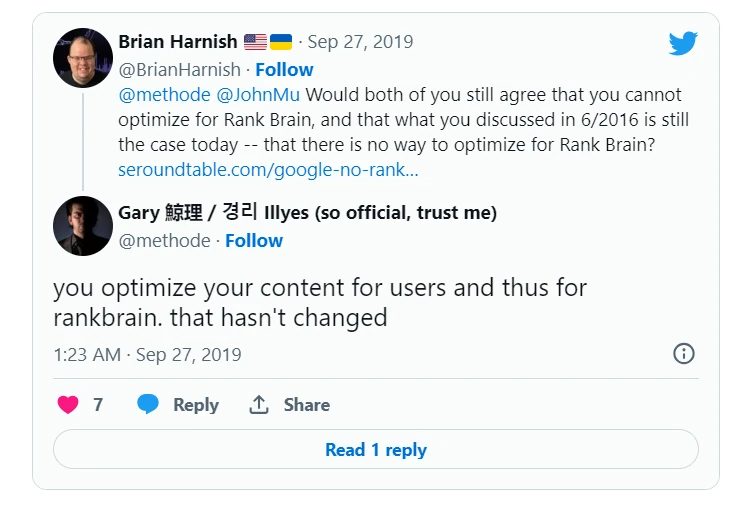
Bill Slawski on RainBrain in the search space
To an equestrian a horse is a large 4 legged animal, to a carpenter, a horse has 4 legs, but it doesn’t live in fields or chew hay, to a gymnast a horse is something I believe you do vaults upon; with RankBrain context matters, and making sure you capture that context is possibly a key to optimizing for this machine learning approach.
How does RankBrain work?
Admittedly, Google did not explain exactly how RankBrain works. Nevertheless, there are some assumptions about how this algorithm operates.
- 01Understanding intentAnalysing query meaning
- 02Recognising 'entities’Identifying key entities
- 03Linking similaritiesShared results for similar queries
Key takeaway: the algorithm learns to understand meaning, not just keywords.
A new search function
First and foremost, you need to start thinking like a machine. In the case of RankBrain, the search engine understands the nature of Entities, and it is possible to focus on the meaning of a given query entered into the search engine.
Entities (entities)
One of RankBrain’s basic mechanisms is the ability to recognise Entities. If the algorithm understands that a query contains the same Entities as another query seen before, then this can indicate that the sets of results may be similar, identical or taken from the same list of URL links.
- 01IntroductionA success since 2015.
- 02Third factorThe most important ranking factor.
- 03Query relevanceDetermines the relevance of results.
- 04Self-learningThe system learns by itself.
- 05One of hundredsOne of many signals.
The self-learning system is key to relevance, but it is only one of many ranking signals.
TOP10
In 2013, when it came to answering queries using unstructured data, Google described a method in which you can:
- Add Entities to their own index.
- Check Entities within their own top 10.
- Predict which Entities are related to each other and to the best answers to queries.
Monitoring
It should be remembered that this is a machine learning system. In this case, the function of defining, testing, tracking and adjusting is inherent.
In essence, the system will perceive queries with the measurement of success in mind. Then various signals will be evaluated and their effectiveness will be monitored.
The system was launched in order to solve the problem of queries that Google had not yet encountered. They usually contain few words that can be monitored.
It should be remembered that the system not only focuses on the Entities present in the query, but also on the Entities used to create it. This therefore means the user himself, his location and device.
These are variables that RankBrain will take into account in the same way as when analysing and comparing traffic between desktop and mobile devices. The time of day and device type will also be taken into account to understand how different users interact with a given business in different scenarios.
Based on the above information, it can be concluded that Google introduced RankBrain to better understand queries.
RankBrain as a ranking factor
According to information provided by Google, RankBrain has been a considerable success since its introduction in early 2015. It has a huge impact on a large number of queries. The importance of this self-learning system has made it the third most important ranking factor in the search engine. RankBrain plays a significant role in determining query relevance.
A major difference compared with the updates Google has released so far is that the system learns new things on its own, and algorithm changes are not made by a human. However, even if RankBrain ranks third on Google’s list of ranking factors, it is still one of hundreds of factors used by Google to determine the relevance and quality of a website in relation to a query and to set search results correctly.
RankBrain and Google search
Currently, based on relationships between websites (referral links backlinks) and semantic signals such as user behaviour, RankBrain is the third most important ranking factor.
It can therefore be stated that RankBrain is an important component of Google search, which is based on an algorithm called Hummingbird. Up to 200 different factors, or so-called signals, are taken into account to determine whether a given piece of information matches the user’s search intent and whether it can be displayed in the search results. This information can take any form, such as a website, an app, a document or a video.
Before the introduction of RankBrain, search results were calculated using statistical evaluation criteria created by people. If the search results were unsatisfactory, these values were checked, changed and sometimes even removed altogether. Such evaluation criteria can be seen as filters related to selected aspects of Google’s algorithm.
Some of these filters are well known and have borrowed their names from the animal world. One example is Panda, which focuses on content and the relevance of websites; meanwhile, Penguin analyses link quality from websites. Pidgeon (pigeon) focuses on local search.
Which websites will benefit from RankBrain?
Using RankBrain and the shift from purely statistical to semantic ranking factors in Google’s algorithm leads to the following conclusions regarding websites that benefit from this. These are websites and elements such as:
- Websites with a clear and easy-to-understand information architecture.
- Websites with unique content that align with user intent (even at article level).
- Websites with the ability to satisfy conversion-focused search demand.
- Structured data (structured data markup).
- Entities (search queries associated with people, places and facts) and their semantic relationships.
- User-focused content.
- Content diversification related to all aspects of the Entity (subject).
These can be various kinds of images, graphics and video materials worthy of being displayed separately in Google search results (Knowledge Graph, Universal Search, Featured Snippets). RankBrain still has a long way to go before it can be regarded as an independent AI system. This algorithm does not yet learn independently; it is still being “trained” by Google engineers. Nevertheless, the implementation of machine learning should make things easier in the case of complex queries and when answering previously unknown queries without human assistance
FAQ
Frequently asked questions
How does RankBrain work in Google Search?
RankBrain matches a query to the user’s intent instead of focusing solely on words. It also takes into account meaning, context and Entities, i.e. entities and their semantic relationships.
Why did Google introduce RankBrain?
The main goal was to handle better queries that Google had not previously seen. It was also about improving results where earlier methods were not enough to read the user’s intent.
Is RankBrain an important Google ranking factor?
Yes, in the article it is described as Google’s third most important ranking factor. At the same time, it is only one of hundreds of signals taken into account when determining search results.
Which sites can benefit from RankBrain?
The biggest gains can come to sites with a clear information architecture, unique content aligned with user intent and structured data. User-focused content and semantically related Entities are also important.
Does RankBrain take into account the user’s location and device?
Yes, the article points out that RankBrain also takes into account the user, their location, device and time of day. This helps it better understand different search scenarios.
What does it mean that RankBrain focuses on Entities?
It means that Google recognises the entities present in a query and compares them with previously seen queries. If the Entities are similar, the search results can also be similar or identical.