

Google is a powerful online tool that continually expands its capabilities by introducing and updating many algorithms. One of them is Hummingbird, which has a huge impact on search engine behaviour and rankings. It is worth finding out more detailed information about it.
What is Hummingbird and what is its significance for Google?
Unlike earlier updates called Panda and Penguin, which are modifications to the algorithm’s filter, Hummingbird led to a fundamental change in the core algorithm. Even if the foundations of the algorithm remained the same, Hummingbird showed that Google can better understand Internet users and their intentions.
Indeed, Hummingbird is the only algorithm that can understand a query made up of many words. Previously, each word was processed and analysed separately. Hummingbird can understand the meaning of many words at once, and even an entire sentence. The aim is to surface pages that effectively answer the general query, rather than pages that are related to only a few words making up the query.
Launching Hummingbird in 2013 on Google’s 15th birthday was the starting signal for semantic search. Google described the algorithm update as the most significant since the Caffeine update in 2010.
It is said that the introduction of this update affected around 90% of queries. This solution helps to better interpret complex queries in order to better understand the intent or questions hidden behind a search query. In response, it is possible to provide relevant documents. The actual intent hidden behind the content should also be better matched with the query at document level.
- 01Core algorithm changeMore than just a filter
- 02Understanding intentWhole sentences and context
- 03More relevant resultsAnswering the general query
Key takeaway: Hummingbird is a fundamental change that enables Google to better understand the context of users’ entire queries.
How does Hummingbird work?
Hummingbird is the result of extensive research in semantics. A year before its release, Google introduced Knowledge Graph, providing a set of features designed to deliver fast and accurate answers to questions from users about specific topics.
Knowledge Graph was, however, heavily criticised by owners of many websites complaining about lower traffic. In practice, it became possible to answer closed questions quickly from Internet users who no longer visited pages ranked in the SERPs.
This raises the question of how Google is able to determine which results are most relevant for the Internet user and, above all, how the search engine is able to decipher the user’s intent. It turns out that this is possible thanks to semantics.
Semantic research makes it possible to match SERP results to the different words making up Internet users’ queries, going beyond the meaning of each individual word.
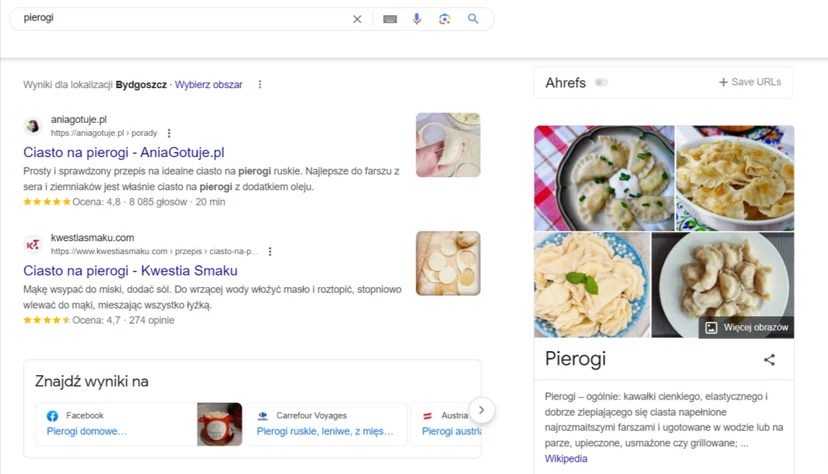
Using “chocolate cake” as an example, thanks to semantic research and predictions, Google provides not only recipes, but also nutritional information and other topics related to preparing or eating chocolate cake. Before Hummingbird was introduced, the algorithm only displayed pages associated with the words “cake” + “chocolate”. The same goes for pierogi! 🙂
Increasing proficiency in semantic areas allows algorithms to understand “Entities (real-world entities) and the relationships between them”. This means that Hummingbird interprets every request by adapting it to context. In short, the technology responsible for understanding search language based on words was not able to assess the intent behind such a search. That is why improvements in semantic research and the implementation of Hummingbird are a true revolution.
What impact can it have on a website’s organic ranking?
When Google announced the launch of Hummingbird on 26 September 2013, the algorithm had in fact already been running for a month. Earlier updates to the Panda or Penguin algorithm caused strong reactions in the SEO community, because many websites were losing their rankings. It seems that Hummingbird generally had no negative impact on the web. It was even said that this algorithm had a positive impact on the data in the Knowledge Graph.
However, if a website experienced a drop in traffic or in the rankings of some of its strategic subpages, you can check the date of each Google update, regardless of the algorithms. It may then turn out that such a change was caused by Panda or Penguin solutions, and not necessarily by Hummingbird.
In hindsight, creating Hummingbird could have been seen as the first step towards understanding and interpreting voice search. Indeed, in 2013, when Hummingbird was officially launched, the term conversational search was popular in the SEO community.
This was the beginning of voice search, which forced Google to develop technologies capable of understanding natural language and/or specific questions, such as “What is the best sushi restaurant in New York?”.
While the SEO community was worried about Hummingbird’s general impact on the web, local websites experienced some issues related to the update. At first, it seemed that Hummingbird was delivering many incorrect local results.
Matt Cutts on Hummingbird
Hummingbird effects 90% of all searches but usually to a small degree because we are saying, this particular document isn’t really about what the user is searching for.
- 01Hummingbird launch (2013)It had been running a month earlier
- 02No negative impactStable SEO rankings
- 03Positive Knowledge GraphBetter semantic data
- 04Ranking drops?Check Panda/Penguin
Overall, Hummingbird did not harm rankings; sudden drops could have resulted from other updates.
How to meet the Hummingbird algorithm’s expectations?
Probably the most convenient advice for website owners is to make sure that the page content reflects natural language. Hummingbird can be seen as a kind of bridge between older (more spammy) practices and modern SEO, which tries to understand the natural language of readers using their own words.
Since Hummingbird uses phrases instead of keywords, long-tail queries are likely to become much more important in SEO than before. Content explaining how to do something (how…) is also very useful, because Internet users ask Google direct questions.
It is therefore important to saturate content with words and phrases related to the business. If a website aligns with user intent, it is possible to achieve not only good organic and local rankings, but also to have the content featured in the Knowledge Graph or reach the zero position. Modern SEO should be based on building direct interactions with audiences, in the area of keywords and semantic research, which are the keys to success.
Go for a conversational content format
There are also other tips that help to better understand Hummingbird. Among other things, it is worth adapting your keyword strategy to conversational queries; for example, it is a good idea to create sentences/titles in question form. This will make it easier to identify specific issues that the website owner may not have known about.
Another good idea is to use synonyms and recurring terms. There are certain tools that allow you to find such terms.
It is also worth reconsidering your anchors. It is worth using not only exact anchors, but you can also expand them by using words that form part of the semantic field (this is about keyword synonymisation).
Using structured data is another excellent way to gain additional visibility in the Knowledge Graph, in search results, and even in the zero position. Structured data makes it much easier to enrich pages.
An important issue is optimising images and their alt attributes (we are talking about image optimisation), which help Google read images and better understand the overall meaning of the page.
- 01Question-based contentAdapt to queries
- 02Synonyms and repetitionsUse natural phrases
- 03Varied anchorsExpand the semantic field
- 04Structured dataGain visibility in Knowledge Graph
Understanding the user’s intent and context is the key to better visibility and content relevance.
FAQ
Frequently asked questions
How does the Hummingbird algorithm work in Google?
Hummingbird analyses the meaning of multiple words at once, or even the entire sentence, instead of processing each word separately. This allows Google to better match results to the user’s intent.
How does Hummingbird differ from the Panda and Penguin updates?
Panda and Penguin were modifications to algorithm filters, whereas Hummingbird changed Google’s core algorithm itself. It was a major change, not just an adjustment to how a filter works.
Why was Hummingbird important for semantic search?
The update was the starting signal for semantic search in Google. It enabled a better understanding of context, intent and the relationships between concepts.
How does Hummingbird affect search results for complex queries?
The algorithm can match results to the entire query, not just to a few matching words. This means Google can show content that better answers the user’s overall problem.
How should you create content for the Hummingbird algorithm?
It is worth writing in natural language, using questions and developing long-tail phrases. Synonyms, recurring terms and words related to the site’s topical area also help.
Did Hummingbird have a major negative impact on site rankings?
According to the article, Hummingbird generally did not have a negative impact on the web. If drops appeared, they may have resulted from other updates, such as Panda or Penguin.