

Google algorithm updates are a constant part of SEO, but in practice what matters is not how Google labels the change, but what actually happened to your visibility and traffic. It is worth approaching the topic operationally, analysing page types, query groups, devices, countries and changes in the SERP. A drop after an update does not have to mean a penalty or a “ban”, because it often results from a re-evaluation of quality, competitors matching results better, or a change in how user intent is interpreted. The most useful approach is simple: detect the change, isolate the area of impact, find the pattern, remove the cause and observe the next recalculations. In this guide we focus on how to read Google updates in the data and what to do with them in practice. This makes it easier to distinguish between content, technical, link-related and purely competitive issues.
What algorithm updates are in practice
Google algorithm updates are, in essence, adjustments to the way pages, queries, content quality, usability and trust in a site are assessed. For a site owner, this is not an abstract technical event, but something that can translate into the number of impressions, clicks and positions of specific pages. That is why you do not look only at the update announcement, but at its real impact on organic data.
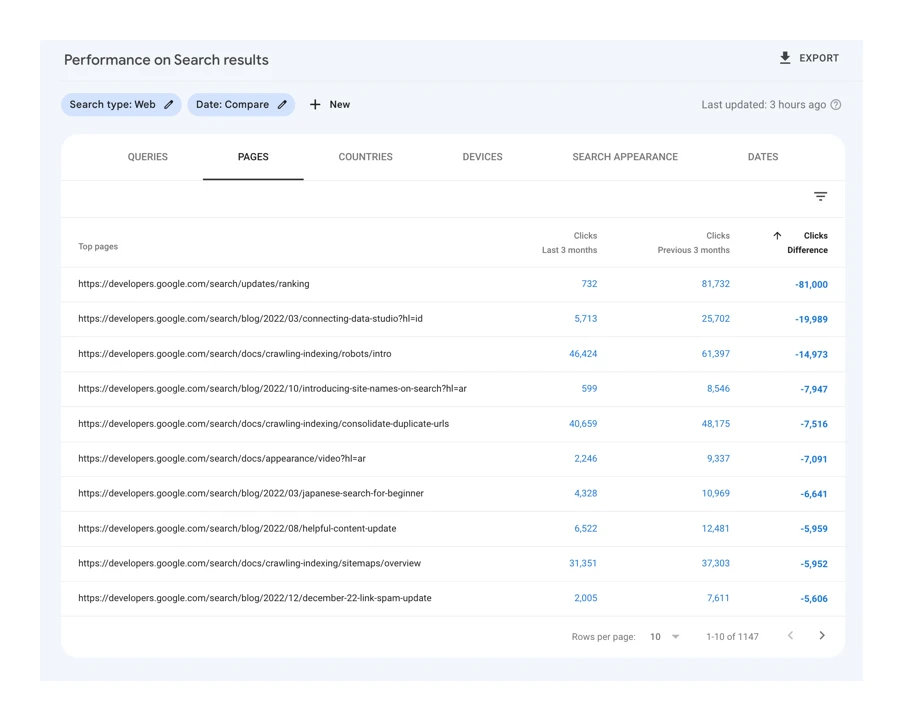
Several types of changes are most often mentioned: core updates, spam updates, content quality systems, review systems, link quality and matching results to query intent. Each of these categories leaves a different trace in the data. If only part of the site drops after a change, the problem usually does not concern the whole domain, but a specific directory, template or topic cluster.
In practice, one update rarely affects the whole site evenly. It happens that it affects only informational pages, only mobile, only a given country or only non-brand queries. This matters because an analysis of the “whole domain” often blurs the real picture.
It is also worth distinguishing an algorithmic update from a manual action by Google. A drop in visibility after an update most often does not mean a manual penalty, but a recalculation of rankings and a fresh assessment of the relative quality of documents against competitors. The most common mistake is looking for one “penalty” when, in reality, Google simply decided that other pages were a better match for the query.
The most practical working model remains simple: first you determine what fell or rose, then you isolate the area of impact, and finally you look for the common feature of the pages affected by the change. That feature may be thin content, a weak template, too many ads, an unclear author, duplication, flawed information architecture or an answer that misses user intent. Only at this stage do planned improvements make sense.
- 01Assessment adjustmentsContent, usability, trust.
- 02Impact on dataImpressions, clicks, positions.
- 03Main types of changesCore, Spam, Quality, Intent.
- 04Diagnosing dropsOften local, not global.
The key is analysing the real impact on organic results, not just the update announcement.
The current operational context of Google algorithms
The current context of how Google algorithms operate is that ranking systems are constantly being adjusted, while only part of the rollouts are publicly highlighted. In practice, this means that diagnosis cannot be built solely on industry headlines. It is worth comparing official communications with your own data from Google Search Console, analytics and ongoing SERP observations.
The most reliable reference points are official Google sources, including the Search Status Dashboard and Google Search Central, but the announcements alone will not show what exactly happened on your site. That has to be verified directly in the data. The key is not general fluctuations across the whole domain, but changes at the query, page type, folder, device and country level.
At present, Google much more strongly links quality assessment with user intent and a page’s usefulness after the click. The mere presence of keywords is no longer enough if the content does not answer the question directly, is derivative or does not provide a complete answer. Trust signals also play an increasingly important role, such as clear author information, cited sources, methodology and consistency between the promise and the actual content of the page.
At the same time, Google is becoming ever better at limiting mass-produced pages with no real value, manipulative link schemes and content created solely to capture long tail. This is not only about classic spam. A problem can also be a large number of very similar subpages which are formally “different”, but from the user’s perspective add nothing new.
After an update, it is worth analysing not just rankings. Changes in CTR, share of visibility in key topics, indexing speed and traffic stability after rollouts are equally important. If the ranking remains roughly the same but CTR drops noticeably, the issue may be the match between the result and intent, or how your page presents itself against new competitors in the SERP.
It is also worth bearing in mind that after a core update there is no simple “fix” form. As a rule, it is about improving the quality of the site and patiently waiting for the next recalculations of the ranking systems. By contrast, in the case of technical or indexing issues, effects can appear faster when Google crawls and processes the corrected URLs again.
How the analysis and response process looks
Analysis and response should follow a fixed sequence: detecting the change, separating the area of impact, finding the pattern, implementing fixes and checking the effects. Such an order makes it easier to distinguish the real impact of an update from seasonality, implementation errors and natural ranking fluctuations. The most common mistake is treating the whole domain as one problem, even though an update often concerns only part of the site.
At the start, you need to check whether the timing of the drop or rise coincides with a confirmed change on Google’s side. Official announcements, Search Status Dashboard, Search Console and your own analytics help with this. A matching date on its own does not prove the cause, but it is a sensible starting point for further diagnosis.
The second stage is data segmentation, because only this lets you see where the problem actually lies. It is worth comparing directories, URL types, branded and non-branded queries, devices, countries and intent groups. If the drops concern only guide pages on mobile or just one product folder, your area of action is already clearly narrowed down.
The next step is to identify the pattern. In practice, you verify whether the source of the problem is thin content, duplication, a mismatch with intent, a poor template, indexing issues, links or spam elements. The aim is not to pin on a single label, but to find a repeatable cause visible across the whole group of pages.
Then it is a good idea to compare this with the results that gained after the update. SERP analysis shows whether Google has started rewarding a different response format, greater freshness, a better-structured information hierarchy, stronger trust signals or a more comprehensive answer to the user’s question. This matters, because a drop does not always mean your site has worsened. Sometimes it simply indicates that the competition is answering the current interpretation of the query more accurately.
At the same time, you should carry out a technical audit. You need to check indexing, canonicalisation, redirects, meta robots, sitemap, rendering, internal linking and page accessibility for Googlebot. Technical faults can look like the effect of an update, even though in practice they result from implementation errors or a template change.
In the area of quality, you assess not only the text itself, but also the whole experience after the click. What matters is completeness of the answer, freshness of information, originality, author transparency, sources, the ratio of main content to ads and the usefulness of the template. If the page formally matches the topic, but the user gets little content and a lot of secondary elements, the ranking may weaken.
At the end, prioritisation and validation are needed. First, quick technical fixes and template adjustments are implemented, and only then are key pieces of content rebuilt and low-value pages tidied up. If the problem concerns quality assessed by core systems, improvement often does not appear immediately after publishing the changes, but only after subsequent recalculations.
- 01Detecting the changeMonitor the drop/rise
- 02Separating the areaNot the whole domain
- 03Finding the patternAnalyse data segments
- 04Implementing fixesApply changes
- 05Checking the effectsVerify the results
Such an order makes it easier to distinguish the real impact of an update from seasonality and other factors.
The most important steps when implementing fixes after an update
The most important steps when implementing fixes after an update involve setting priorities, limiting change-related chaos and refining exactly those areas that have lost visibility. In practice, the team that wins is not the one that does the most, but the one that improves the right elements in the right order. That is why the implementation plan should come from the earlier diagnosis, not from a general list of “SEO best practices”.
- First, define the scope of the problem: individual URLs, an entire directory, a content type, a country, a device or non-branded queries.
- Then divide the fixes into three groups: technical, template-based and content-related.
- Then choose the pages with the highest business importance and the biggest traffic drop, because that is where the fixes will bring the greatest difference.
- Finally, configure monitoring of clicks, impressions, indexing and changes at the level of topic clusters.
When implementing changes, it is best to start with elements that can block page evaluation or its correct processing. This includes indexing errors, incorrect redirects, canonical issues, accidental noindex directives, rendering errors and poor internal linking. Such fixes often deliver a faster effect than a content rebuild, because they remove the technical barrier.
If the update hit content quality, simply adding a few paragraphs will not be enough. You need to align the material with the full search intent, fill in missing context, show limitations, organise the structure and remove fragments written solely for keywords. The changes that work best are the ones that genuinely improve the answer for the user, not just lengthen the text.
On many sites, the source of the problem lies in the scale of publishing rather than in a single article. In such a situation, it is worth removing or merging pages that do not add standalone value, duplicate a topic or were created solely to capture long tail. This consolidation tidies up the information architecture and reduces the share of weak URLs across the whole site.
It is also worth strengthening trust signals at template and editorial level. The author, methodology, sources, contact details, site policies and clear labelling of commercial content help Google better understand who is responsible for the publication and why the user should trust it. This is not just cosmetic work, but an element of the site’s overall quality.
Do not implement everything at once and without documentation. Every major change should have a date, scope and list of affected pages, so that later it is possible to assess the impact on results. Without a record of deployments, it is easy to confuse the effect of a Google update with the result of your own actions.
After publishing the fixes, you need to monitor not only rankings, but also CTR, the share of pages exposed for important topics, indexing frequency and traffic stability. If the problem was technical or related to spam, some effects may appear after recrawling. If the problem concerned quality assessed more broadly by ranking systems, you often need to wait longer for a fuller signal.
What to do and what to watch out for after an algorithm update
After an algorithm update, you first need to determine exactly what lost or gained visibility, and only then make fixes. The key is to break the problem down by directory, page type, query group, device and country. This makes it clear whether the drop concerns, for example, guides, category pages, reviews, or only non-brand traffic. First diagnose the scope of impact, then decide on changes.
In practice, it is a good idea to check not only rankings, but also clicks, impressions, CTR and indexing. Average position on its own can be misleading, because a single update can reduce exposure for important queries while leaving less important keywords unchanged. If impressions have fallen, the problem may relate to matching user intent or losing visibility in key topical areas. If CTR has suffered, it is worth analysing titles, descriptions, the type of result and how the page presents itself against the current SERP layout.
Changes should result from the real cause, not from the symptoms alone. If the problem concerns content quality, you need to answer the user intent more fully, remove “fluff”, refine the structure and update the information. When the source of the drop is the template, you need to reduce distracting elements, improve readability and increase the share of main content on the page. Not every loss of visibility means a penalty; often it is a sign that the competition is answering the query more accurately.
After the update, it is also worth reviewing trust signals at sitewide level. This means clear information about the author, editorial team, sources, publishing rules, contact details and commercial transparency. These are not additions “for the sake of formality”, but elements that make it easier for the user and for algorithms to assess the site’s credibility. This is especially important for how-to, financial, health and review sites.
The most caution is required for chaotic implementations. If you change content, linking, the template, metadata and URL structure all at the same time, it will later be difficult to determine what helped and what caused harm. Every major change after an update should have an implementation date, URL scope and a clearly defined goal. Without this, post-implementation monitoring quickly turns into guesswork.
In some cases, it is also worth reviewing the link profile and low-value pages. This is not about automatically cutting everything, but about spotting schematic actions, unnatural anchor text, low-quality private blog networks or a large number of subpages that do not answer any meaningful query on their own. It is better to consolidate weak content than to keep many thin pages that cannibalise the topic.
- 01Diagnosing the scope of impactAnalyse what gained or lost visibility
- 02Data segmentationBreak down the problem: page type, queries, device
- 03Decisions about changesImplement fixes after a thorough analysis
Key takeaway: first precise diagnosis and segmentation, then the implementation of informed fixes.
Typical mistakes and how to avoid them when working with Google updates
The most common mistake when working with Google updates is treating the entire domain as one problem. In practice, drops usually affect specific templates, topics or intent types, not all URLs at once. If you analyse only aggregated data for the whole site, it is easy to miss the real source of the problem. That is why you need to go deeper, down to the level of folders, recurring page patterns and query clusters.
The second common mistake is making lots of changes without a diagnosis having first been confirmed. After drops, companies often simultaneously rewire the menu, rewrite titles, remove links, shorten content and replace the template. Such a reaction increases the risk of further technical issues and blurs the picture of what actually worked. It is more sensible to roll out fixes in stages and observe how specific groups of pages respond to the changes.
A large share of mistakes also comes from incorrectly identifying the source of the problem. A drop may coincide with a Google update, but it may just as well result from a migration, incorrect canonicalisation, an indexing block, changes in internal linking or seasonality. The update notice alone does not replace a full technical audit or data analysis. This is particularly important when the problem appears suddenly and concerns only part of the site.
Another typical mistake is judging the effects solely through the prism of rankings. After an update, it is more useful to check which queries dropped, which pages lost visibility and whether the site’s share in key topics changed. Average position can mask significant losses if the site is still ranking for many low-value keywords. In practice, traffic stability, visibility for priority queries and the quality of visits matter more than the position number itself.
It is also a mistake to copy visible elements of competitors without understanding what makes them effective. The fact that a competitor has a longer text, more FAQ or a more developed product block does not yet mean that this is what is driving growth. It is worth comparing the whole document: intent match, completeness of the answer, clarity, trust and usefulness after the click. Only then can you sensibly plan your own changes.
Many teams also make the mistake of expecting a quick bounce after quality improvements. If the problem concerned the assessment of page quality within a core update, the effects may only appear after the ranking systems are recalculated again. That does not mean the actions are ineffective, only that the process is slower than in the case of fixing a technical error. That is why it is worth separating quick indicators, such as indexing and crawl, from the longer-term assessment of ranking changes.
How to measure the effects of implementations after algorithm updates
The effects of implementations after algorithm updates are best measured by comparing data before and after the change at the level of specific segments, rather than looking only at the whole domain. It is best to compare the same type of pages, the same query group, device, country and a period with similar demand. The most common mistake is assessing success only by average position or total organic traffic. After an update, it is more important whether visibility has returned in key topic clusters and whether the quality of exposure for the right queries has improved.
A good starting point is a stable baseline, meaning a record of the situation before implementation. In practice, it is worth comparing at least 2 time windows: the period before the drop and the period after implementation, taking into account seasonality, days of the week and any changes to the offer. When the site generates little data, it is better to analyse a longer time span than individual days. Without a sensible point of reference, it is easy to confuse the effect of implementation with a natural fluctuation in demand or the SERP.
The key metrics are clicks, impressions, CTR and average position from Google Search Console, but interpretation only makes sense when you look at them together. More impressions without an increase in clicks may suggest that the page has returned to visibility, but is still losing out because of the result format or a mismatch with intent. A drop in position with rising clicks can also be real if the site has regained visibility for a larger number of long-tail queries. First check changes in query groups and page types, and only then draw a conclusion for the whole site.
After technical implementations, it is also worth monitoring indexing and crawl. If canonicalisation, redirects, meta robots, internal linking or rendering errors were improved, it is a good idea to monitor the number of indexed URLs, the pace of recrawling and whether the improved pages start appearing in the results. In this area, effects are often visible sooner, because they result from Googlebot reprocessing the documents rather than from a broad recalculation of quality.
After quality changes, especially after a core update, measurement should proceed more slowly and with greater caution. When you rebuild content, strengthen trust signals, remove thin pages or better match the material to intent, the result does not always appear immediately. Some improvement may be visible after the next crawl, but the fuller effect usually depends on subsequent recalculations of the ranking systems. A lack of an immediate bounce does not yet mean that the fixes were wrong.
It is also important to measure the impact on topic clusters, not just on individual URLs. If the update hit the whole area, for example buying guides, reviews or categories with filters, a single subpage will not tell you much. It is better to check whether the whole segment is regaining impressions, whether share in non-brand queries is improving, and whether traffic is returning to pages that have real business value.
In practice, a simple implementation log works well. Note the date of the change, the scope of URLs, the type of fix and the expected mechanism of impact, for example better indexing, stronger intent match or the removal of keyword cannibalisation. Thanks to this, after a few weeks you can link the change in the data with a specific action, instead of guessing what worked.
Do not assess results solely through the lens of visibility if the website’s main goal is lead generation or sales. It sometimes happens that after cleaning up the content, traffic falls, but it becomes more relevant and simply more valuable. Therefore, alongside data from Search Console, it is also worth analysing what happens after the SEO visit: the share of landing pages, progression to the next stages, session quality and conversions from organic traffic.
In practice, reliable measurement of results comes down to separating three questions: whether Google once again sees and indexes the improved pages, whether the site is rebuilding exposure to the right topics, and whether the user receives a better answer after clicking than before. Only a comparison of these levels gives a credible picture. When you look at just one chart, you usually lack the context to make a sensible decision about the next implementations.
FAQ
Frequently asked questions
How can you tell whether a drop in visibility after a Google update affects the whole domain or only part of the site?
You need to break the data down by directories, URL types, query groups, devices and countries. Often the problem affects only one folder, template, topical cluster or non-brand traffic.
Does a drop after a Google update mean the site has been penalised?
No, most often it does not mean a manual penalty. Usually it is about a reassessment of quality, better competitor alignment or a shift in how user intent is interpreted.
What should you check first after a Google algorithm update?
First, it is worth establishing exactly what dropped or increased, and comparing that with official communications and your own data. Only then do you segment the impacted area and look for the common cause.
Which data are most important when analysing the impact of a Google update?
Beyond rankings, it is worth checking clicks, impressions, CTR, indexation and traffic stability. Average position alone does not show the full picture of the changes.
Why does CTR drop after a Google update even though the position has barely changed?
This may indicate a poorer match between the result and user intent, or a weaker presentation of the page against the backdrop of new results in the SERP. It is then worth analysing titles, descriptions and the layout of results.
What fixes are worth implementing first after a Google algorithm update?
First, you should remove technical blockers such as indexing errors, redirects, canonicals or noindex. Only then is it worth rebuilding content and tidying up low-value pages.