
The lead generation system from content organises content marketing so that texts do not end their life on traffic and page views alone, but deliver real sales contacts. It is not magic. It is the joining up of topics, formats, CTAs, forms, analytics and CRM into one repeatable process that can be measured and improved. This makes it clear, in black and white, which articles, service pages and expert materials genuinely push sales forward. Simply publishing content does not create a system — the system only comes into being when you know which lead is to be acquired, where the user is supposed to take action and what happens to the contact after conversion. In practice, this is more of an operational than a creative topic. What matters is not only content quality, but also alignment with user intent, measurement and efficient handover of data further on.
What is a lead generation system from content?
A lead generation system from content is an operational setup that turns traffic from articles, service pages and expert materials into measurable sales contacts. It is not just about publishing. It involves audience analysis, topic selection, CTA design, forms, landing pages, event tracking and passing data to CRM, in other words everything that turns content into a tool rather than decoration. The goal is not “more visits”, but a larger number of useful leads.
Such a system starts with a simple question, what decision should the user make after reading the content. And there is no single scenario here. For one topic, it will be signing up for an expert newsletter; for another, downloading a checklist; and for content with high purchase intent — a request for contact, a demo or a consultation. The problem is that if the next step is not designed, the content may drive traffic, but it will not help sales.
What matters is matching the content to the stage of the decision. Informational content builds interest and lets people get into the topic without pressure. Then it gets more serious: comparative content, problem-solution and case-based content better qualify the audience, because they check whether this is even “that” problem and “that” scale. Content should act like a stage in the journey, not like a closed publication with no further step.
The system does not end with the form. That is where the real work starts. The lead should be tagged with the source of entry, topic and intent, and then sent into the right process: automatic follow-up, segmentation or directly to the salesperson. Only then can you reliably assess which pieces of content genuinely affect the pipeline and which only look good in traffic reports.
What are the key elements of a lead generation system?
The key elements of a lead generation system are topic and intent strategy, content production, conversion points, analytics and lead handling after conversion. Each element is responsible for a different stage of the journey: from the visit to the site to the sales contact. And there are no shortcuts here. If one link is missing, the effectiveness of the whole system drops, even with high traffic.
- Audience and intent analysis — you need to know who is visiting the site, what problem they are coming with and what stage of the decision process the user is at.
- Topic and content format map — topics should answer real buying questions, not just chase popular keywords.
- Conversion mechanisms — CTAs, forms, landing pages, lead magnets, webinars, consultations or demos must be aligned with user intent, not our whim.
- Analytics and event tracking — you need to measure CTA clicks, visits to the landing page, form submissions, traffic source and lead quality, because without this we are shooting blindly.
- CRM and follow-up — the contact needs to be saved, tagged and further handled, automatically or manually, but consistently.
Most often the problem is not a lack of content, but a lack of linkage between these elements. An article generates traffic, but does not lead to the right CTA, so the user is left with the reading alone. The form collects data, but the entry source does not make it into CRM, and that is where it starts to hurt. A lead lands in the system, only nobody knows which topic they came from and with what intent they clicked. What is usually lost most is not reach, but the poorly designed transition between content and offer.
An increasingly important part of the system is owned data, i.e. first-party data. It sounds technical, but in practice it means reliably collecting information about the entry source, the user journey, on-site behaviour and form data. And this is not just a decorative report add-on. These data feed segmentation, scoring and make it possible to assess which content attracts valuable leads and which delivers only cheap traffic.
At the implementation stage, you also need to sort out privacy and system maintenance. Forms, consents, the data policy and the way contacts are passed to sales tools should be designed from the outset, not bolted on afterwards. The problem is that a lead system is not a “done and forgotten” project. A well-functioning lead system requires updates to content, CTAs, internal linking and the offer, because user intents and page effectiveness change over time.
Which content strategies work best in practice?
The strategies that work best are those based on user intent and assigned to a stage of the buying decision. It is simple, though often ignored. Different content is needed by someone who is only recognising the problem, and different content by someone comparing suppliers or wanting to arrange a call. If all materials try to do the same thing, traffic grows, but conversion usually stays where it is.
In practice, dividing content into informational, comparative and transactional works well. Informational content builds visits and trust, but it has to push the audience one step further, for example to a checklist, template, calculator or signup for an expert newsletter. The question is what happens after the last paragraph. Content that ends only with reading the article often does not work for sales.
The most effective topics are usually those anchored in a real purchasing problem. Rather than broad general texts, materials such as “how to choose”, “how much it costs”, “what to watch out for”, “comparison of options”, “step-by-step implementation” or “what to check before making a decision” work better. This is not a cosmetic tweak, but a quality filter. Such content qualifies traffic better because it attracts people closer to taking action.
- Problem–solution articles that name a specific pain point and immediately lead to a possible solution.
- Comparative content, when the user is weighing variants, cooperation models or tools.
- Downloadable materials, i.e. checklists, templates, briefs, calculators and initial audits.
- Service pages and landing pages tailored to one intent and one conversion goal.
- Case-based content, when the audience needs proof of performance rather than promises.
It is also crucial to match the CTA to the type of content. An educational article will usually close a micro-conversion better than a sales form straight away, because the user is not yet ready for that step. On service pages and comparison pages, the game looks different. There it is worth shortening the path to contact, because intent may already be clearly stronger.
A smaller set of high-intent content is better than a large number of texts written solely for reach. In practice, it pays to build topic clusters around the most common sales questions, objections and stages of selection. This brings structure to the whole layout. It makes internal linking, CTA design and later reporting on the impact of content on leads easier.
Results are influenced not only by the topic itself, but also by distribution and measurement. The same piece of content can perform differently in SEO, differently in a newsletter, and differently again in a paid campaign. That is why entry sources should be tagged consistently. And analysis should show not only page views, but also the move to the landing page, form submission and lead quality in the CRM.
Implementing a lead generation system in a company
The system starts with an audit, defining the lead and designing the conversion path, and only then comes content production. First, you need to establish what you consider a valuable contact, where it should come from and what should happen to it after the form is submitted. Without this, the company produces content but does not build a process. And that is usually where losses begin.
The first stage is to check the current state. You need to see which pieces of content already have traffic, which pages have conversion potential, where users drop off and whether data from forms is being passed correctly into analytics and the CRM. The audit very often shows that the problem is not a lack of content, but a lack of connection between content, CTA, form and lead handling. This is not a detail, it is a bottleneck.
The second stage is a map of audiences, intents and funnel stages. In practice, this means assigning topics to segments, buying problems and the expected user action. This is organisational work, not decoration. At this stage it is also worth determining which materials are to collect micro-conversions and which are to lead directly to a sales conversation.
The next step is the conversion architecture. You need to decide which CTAs will be used, where the user will land after clicking, which landing pages are needed and which forms are to collect data. A long form may make sense for expensive services. But at the initial contact stage it often reduces effectiveness without any real benefit.
Then comes the implementation stage for tools and measurement. The CMS is responsible for publishing, analytics and tag manager for events, the CRM for lead handling, and marketing automation for follow-up. Without proper event tracking and CRM integration, it is impossible to reliably assess which pieces of content really generate sales opportunities. This is not about pretty reports, but about a hard answer to the question of what feeds the pipeline.
- defining the ICP, segments and lead definition,
- content audit, forms, traffic sources and data in the CRM,
- topic map and assigning them to TOFU, MOFU and BOFU,
- designing CTA, lead magnets, landing pages and thank-you pages,
- implementing event tracking, source tagging and CRM integration,
- setting up the follow-up workflow, scoring and sales handover rules,
- building a dashboard with operational KPIs and regular optimisation.
After conversion, the real work begins. Lead handling needs to be designed so that some contacts go straight to sales, some to an e-mail sequence and some to further segmentation by problem or buying readiness. That is the difference between a process and a randomiser. If every lead gets the same follow-up, the company loses the value of the information collected in the content and the form, and then acts surprised that the quality of conversations is dropping.
Implementation has one more hard point. Privacy and consent. Forms, data policy, the scope of information collected and the way it is passed into systems must be consistent with the adopted process. This matters not only legally, but also operationally, because mistakes in this area spoil data quality, distort reporting and make further contact more difficult.
Once launched, the system cannot stand still. In practice, you go back to high-traffic, low-conversion content, test CTAs, simplify forms, improve internal linking and update offers. First small adjustments, then a tidy-up of the paths, and finally a rebuild of what is not delivering. A content-based lead system is not a one-off project, but a process that works well only when it is continuously measured and improved.
What are the most common mistakes in lead generation from content?
The list of mistakes is short, but costly. Misalignment of content with user intent, the lack of a sensible conversion path and evaluating results solely by traffic. An article may generate visits, but if it does not lead to the next step, it does not build a sales pipeline, only inflates the numbers. This is a common mistake made by companies that publish regularly but do not design the whole process from content to CRM. Traffic growth alone does not mean the system is working.
The second classic mistake is choosing topics that are too broad or written solely for generic keywords. This kind of content attracts people at a very early stage or users who will never become customers, so there are plenty of leads, but little value. Rather than going broad and playing it safe, it is better to target something specific: a problem, a buying decision, a solution comparison or implementation. That makes it easier to choose the CTA and then honestly assess lead quality, not just volume.
Another mistake is using one CTA for all materials and every stage of the funnel. It sounds convenient, but in practice it misses the point. A user reading an educational guide is usually not ready for a sales call, while someone comparing providers no longer wants to sign up for a generic newsletter. The CTA must match what the user wants to do now, not what the company wants to sell straight away.
The biggest leaks happen on forms and landing pages. Too many fields, no clear explanation of why you are asking for the data, poor validation, no thank-you page or an unclear offer can reduce conversion even when the content itself delivers. If a form is meant to qualify leads, the fields need to be trimmed down to the information that is really needed at that stage. The rest can be collected later in the CRM or during a conversation.
A common operational mistake is the lack of integration between content, analytics and sales. A lead comes in through a form, but without a marked source, entry topic, campaign or the page they came from. And then what? It is impossible to honestly assess which content generates valuable contacts and which only inflates traffic. If the source and intent of the lead do not make it into the CRM, optimisation turns into guesswork.
Many companies stop at publishing and abandon content after implementation. The offer changes, customer questions change too, and old CTAs, proof points and internal linking are left behind. Such a piece can still attract search traffic, but its conversion effectiveness drops. A regular review of high-traffic, low-converting content usually delivers more than producing more new copy.
There is also privacy and data quality to consider. Poorly implemented consent, unclear information about data processing or inconsistent form fields make both contact acquisition and later handling harder. A lack of a naming standard for sources and campaigns can also be a problem. When every channel labels traffic differently, the report becomes inconsistent and it is hard to compare results.
How to measure the effectiveness of a lead generation system?
The effectiveness of the system is measured across the whole journey, from entering the content to lead quality and its impact on sales, not on pageviews alone. The key is to see: where the user came from, which content they read, whether they clicked the CTA, whether they went to the landing page, whether they submitted the form and what happened to the contact afterwards. Only this kind of view shows whether the content is really doing business work. The most important thing is the data chain from the first visit to the lead stage in the CRM.
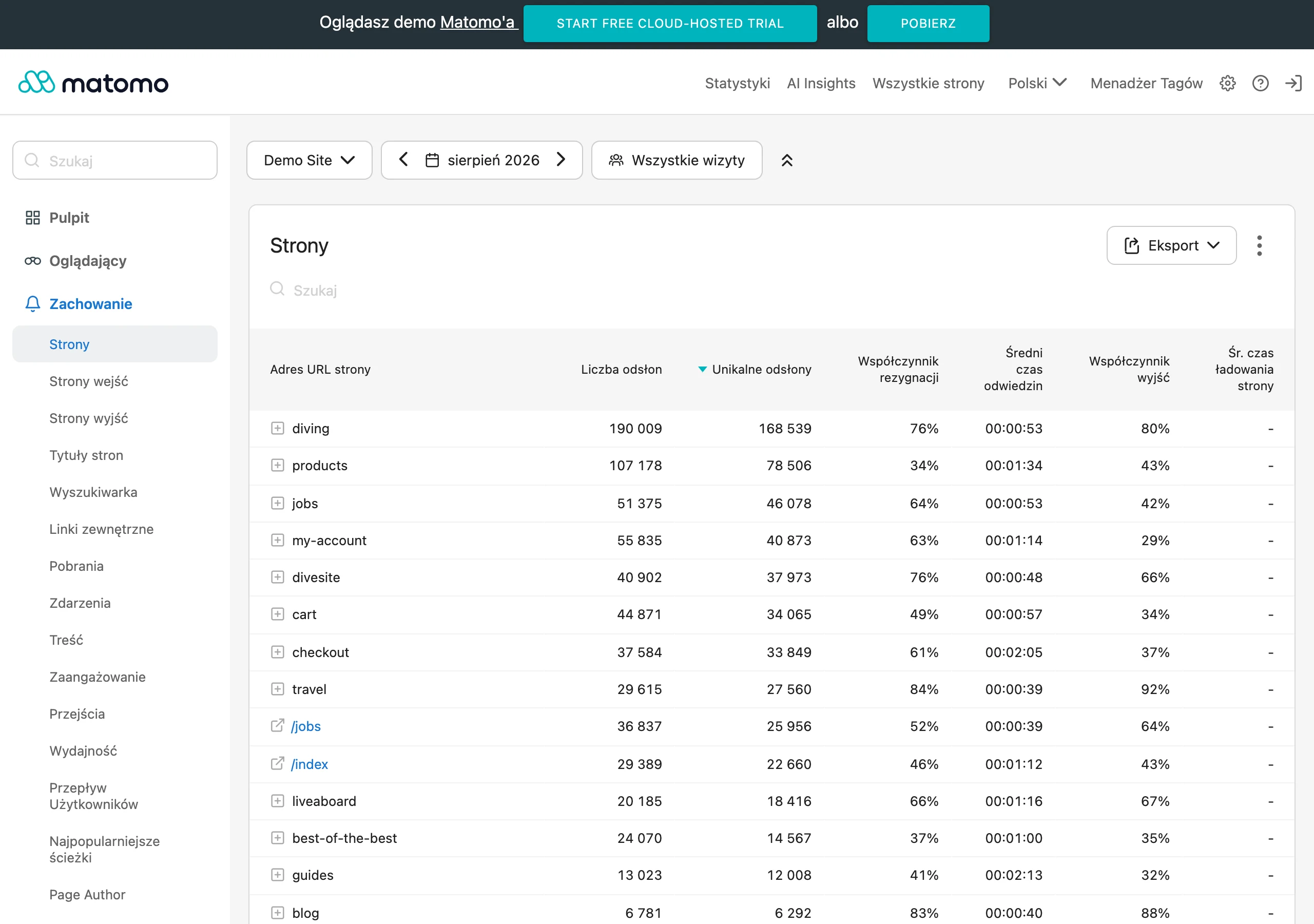
At the content level, it is worth measuring visits, traffic source, engagement, CTA clicks and moves to the next step. Metrics such as time on page or scroll depth are only context. They show whether the material is being consumed, but they do not yet say whether it leads to action. Their value increases only when you combine them with a click, form submission or sign-up.
At the conversion level, transitions are what matter. And it is the relationships between stages that tell the truth: article to landing page, landing page to form, and form to accepted lead. If an article generates high traffic and plenty of clicks, but the landing page does not close the sign-up, the problem is that something is off in the offer, page layout or the form itself. If, on the other hand, there are hardly any CTA clicks, there is no point polishing the numbers. You need to go back to the alignment between the content and the call to action, because that is usually where the consistency breaks down.
The form itself is by no means the judge of effectiveness. The system should distinguish which leads have business weight and which only inflate volume and make the report look better. That is why the CRM should receive not only contact details, but also the entry source, content topic, campaign, intent and type of offer. The earlier you describe this, the less guessing there is in sales. A lead from an informational article and a lead from comparison content have different buying readiness, so they should not be put in the same bucket.
In practice, a simple division into three layers works well. The first is visibility and traffic, the second is behaviour and conversion, and the third is sales quality. This makes it easy to see quickly whether the problem lies in attracting the user, the on-site experience or only in qualification in the sales process. It brings order to the diagnosis. And, just as importantly, it makes conversation between marketing and sales easier, because both sides start talking about the same thing.
Reporting only makes sense when it is based on first-party data and consistent source tagging. If traffic comes in from SEO, newsletters, paid campaigns and social media, all channels need to be described with one standard, with no exceptions or “local” names. Otherwise the same type of visit will land in the report under different labels, and comparing lead cost and quality will simply become misleading. And then someone will draw “conclusions” from it. This is especially important when several teams are running activities in parallel.
For day-to-day work, a simple dashboard is enough. But beware, provided it shows relationships rather than a wall of charts. It should bring together data on traffic, CTA clicks, forms, the number of leads, lead quality and the stage in the CRM. It is not about the number of tiles, but about a practical answer to a few questions: which pieces of content generate the best leads, which channels deliver the best cost per contact, and where users drop off most often. If you cannot see that, you are looking but not seeing.
The most common measurement mistake is the cult of the last click. As a result, the impact of content from an earlier stage is ignored, even though it is often what “opens” the topic and builds trust. A user will usually first land on an educational article, then return from a newsletter or remarketing campaign and only then submit a form. If you measure only the last source, you will automatically underestimate the role of content in demand generation, and you will start shifting budget to where the tail of the funnel is currently shining. That is a straight path to wrong decisions. Content should be assessed not only by the direct lead, but also by its contribution to the conversion path.
The best insights come from regular data reviews, not from a one-off report. Every few weeks, check content with high traffic and low conversion, pages with a high form abandonment rate, and sources that deliver a lot of, but poor-quality, leads. And this is not cosmetic. It lets you quickly improve the CTA, shorten the form, swap the offer on the landing page, or direct traffic differently before the budget starts burning. This is precisely the stage at which the system starts to grow in earnest, because decisions are driven by data rather than by intuition.
What tools are essential for handling leads?
To handle leads, you need at least forms or landing pages, analytics with event tracking, a CRM, a contact automation tool and one coherent results report. This setup lets you not only collect contacts, but also know where they came from, what topic they responded to, and what happened next. The most important thing is for the data to move between tools without manual re-entering. The problem is that if the form works but the lead does not land correctly in the CRM or loses its entry source, the whole system simply remains incomplete.
- Form and landing page – to capture the contact and direct the user to a specific action.
- Analytics and tag manager – to measure visits, CTA clicks, form submissions and the conversion path.
- CRM – to save the lead, assign the source, status, sales rep and follow-up actions.
- Marketing automation or e-mail system – for follow-up, nurturing, segmentation and simple workflows.
- Reporting dashboard – to assess lead quality, content effectiveness and impact on the pipeline.
The CRM is the central tool, because that is where a lead stops being just a contact and becomes part of the sales process. The key is for it to store not only form data, but also the conversion topic, traffic source, campaign, stage in the funnel and contact history. If the CRM does not show which piece of content the lead came from and with what intent, it is hard to assess which materials really support sales. So the question is not “should you have a CRM”, but “does the CRM see context”.
An automation tool is useful when not every lead should go straight to sales. In practice, it lets you send a series of e-mails, assign a contact to a segment, trigger scoring or pass the lead to sales only after specific conditions are met. This makes a difference especially in a longer purchase process, when the user first downloads a resource and only later is ready for a conversation. A simple workflow based on user behaviour works well, not an elaborate automation implemented without a plan.
Analytics and tagging are there to measure the whole process, not just the number of forms. What matters is the user journey: moving from an article to a landing page, CTA clicks, form submission, entries from specific channels and the next stage of the lead in the CRM. That means specifics, not theory: event configuration, thank-you page and consistent source tagging. Without a shared naming convention for sources and campaigns, the report quickly becomes inconsistent.
A good complement is UX analysis tools, such as heatmaps and session recordings. They show, ruthlessly, where users drop off before conversion, before you even manage to blame “poor traffic”. They make it crystal clear whether the problem is the page layout, a form that is too long, weak CTA, or simply a lack of trust in the offer. The question is: where exactly does the path break down. This does not replace analytics, but it explains very well why traffic does not turn into leads.
When choosing tools, look at the process, not the number of features. For some organisations, a simple form, CRM and basic e-mail automation are enough, and only later does it make sense to expand the stack. It is better to have fewer tools that are well integrated than an extensive set in which lead data is scattered. And this is where the tougher part of the topic appears: consents, data policy, how contacts are stored and the scope of information passed between systems. Rather than adding more modules — get your data in order, because otherwise even the best reports will be only a pretty narrative.
FAQ
Frequently asked questions
How does a lead generation from content system work in practice?
Content is designed to lead the user to a specific action: subscribing, downloading a resource, booking a consultation or getting in touch. After conversion, the lead goes into analytics and CRM, where its quality can be assessed and it can be followed up.
Is publishing articles enough to generate leads?
No, because publishing alone brings traffic and page views, but it does not build a sales process. The system only starts working when you know what kind of lead should be created, where conversion should happen and what happens to the contact afterwards.
Why is matching content to user intent so important?
Because different content works at the stage of recognising a problem, while other content is better when the user is comparing options or already wants to talk to the company. If all materials lead to the same goal, conversion usually drops.
Which content generates leads best?
The best-performing content is based on a real buying problem, such as “how to choose” guides, comparisons, problem–solution materials, case studies and downloadable resources. Service pages and landing pages matched to a single intent also work well.
Should the contact form be the same for all content?
No, because the CTA and form should match the decision stage and the type of content. An educational article usually closes a micro-conversion better, while a service page can shorten the path to contact.
What are the most common mistakes in lead generation from content?
The most common problems are mismatching content to intent, lacking a conversion path and judging results only by traffic. Other major mistakes are overly broad topics, weak forms and no integration between content, analytics and CRM.