
Today, the process of SEO for a website in Google search results is very complex and involves many tasks. This means you need to be familiar with various important concepts. These include Entity (subject), among others.
What is SEO Entity?
From the very beginning, SEO has mainly focused on keywords in order to increase traffic. However, when it comes to Entity-based SEO, it focuses on Entities (subjects) rather than keywords. This may seem easy, but it requires a fundamental change in mindset.
- 01Fundamental change in mindsetFocusing on subjects, not words
- 02A single, specific thingA concrete concept that carries meaning
- 03Connection with Knowledge GraphLinking to a global knowledge base
- 04Language independenceMeaning beyond language and synonyms
Entity-based SEO builds a deeper understanding and meaning in the context of the Knowledge Graph, going beyond simple keyword matching.
Entity – what is it?
In general terms, Entity (or referred to as entities/subjects) means a single, well-defined thing or concept that can be linked to the Knowledge Graph.
Unlike a keyword, which is only a set of letters specific to a given language, Entity carries meaning and is independent of the language and synonyms of the keywords that describe it.
More precisely, in the SEO industry, Entity includes any subject that can be linked to search engines’ Knowledge Graph, such as Google Knowledge Graph, for example.

We also know that Wikipedia was used as the primary trusted source of information for the Knowledge Graph. In simple terms, we can call an Entity any subject that has been assigned to, for example, the Wikidata database.
The interpretation is very broad, and as an Entity you can also consider the owner of the website being optimised or their company, currency, place or film. Below is a list of examples of what can be considered an Entity:
- people,
- places,
- brands,
- ideas,
- objects,
- books,
- companies,
- events,
- domains,
- dates,
- colours,
- currencies,
- shows,
- animals,
- media.
Entity vs keywords
In SEO, a keyword (słowo kluczowe) consists of one or more words entered by a user into a search field such as Google or Bing.
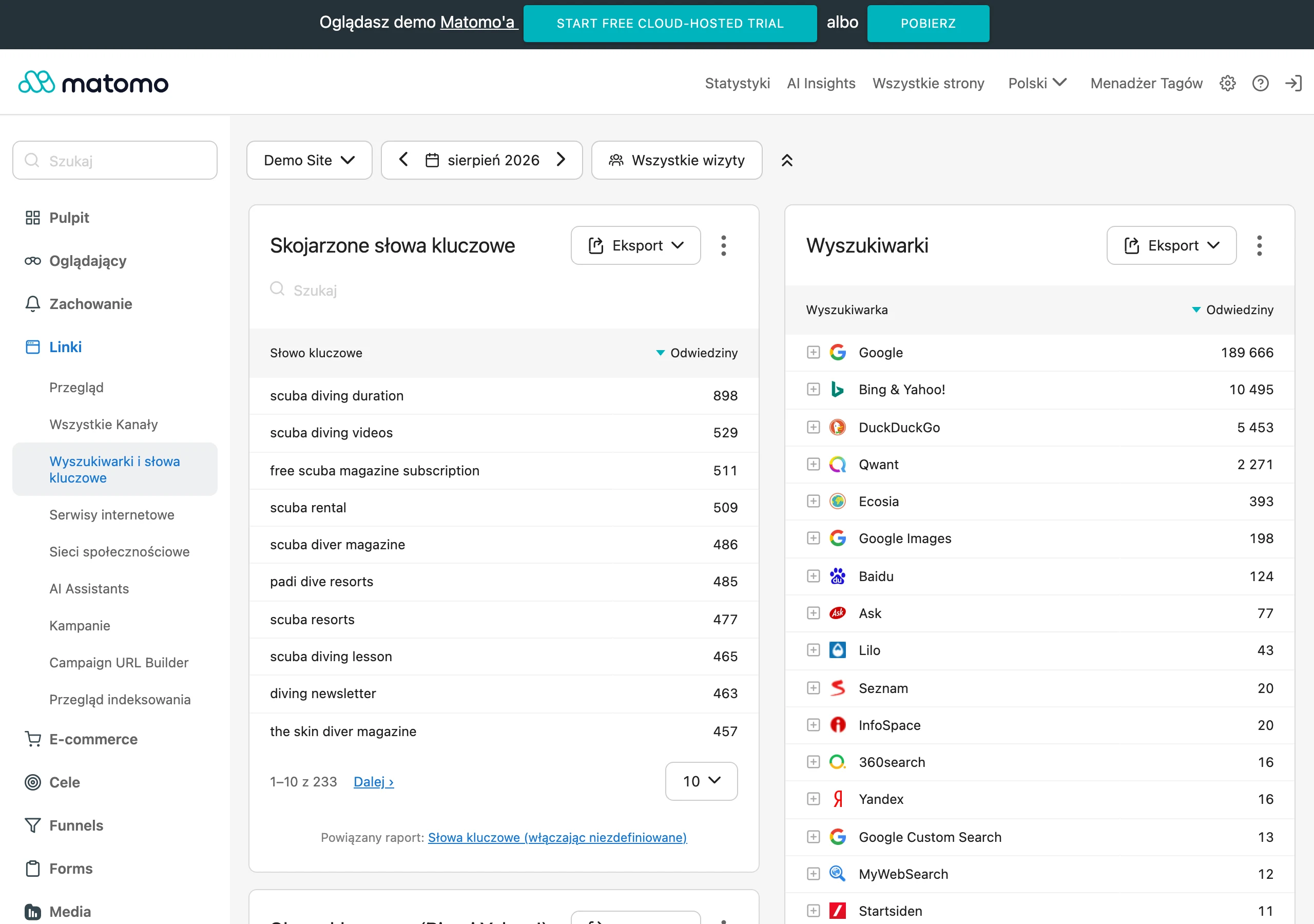
When search engines were created, the concept of keywords became the basis of organic search strategy, whose aim was to ensure a website’s visibility in search results for one or many specific phrases.
Keywords have two basic distinguishing features:
- Ambiguity – a keyword can refer to many different subjects. For example, the English word “Cookie” can mean an edible biscuit or information sent by a web server while a page is loading.
- In most cases, they are tied to a specific language – the keyword “machine à laver” means “washing machine” in English, and in Polish it is “pralka”.
Today, Entities are taking the place of keywords as the main focus in Google search.
There are several reasons for this state of affairs. Above all, keywords are ambiguous.
The above-mentioned example of the “cookie” biscuit means that relying on keywords can end up frustrating people who cannot find what they are looking for.
Ambiguity is also caused by different words in specific languages meaning the same thing. In addition, it is difficult to create contextual links using keywords.
- 01No connection to WikipediaGeneral terms are not Entities.
- 02Synonyms, not EntitiesA reference to 'sneakers’, not as a new Entity.
- 03Synonym for the companyA reference to 'Nike, Inc.’ as a company.
The key is to avoid confusion and understand that not every keyword is a separate Entity, but often its synonym.
Common mistakes related to Entities
There are many different mistakes related to Entities that can be found online. It is worth avoiding ambiguity and confusion.
Mistakes encountered in SEO literature
Examples include articles suggesting that “player”, “best basketball shoes” and “basketball” are Entities detected by Google when analysing text about basketball.
What mistakes are we dealing with here? The phrase “best basketball shoes” does not refer to an Entity, because there is no page about it on Wikipedia.
The phrase “basketball shoes” is not an Entity either. It is a synonym of the keyword referring to the Entity “sneakers”.
Even the word “Nike” refers to the Entity that is the company Nike, Inc. This Entity was correctly detected by Google NLP, creating a synonym, but the word “Nike” here refers to the Wikipedia page about the Entity Nike, Inc.
So it is worth remembering that Google creates lists of keywords in its Google NLP API. Entities are linked to Wikipedia URLs concerning the given words.
- 01Voice and mobile searchRequires better structuring of algorithms
- 02The problem with keywordsRelying on them alone is not enough
- 03More relevant resultsProvides users with better answers
- 04Easier for assistants and translationsBetter digital support and multilingualism
The shift to Entities improves context understanding and search precision, adapting to modern methods of interaction.
Other mistakes encountered
Wikipedia can also be misleading when it comes to its pages with specific Entities.
An example is the opinion below:
“In the sentence “Trump is the president of the United States”, both Trump and the United States are specific Entities, because they refer to specific entities (Donald Trump and the United States). The president, however, is not a specific Entity, because this word can refer to many different entities.”
How does Google use Entities?
Before answering the question “How?”, it is worth finding out why Entities are important elements of Google’s algorithms and services, and why they are increasingly and gradually replacing keywords?
Why does Google use Entities?
One reason is obvious. If Google uses Entities, it is because they enable all the world’s information to be linked together, regardless of language. Entities also make it possible to understand the meaning of that information as well as the areas of interest of its users.
By detecting Entities contained on web pages, Google will be able to connect two pages describing the same thing in different languages.
Which Google services use Entities?
In its 2018 article, titled “Helping you along your Search journeys” Google declared the detection and indexing of Entities found on all web pages published on the web, in many key applications.
Summing up all these applications, it can be stated that Google uses Entities to interpret and categorise web pages, establish links between Entities (and therefore between web pages) and to provide the best answers to questions asked by web users.
Knowledge Graph
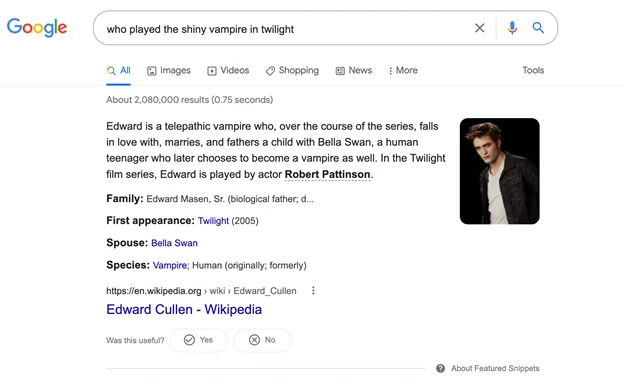
According to information from Google, Knowledge Graph is used by Google Search to help users search for information faster and more easily. Such a Knowledge Graph contains the largest number of real-world Entities, such as people, places and things, and is updated every evening thanks to Wikipedia.
Using Knowledge Graph allows Google in particular to:
- present knowledge graphs concerning the Entities searched for by internet users,
- improve the results of its other services based on users’ interests.
Google Search
Using Entities allows Google to personalise the results delivered by its search engine, based on its users’ interests and their search history.
Without any doubt, the following elements and Google algorithm updates may focus on Entities:
- Google Hummingbird: thanks to this update, Google changed the way it processes internet users’ queries by shifting from a keyword-focused approach to an Entity-focused approach.
- Google Rankbrain: RankBrain allows Google to answer better queries it has not previously encountered. This is achieved through the use of Entities and artificial intelligence.
- Google BERT: this setting uses Natural Language Processing (NLP – natural language processing) to understand queries, interpret content on websites and thus identify Entities and the relationships between them.
Thanks to these effective improvements, Google is now able to rephrase internet users’ requests, and it probably can also rephrase website content.
Search suggestions provided by Google also increasingly include suggestions containing Entities.
Searching for “queen” without using suggestions can produce various ideas regarding the results, but using the suggestion field gives us a list of results that is quite surprising, because it does not contain errors (for example, no suggestions regarding monarchs or films). This indicates that Google provides search results based on Entities, and not only on keywords.
Google Discover
The results provided by Google Discover are based on users’ interests, that is, they are based on Entities found on the websites they use. Based on these sites, Google creates what it calls a “topical layer” (Entity should be understood as Topic), e.g. each user’s interest graph.
When a new article containing one of these areas of interest is published on the web, Google can suggest it to the relevant user in Google Discover.
Google Trends
Google offers two types of searches in its Trends tool:
- Search by a “term”, that is, a keyword
- Search by an “entity”, that is, an Entity
How does Google detect Entities?
Research carried out in industry reports has shown that Google detects only around 20% of Entities found in content.
This result is achieved solely through the use of the Google NLP API.
Research has shown, however, that in many cases Google API does not directly detect the main Entity in articles, which is then offered within Google Discover.
It is therefore reasonable to assume that Google uses other methods to determine the Entities found on a page:
- An NLP algorithm similar to the API (the API detects almost 100% of people, places and organisations, but few concepts/things),
- Off-page factors, such as Entities detected on other subpages of a given site (used as contextual Entities to enable disambiguation),
- On-page factors, such as the Schema.org markup to explicitly define Entities found on the page.
Why are Entities important in SEO?
There are several reasons why Google SEO is increasingly focusing on Entities.
The introduction of voice and mobile search had a huge impact on the structuring of Google’s algorithms in order to find results. There is also the issue associated with relying solely on keywords.
In addition, there are many basic benefits associated with using Entities in search.
Better search results
The main reason behind the shift from keywords to Entities is to provide searchers with more relevant search results. Solutions such as mobile and voice search, using digital assistants, are easier to use thanks to Entity-focused SEO.
Improved translations
Entities in web search engines also make things easier, such as translations between different languages based on the user’s search settings. They also improve searching using synonyms, antonyms and homonyms.
Improved rich snippets
Thanks to Google Knowledge Graph, rich snippets are also improved through searching by Entity. When a snippet is more useful for users, search results are better, and this improves the user experience while the algorithm continues to learn.
FAQ
Frequently asked questions
What is Entity in SEO and what does this concept mean?
Entity is a single, well-defined subject or concept that can be linked to the Knowledge Graph. In SEO, it means something more than a keyword, because it carries meaning independent of language and synonyms.
How is Entity different from a keyword?
A keyword is a string of letters entered by a user and can be ambiguous. An Entity refers to a specific subject or meaning that Google can recognise and connect with other information.
Why is Google increasingly focusing on Entity instead of keywords?
Because Entities help connect information regardless of language and better understand its meaning. This makes it easier to return more relevant results and create contextual connections.
How does Google use Entities in search?
Google uses Entities to interpret and categorise pages, connect related content and provide better answers. This also affects the personalisation of search results.
What Google services are based on Entity?
Entities are used, among others, in Google Search, Google Discover, Google Trends and the Knowledge Graph. Google also uses them in updates such as Hummingbird, RankBrain and BERT.
How does Google detect Entities on a page?
The article points out that Google NLP API detects only some Entities, so Google may also use other methods. These may include off-page factors, context from other subpages and Schema.org data.