
Google now uses many solutions designed to match search results to users’ queries as closely as possible. This group includes Knowledge Graph (graph wiedzy).
Knowledge Graph – what is it?
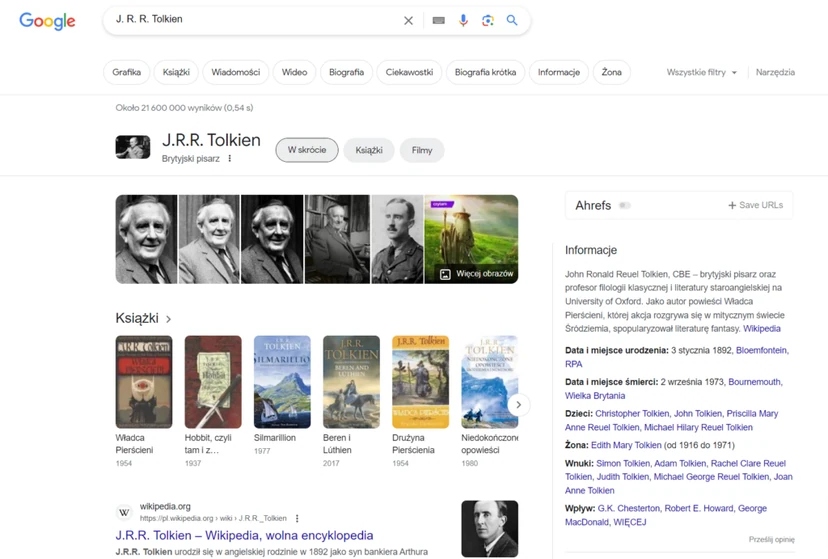
Knowledge Graph is a set of internally connected data used to present Entities (entities) of the real world and the relationships between them. These data are usually presented as a set of nodes (representing Entities) and edges (representing relationships) in a graph structure, hence the name Knowledge Graph is used.
Knowledge Graph solutions can be used to create semantic data models and can be applied to improve the quality of a website’s semantic model. One way is integration with external knowledge sources such as Wikipedia, Wikidata and product ontology. This allows data to be connected with highly trustworthy sources and aligned with the overall understanding of concepts and relationships. This makes it possible to improve the conciseness and accuracy of content.
- 01DefinitionA set of connected data.
- 02StructureNodes (entities) and edges (relationships). Entities, relationships
- 03ApplicationSemantic models, integration, trustworthiness.
Data integration for semantic models
What is ontology?
Ontology can be defined as a model representing knowledge as a set of concepts within a domain. Ontology also includes the relationships between those concepts.
Ontologies are used to standardise and organise knowledge so that sharing and reusing information is easier.
Ontology is used to create a formal representation of Entities (entities) and their relationships in Knowledge Graph. It is worth noting that ontology is a general data model, which means it does not need to include information about specific Entities. Instead, it provides a reusable foundation for describing additional Entities in the future.
Using ontology as a foundation, it is then possible to add specific real-world data about individual Entities in order to create a Knowledge Graph.
Ontologies are similar to Knowledge Graphs in that they use nodes and edges and are based on the Resource Description Framework (RDF). The similarity can also be seen in their visual presentation.
Ontology can be used to describe the content of a website or blog by providing a clear and defined structure for the information conveyed. It can be used to help a website achieve a better position in search engine rankings by providing a clear structure and meaning for the content published on the site.
Schema.org is an example of a widely adopted ontology that is supported by Google, Bing, Yahoo, Yandex and the wonderful community that supports the semantic presentation of content on the Internet.
The knowledge presentation mentioned is supported by technological infrastructure such as databases, API and machine learning algorithms. These exist to help people and services locate and process information more effectively.
How does Knowledge Graph work?
Knowledge Graph consists of data from various sources, which often have different structures. To organise such data, elements such as schemas, identities and context are used to provide structure and meaning.
Schemas create the structure for the graph, identities classify the nodes, and context sets the background for the knowledge. These elements allow products such as Google’s search algorithm to distinguish words with multiple meanings, such as “Orange” (the brand or an orange in English). Search engines such as Google, Bing and Yahoo use Knowledge Graph to deliver more accurate search results. This is made possible by understanding the context and intent behind the query.
Knowledge Graphs powered by machine learning use Natural Language Processing (natural language processing, NLP) to build a comprehensive representation of nodes, edges and labels through a technique known as semantic enrichment.
Semantic enrichment is the process of adding topical metadata to content, which allows machines to understand the content and create connections with it. This process enables machines, such as internet search engines, to understand and identify the meaning of entities and the relationships between them.
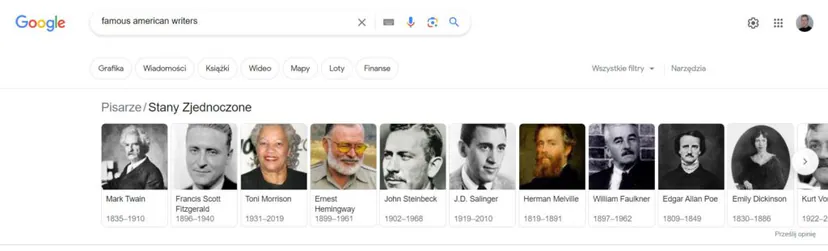
Once a Knowledge Graph has been created, it is compared and linked with other datasets that are related and similar to one another by nature. Once this process is complete, the graph makes it possible to answer questions. Internet search engines, in turn, are able to retrieve and reuse detailed answers to queries.
Such systems not only save consumers time, but also can be used in business to automate the process of collecting and integrating data. This in turn supports decision-making.
Creating a Knowledge Graph can also support the discovery of new knowledge by connecting previously unconnected data points.
- 01Data organisationSchemas and structures
- 02Assigning meaningIdentities and context
- 03Distinguishing meaningsAvoiding ambiguity
- 04More accurate resultsUnderstanding intent
A Knowledge Graph organises data, gives it context and allows search engines to understand user intent, delivering more relevant answers.
What are the popular Knowledge Graphs?
Popular Knowledge Graphs used by consumers have set high expectations for search systems in businesses. The following examples can be counted among such knowledge graphs:
- DBpedia: a graph of information extracted from Wikipedia.
- YAGO: a large database of general knowledge about people, cities, countries, films and organisations.
- Freebase: a general knowledge graph (no longer maintained) whose history is worth learning about.
- Wikidata: a graph of structured data from Wikipedia and other sources.
- Google Knowledge Graph: a graph of information used by Google to improve search results.
- Microsoft Satori: a proprietary knowledge graph used by Bing and other Microsoft services.
- Amazon Neptune: a fully managed database service that makes it easier to build and use applications that work with highly interconnected datasets.
Examples of Knowledge Graph use: are there industry-specific examples for a given field?
To automate the process of creating a Knowledge Graph and describing Entities and their relationships without knowledge of how to code, you can use tools such as Schemantra. Such tools make it possible to create appropriate Entities and build ontologies in order to connect them using schema.org.
However, it is worth remembering that knowledge graphs are also used in practically all industries, such as for example:
- 01No-code automationSchemantra, schema.org, ontologies
- 02Example: automotive industryVehicles, parts, offers, prices
- 03Better customer experiencesPersonalised recommendations, prevention
Knowledge graphs organise information across every industry, enabling better personalisation and decision-making.
Automotive industry
Knowledge Graph can be used in the automotive industry to describe and organise information about vehicles, parts, suppliers, offers and prices.
This information can be used to improve the customer experience. This can be achieved by providing personalised vehicle recommendations, highlighting potential vehicle issues and making it easier to obtain search results relating to vehicle and service information quickly and more accurately.
Property industry
Knowledge Graph can be used in the property industry to describe and organise information about properties, locations and amenities.
This information can be used to improve the customer experience. This can be achieved by providing personalised recommended properties, identifying potential property issues and also making it easier, faster and more accurate to obtain relevant search results covering property market information.
e-Commerce industry
Knowledge Graph can be used in the e-commerce industry to store and organise and present information about products, manufacturers and prices.
This information can be used to improve the customer experience. This is possible by providing personalised product recommendations, identifying products that are often bought together and making it easier to quickly obtain accurate search results.
Additionally, Knowledge Graph can be used to improve search engine effectiveness by identifying patterns in customer behaviour and product performance. Such information helps users find the target product.
Summary
Knowledge graphs (Knowledge Graph) play a significant role in SEO by providing search engines with a more comprehensive understanding of website content.
By creating ontologies and using tools such as Schema.org to mark up websites with structured data, sites can increase their visibility in search results. In addition, search engines are able to understand website content more easily.
Knowledge graphs also help search engines understand the relationships between different Entities and concepts on a site. This allows them to deliver more relevant and accurate search results to users. Knowledge graphs are powerful SEO tools that can significantly improve the performance of website search engines.
FAQ
Frequently asked questions
How does Google Knowledge Graph work in search?
It combines data from different sources, organises it using schemas, identities and context, and then helps the search engine better understand the intent of the query. This makes it possible to return more accurate answers and distinguish between words with multiple meanings.
Does Knowledge Graph help with SEO for a website?
Yes, because it can support better understanding of content by search engines. The article notes that structured data and ontologies can improve a site’s visibility in search results.
What is an ontology in the context of Knowledge Graph?
An ontology is a knowledge model composed of concepts within a given domain and the relationships between them. It is the foundation on which a Knowledge Graph can be built and enriched with specific data about real-world entities.
Why is Schema.org important for a knowledge graph?
Schema.org is a widely used ontology supported by several search engines and the community. It helps describe content in a structured way, which makes it easier for machines to understand semantically.
What are examples of popular Knowledge Graphs?
The article mentions DBpedia, YAGO, Wikidata, Google Knowledge Graph, Microsoft Satori and Amazon Neptune, among others. It also mentions Freebase, which is no longer maintained.
In which industries can Knowledge Graph be used?
The article gives examples from the automotive, real estate and e-commerce industries. In each of them, a knowledge graph can organise information, support recommendations and speed up search.