
The modern SEO industry is highly developed due to Google’s regularly improved algorithms. Achieving and maintaining high positions in search engine rankings involves the need to pay attention to many important concepts and issues. One of them is Topical Authority.
Topical authority – what is it?
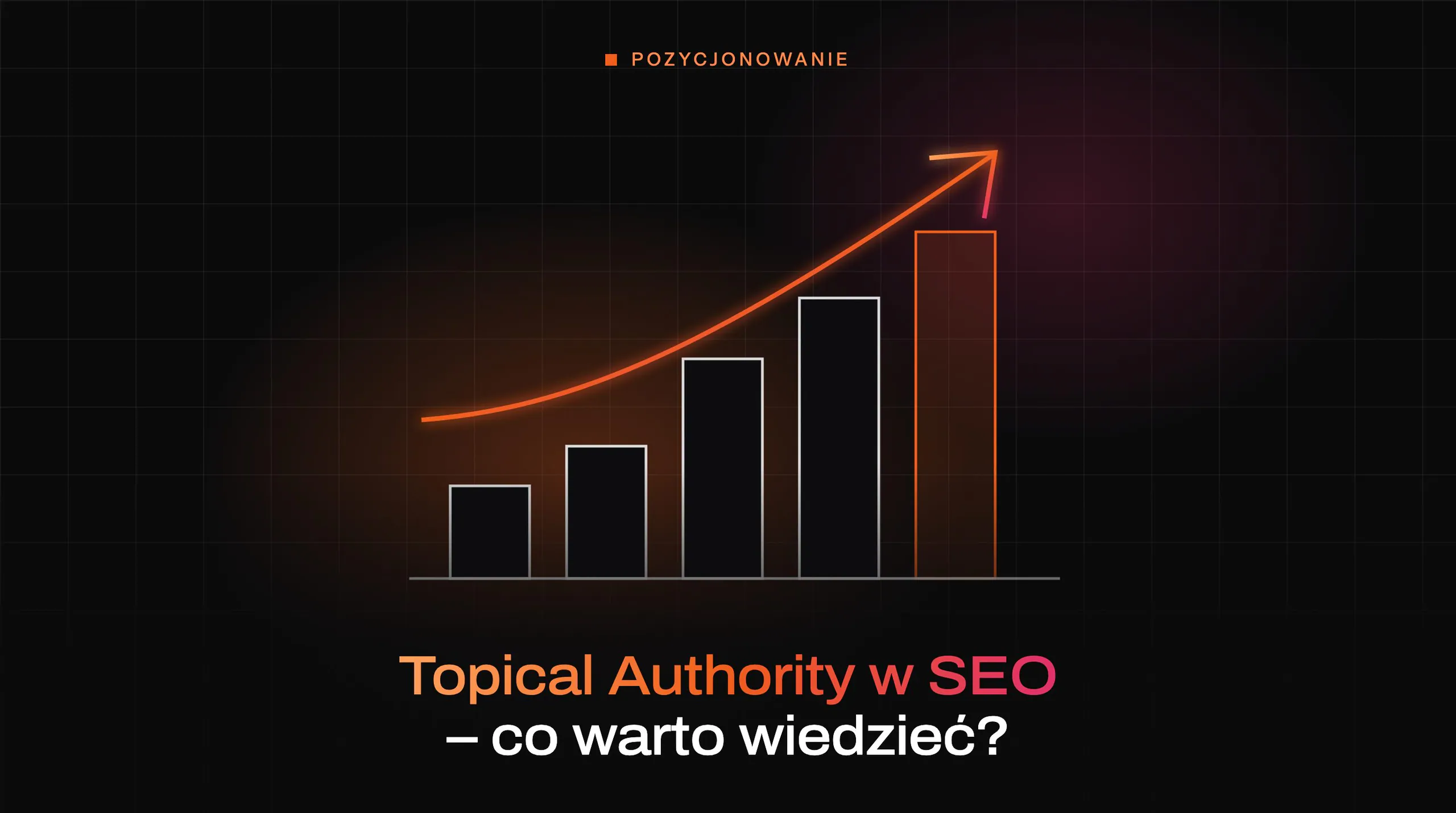
Topical authority (in Polish, autorytet tematyczny) is an SEO concept in which a website aims to gain the status of an authority to which users are directed in the case of one or more topics. Building such authority is intended to help search engines understand the topical focus of a website.
For example, writing just one article about protein supplements will not be enough to gain expert status and compete in this niche. It is a broad topic that cannot be covered in just one article. You need to pay attention to many important elements, such as:
- What is protein?
- What are protein supplements for?
- What are the best protein supplements?
- How do you use protein supplements?
- etc.
Topical Authority (topical authority) is achieved when a website fully covers a given topic instead of focusing on individual keywords.
- 01Expert statusBuilt over the long term, not with one article.
- 02Topical coverageA comprehensive treatment of the topic, not just keywords.
- 03Understanding by search enginesMakes it easier to interpret the topical focus of the site.
Topical Authority is a full and authoritative coverage of a given topic, increasing the trust of users and search engines.
Why is Topical Authority important in SEO?
Google, as a search engine, operates on the basis of semantic relationships. This means that it has to associate a website with a topic in order to rank it as a relevant resource for keywords that are part of a specific topic.
Having a substantial amount of content on a specific topic makes it possible to create more relevant internal links, making it easier for Google and users to find specific content. This in turn can lead to acquiring more natural backlinks.
By creating content that covers the same topic and linking it together, you can increase Topical Authority in Google’s eyes. This shows that the people creating the site are authorities and experts in their field, and that their site is a trusted source of information.
How does Topical Authority work?
The exact workings of Topical Authority are not well known. With the introduction of Google’s Hummingbird algorithm in 2013, Topical Authority became much more important.
It changed the content ranking system so that it was determined based on matching the user’s query. Before the Hummingbird algorithm, the main focus of Google’s search algorithms was keywords. They were used to understand what the user was looking for. Google, however, was not able to understand the context of the search.
- 01KeywordsFormer focus on exact phrases.
- 02Hummingbird algorithmShift to query matching.
- 03Semantic searchUnderstanding context and user intent.
- 04Expertise and reputationPromoting high-quality sites.
A key shift from simple keyword matching to understanding context and building expert authority.
Information on Google’s history and authority
In recent years, Google has focused its efforts on semantic search:
- 2011 – Google announces “Structured Search Engine” for structuring information on the web.
- 2012 – Google introduces Knowledge Graph needed for a better understanding of information about entities from the real world.
- 2013 – The Hummingbird algorithm sets page rankings based on built-in links and keywords. Google Search can now assess content based on its relevance to a given query.
- 2018 – The Google update Medic means that YMYL content must demonstrate expertise, authority and trustworthiness (expertise, authority and trustworthiness – E-A-T) in order to achieve appropriate rankings.
- 2019 – The BERT model was launched to better understand the relationships between words, concepts and entities in human language.
E-E-A-T (Experience, Expertise, Authoritativeness & Trustworthiness)
The strong emphasis Google places on expertise and websites with a good reputation can be seen in the quality rater guidelines. Higher-quality pages are characterised by a higher level of expertise and are trustworthy authorities.
This suggests that building your website’s reputation as an expert on a given topic is likely to positively affect the authority aspect in E-E-A-T. Of course, E-E-A-T is not a ranking factor, but this concept makes it possible to inform ranking algorithms. In other words, if Google Search recognises a given page as an expert source of information on a given topic, then the content will most likely be highly rated in rankings.
Best practices for building topical authority
Achieving topical authority is not easy. However, it can be done by paying attention to the aspects below.
Creating an excellent content strategy
Creating a deep and detailed content strategy is important when building topical authority. A strategy for this kind of topical authority must include a plan to create authority-building content on an ongoing basis. These contents take into account topics and keywords that are interesting to the audience.
It is a good idea to focus your attention on supporting readers by sharing your knowledge with them. It is worth establishing what others are saying in the industry and starting to share your own thoughts with them on topics you are confident about.
Creating topic clusters
When choosing the topics that content will be written about, it is a good idea to focus in particular on a group of key topics that will be used as the website’s pillars.
It is a good idea to create excellent content related to these main topics. Then you can start writing about other related topics, most of which are searched for less frequently compared with the key topics.
When writing about these smaller, related topics, make sure that they include links pointing back to the more important topics and to other smaller topics related to the main subject.
This strategy makes it possible to create Topic Clusters (topic clusters), which are important in the process of increasing topical authority and improving SEO. Topic clusters make it easier for search engines to determine which topic is being explored in depth by a given website and also make it easier for search engine bots to navigate the site and assess its content.
Understanding user intent
Most content marketers introduce a plan for user intent in order to increase their topical authority. There is no secret in the fact that Google’s algorithm is exceptionally good at understanding user intent.
If a user is searching for information on a given topic or a fact or specific keywords, Google’s algorithm tries to determine the intent behind that search and attempts to provide the most relevant results.
This means that your content strategy must take into account the intent of users searching based on specific keywords. If the intent is informational, you should write an article about how to do something. If the intent is transactional, you should consider targeting an e-commerce page.
You can also create content required by Google. For example, it is a good idea to search for something yourself using a given keyword and check which articles appear.
Creating high-quality links
The final strategy you should use when building topical authority for your informational site is creating high-quality backlinks using other authoritative websites.
The key issue is acquiring links from sites with strong domain ratings that are relevant to the given industry. There are many link building strategies you can use to acquire such links. These include blog posts, among other things.
The link-building process should not be underestimated. You need to focus both on creating content and acquiring links in order to achieve the right topical relevance.
How to carry out a topical analysis?
It is worth understanding what information you need to look for in order to find out how Google understands the selected Entity. Google Knowledge Graph does not only cover Entities and their definitions. Google pays attention to how Entities (entities) are connected to one another. There are two ways Entities are connected to one another:
- Sharing attributes (both apples and oranges are fruit)
- Existing within a hierarchy of topics and subtopics
In addition, Google uses information to provide answers to questions from users. This means that Google also needs to analyse each query in order to determine what information to provide in the response.
Understanding that Google Knowledge Graph includes two types of information and uses them to understand queries, it makes sense that if you want to become an authority on a given topic, you should structure information in a way that aligns with both aspects.
To make things easier for Google, you should also include real queries in your content, as well as answers to them. In other words it is necessary to look for three types of information related to the Entity (entity) used to create the content:
- Related Entities: Entities that have attributes similar to the main Entity.
- Related topics: Subtopics that are related to the main Entity.
- Related queries: A list of search queries related to the selected Entity (entity).
This is not always easy, but these three types of information can be sought through SERP analysis and automated tools. It is a good idea to create a data sheet with separate header columns for related Entities, topics and queries.
FAQ
Frequently asked questions
How does Google understand topical authority in SEO?
Google connects a site with a topic based on semantic associations and how well the content matches user queries. The better a site covers a given topic, the easier it may be recognised as a reliable source of information.
Is one article enough to build topical authority?
No, a single text is usually not enough, especially for broad topics. You need to cover the topic more holistically and create content that is connected to other content.
Why do topic clusters help in building topical authority?
Topic clusters organise content around main topics and their subtopics. They also make it easier for search engine crawlers to understand what the site covers most deeply.
How should you choose content for topical authority based on user intent?
Content should answer what the user is looking for: information, a specific answer or an offer. If the intent is informational, it is worth creating guides and explanatory articles about the topic.
When is link building important for topical authority?
Backlinks are important alongside content creation because they help strengthen the site’s topical relevance. It is best to acquire them from authoritative sites related to the given industry.
How should you analyse a topic for topical authority?
It is worth looking for related Entities, related topics and related queries associated with the main entity. SERP analysis and automation tools are helpful, and the results can be collected in a data sheet.