

Are you wondering why competitor analysis is important? Just as sports teams analyse their opponents to find their weaknesses, businesses analyse their competition to improve their SEO strategy.
What is competitor analysis?
Think of competitor analysis as diving into an ocean of SEO competitors. You need to examine how they build their SEO strategies and uncover the keywords they are ranking for. It is like having a secret map to treasure.
Simply put, it is keeping an eye on the biggest players in your industry. You will see what they are doing as part of their SEO and use that information to plan your own strategy.
- 01Diving into dataExamining competitor strategies
- 02Analysing SEO strategiesDiscovering keywords
- 03Discovering keywordsKeeping an eye on the biggest players
- 04Creating a map to successPlanning your own strategy
Your secret map to treasure in the world of SEO, using competitors’ actions for your own growth.
Benefits of competitor analysis
Now let’s check why competitor analysis is considered an effective secret weapon.
1. Discovering new potential keywords
Conducting competitor analysis gives you access to valuable potential keywords.
Think of all the keywords you have missed that your competitors are ranking for. It is like finding a map to hidden treasure.
- 01Different from business onesRanking for the same phrases.
- 02Topic-dependentThey depend on the business area.
- 03Analysis before publishingBefore you create or optimise.
- 04Discover unaware competitionIdentify unknown players.
The key is to understand that SEO competitors are sites competing for the same organic queries, not always direct business rivals.
2. Better understanding of the SEO landscape
A thorough competitor analysis provides a better understanding of the SEO landscape.
You can learn, among other things, what your competitors are doing right, what strategies they use, etc. With this knowledge you can adapt your own technique, gaining an SEO advantage in the process.
3. Gaining valuable information essential for content strategy
A fairly common problem is coming up with new content ideas. By analysing competitors’ content, you can gain inspiration for yourself.
In addition, you can identify gaps in competitors’ content that can be filled and thus overtake your competitors.
- 01Discover competitors’ phrasesValuable keywords
- 02Choose the right phrasesRelevant, broad reach, easy
- 03Focus on intentUnderstand the user’s goal
- 04Increase traffic to the siteMore valuable visits
The key is to understand user intent, not just chase high search volume.
4. Discovering link-building opportunities
Here is the icing on the cake – competitor analysis can help you find potential link-building opportunities. You can see who links to competitors’ pages and identify potential sites that could link to you as well.
How to find SEO competitors?
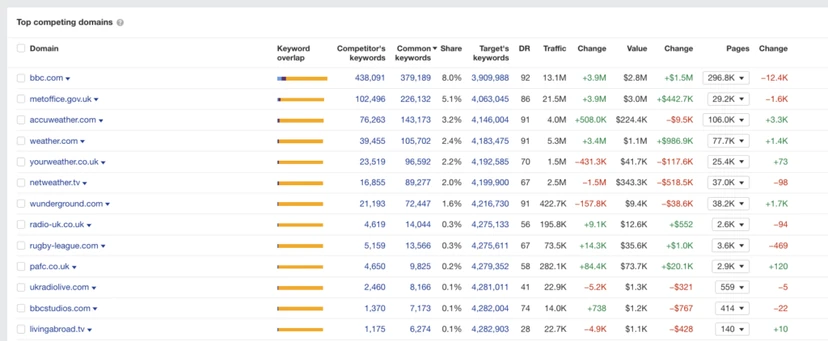
The first thing you need to know about SEO competitors is that they are not necessarily the same entities as your direct business competitors.
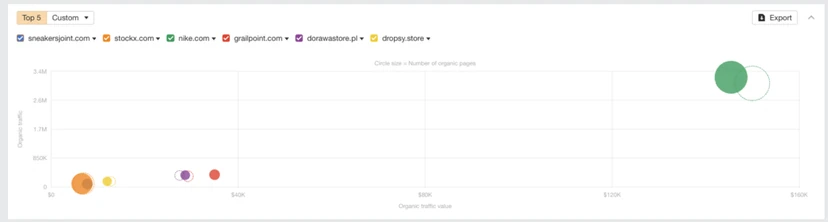
The term SEO competitors refers to sites that are ranking for organic queries for which you are also ranking your site. This means your SEO competitors may differ depending on the topic. It is important to know exactly who you are competing with (and for what) before publishing or optimising any pages targeted at SEO for a specific keyword.
This is where we come to the first phase of competitor analysis – looking for competition you may not be aware of. If different parts of your site focus on different business areas and have many competitors in different industries, this is very important.
Guessing is not the right approach at this initial stage. You may think you know who your competitors are, but the most effective way to uncover SEO competition is data analysis. Competitor pages can be analysed manually, but there are also various useful tools that streamline this process.
When should you carry out SEO competitor analysis?
The effectiveness of your SEO optimisation is always linked to your competition. So it is not static. Due to changes in search engine algorithms, the appearance of new competitors and other digital sellers who want to get ahead of you, you cannot afford any downtime when it comes to SEO. Regular competitor analysis to understand where you stand (compared with them) will help you identify areas with room for improvement before they adversely affect your rankings.
Here are some key processes and events that require you to carry out SEO competitor analysis:
- writing content – this will help ensure that your site meets the user’s search intent in a better and more accurate way compared with competitors’ content,
- content planning – checking what competitors do well and adding your own unique ideas to that is a great way to achieve the right visibility in search engines. You can also use SEO competitor analysis to estimate how much work is needed to outrank competitors in a given topic,
- after a sudden drop in rankings – establishing what your competition did that allowed them to overtake you and identifying what works well and badly in your industry,
- if your site is not changing its position on the search results page – if the page is not in top positions, competitor analysis can help uncover gaps and shortcomings in optimisation,
- if the search results page has changed – if another site has taken your top position for a specific search term, you should use SEO competitor analysis to uncover its strengths and then use them on your own site.
Analysis of competitors’ keywords in SEO
Analysing competitors’ keywords is the process of finding valuable keywords for which competitors rank highly (and your site does not). The information obtained in this way should be used to drive more traffic to your site.
Which keywords should be included in competitor analysis?
Not all keywords are worth equal effort. Keywords that are relevant to your business, have a high search volume and are not difficult to rank for are ideal to focus your efforts on.
Focus on intent, not search volume
Just because a keyword has a high search volume does not mean that achieving a high ranking for it will ensure a significant increase in traffic from search engines. Instead, it is recommended to focus on satisfying search intent (also known as user intent).
User intent is the goal that a user has when carrying out a search. Such a search can be informational, for example “McDonald’s opening hours”, transactional, e.g. “buy 1000-piece puzzle”, or navigational, when users may search for “pałac kultury” instead of entering a URL in the address bar.
Regardless of the type of search, your pages must meet intent through high-quality, optimised content that provides a valuable and relevant answer to the query.
Google prioritises pages that provide relevant, positive user experiences – this includes improving search results that deliver excellent experiences by meeting needs. So if you can satisfy search intent better than your competitors, your content is likely to be rewarded with a better ranking position.
Creating or optimising content so that it is better suited to meeting user intent may include:
- creating valuable content that clearly matches search intent. This is more important than the keywords used,
- adding more varied and engaging content formats to your pages, such as step-by-step guides, infographics and videos,
- looking for potential content gaps and answering questions in the “Similar questions” feature,
- improving existing content. If a competitor has a list of 10 old pages in a given industry, you can expand such a list by offering 50 top pages.
Put yourself in the role of a more credible source of information with authority. If you are an expert in your field, make sure the reader knows it. Consider persuading an expert in your industry to write a blog post with tips that will be useful to potential customers.
Remember that by focusing on meeting search intent, instead of focusing solely on the search volume of target keywords, you will deliver more relevant traffic to your site, achieve a higher position in search results and acquire more high-quality leads.
Check potential long-tail keywords in your competitors’ keyword analysis
What if your site is smaller or younger than the competition. Plenty of pages in Google’s top rankings are 3 years old or more. It is therefore a good idea to shift the focus of your efforts from the most competitive phrases to their long-tail variations. Plenty of users carry out searches using such long, specific keywords.
According to Siteimprove, 50% of search queries contain four or more words (the so-called long-tail). So it is a good idea to go beyond the basics.
For example, the keyword difficulty for popular single words such as “headphones” is high. It is worth using more specific phrases to stand out from the crowd, for example “budget wireless headphones”, “sleep headphones”, etc. These are more descriptive and have less competition in search.
Identifying long-tail keyword variations can seem endless. Fortunately, carrying out SEO competitor analysis with specialist SEO tools will mean that most of the work is done automatically.
Make sure you analyse your competitors not only for the most popular short keywords, but also for longer, more niche ones. Search volume for long-tail variations may be lower, but such phrases deliver more specific, relevant traffic to your site, and their SEO is less demanding.
Track your keyword positions
Carrying out this kind of SEO competitor analysis is only the beginning. As we know, SEO is a broad process. Over time, rankings improve and decline, so it is essential to continuously monitor your own and your competitors’ rankings for target keywords. Depending on the country you want to target, we can use tools well known on the Polish market, e.g. Senuto, Semstorm, or foreign tools such as Semrush or Ahrefs.
However, when you have hundreds or even thousands of keywords, manual checking is not a good use of resources. Stay on top of current rankings by using dedicated automated keyword monitoring tools.
Regular automated monitoring makes it possible to detect and quickly respond to changes in page rankings before your site experiences a drop. At the same time, you can measure the effectiveness of your optimisation efforts when it comes to keywords.
Competitors’ SEO content analysis
Keywords are undoubtedly an important part of SEO competitor analysis. However, your assessment does not begin and end there. You should also support your SEO optimisation by drawing inspiration from your competitors’ most effective content.
The important thing is to discover your competitors’ most popular content and use it to improve your own. This saves time and effort, because you already know that such pages have high rankings and generate substantial traffic.
Mirroring and competing with this approach allows you to better align content with search intent and provide a better content experience for users who land on your pages. In the long term, your content will outperform others in the SERPs.
Once you know which content you are competing with, there are two basic methods of outperforming it:
- identify and fill content gaps – this method involves detecting and exploiting weaknesses in competitors’ content. For example, if competitors provide only one content format, you might consider changing its configuration so as to create a more popular format,
- the “skyscraper” technique – this method is simpler, but requires more work. It involves using your competitors’ content as the basis for creating similar, but better, content. You then need to contact the administrators of sites that link to competitors’ content and ask them to update the link to your more advanced content.
Here are the content elements that should be given particular attention when optimising content in order to overtake a competitor in a given topic:
- content format,
- headings,
- keyword placement on the page,
- titles and meta descriptions,
- word count. Information provided by Siteimprove shows that organic search results contain an average of 1447 words,
- content readability,
- page structure, for example information architecture and headings,
- use of additional images, videos and other media files,
- the answer format. Does the content contain bullet lists, infographics, or questions and answers?
- the presence of structured data,
- publishing frequency.
Analysis of competitors’ backlink profiles
Content remains the most important ranking factor, however acquiring high-quality, authoritative backlinks is an integral part of any effective SEO strategy. Backlinks, also known as inbound links, are links from other sites that point to your site. Search engines use backlinks to recognise how trustworthy a given site is.
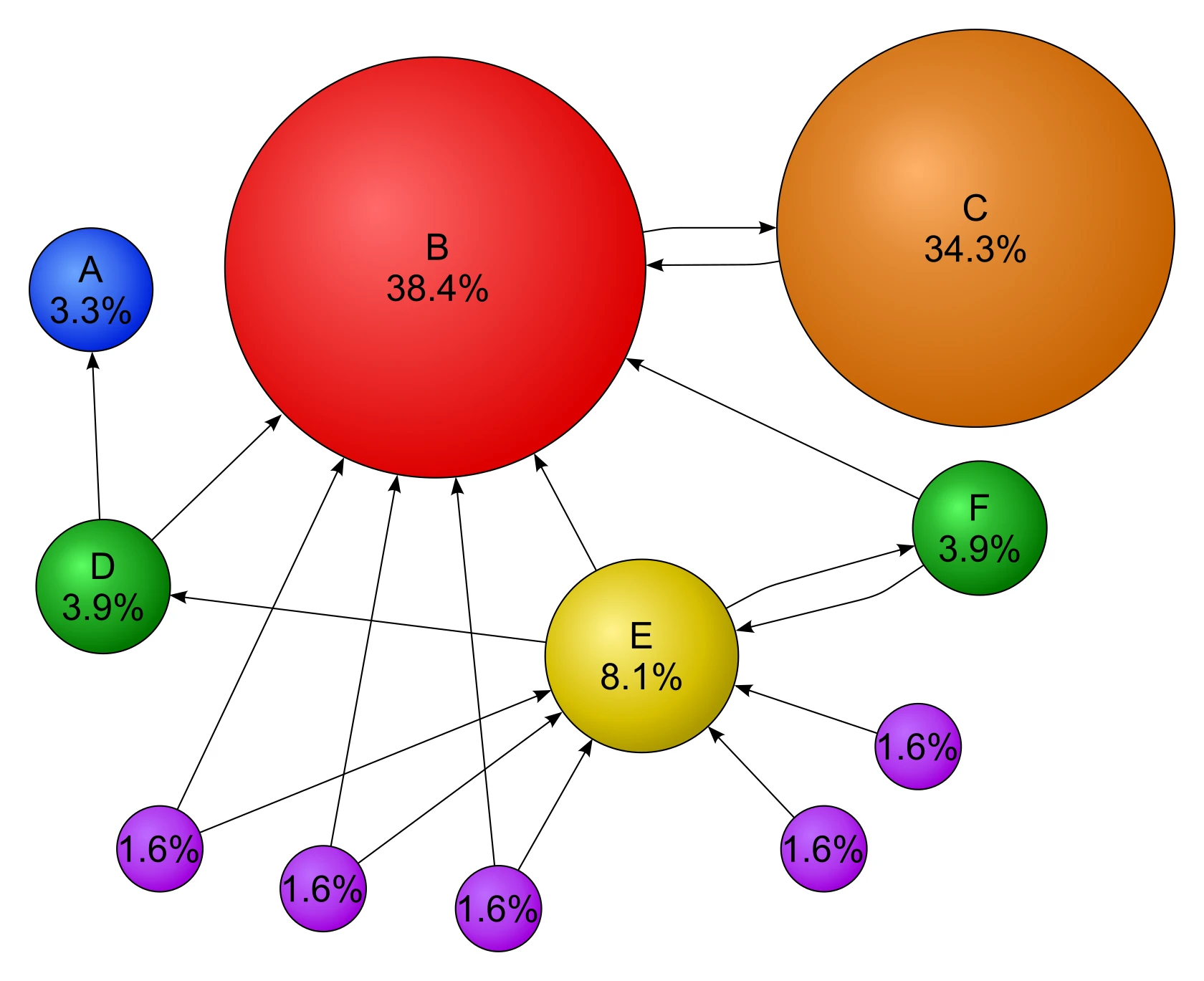
The more important and trustworthy your site is, the higher you will rank in search results and the more organic traffic you will receive. Despite its importance, studies show (information from Siteimprove) that 66% of sites do not have any backlinks at all.
Backlinks still rank among Google’s top three ranking factors. This means that if competitors have a stronger backlink profile than you, overtaking them may be difficult. Improving your inbound link profile is therefore a priority for your site. Fortunately, looking for competitors’ existing backlinks can shorten this process and help improve your own strategy. Sometimes this process is called backlink gap analysis.
With specialist tools, you can discover gaps and develop your own strategies. Of course, you need to remember that not all links are equal. Bad backlinks can negatively affect SEO performance, so it is important to minimise their occurrence.
Good methods for following the competition and improving your backlink profile are as follows:
- monitoring competitors’ ongoing, aggressive link-building activity, so that you can use their approach and create similar, but better content,
- acquiring links with a high reputation by actively leveraging your superior content – for example by using the “skyscraper” technique. Pay particular attention to domains that have linked to many competitors. Such sites can be an excellent source of backlinks,
- paying attention to brand mentions without links and contacting site owners to have a link added to your website,
- making sure that new backlinks point to the most relevant content on your site – not the homepage or the contact page.
Analysis of competitors’ technical SEO
Keywords, content and technical SEO are the three core elements of any SEO competitor analysis. Keywords and content have already been covered, so it is time to focus on a technical SEO audit.
This means reviewing a site’s technical details in comparison with the competition and making sure that any technical SEO gaps that could lead to ranking drops have been fixed. This is extremely important. Here we can use familiar tools, e.g. Screaming Frog or Sitebulb.
The key technical SEO elements for which you should analyse competitors include the following:
- internal linking – internal links help search engines find, index and understand the pages that make up a website. Google’s best practice is to use clear, descriptive anchor text in internal links. A solid internal linking structure helps users and search engines navigate your site more effectively. It is also recommended to link to important pages that you want to optimise, to provide them with additional link authority,
- site structure – site structure affects user experience and how easily search engine robots can crawl it. A good site should have a simple, clear structure that allows hassle-free crawling. It is also worth checking how deeply your key landing pages are located within the site architecture. Ideally, an important page should be no more than 4 clicks away from the homepage,
- page speed – following Google’s May 2021 Page Experience update, page speed became an even more important ranking factor. Your pages should load in no more than 3 seconds – as Siteimprove reports, 47% of visitors expect a page to load within two seconds,
- SSL certificates – does the site have HTTPS security? Search engines place great emphasis on providing their users with safe browsing. Having secure HTTPS encryption is a Google ranking factor that protects a site from receiving the “Not secure” label next to its name in search results,
- mobile optimisation – how well has the site been optimised for seamless browsing on mobile devices? With Google’s mobile-first indexing approach and with more than half of searches on Google (58% according to Siteimprove) taking place on mobile devices, any business serious about its website must make sure it is mobile-friendly.
Summary
As you can see, competitor analysis in SEO is very important. It offers a number of benefits and access to invaluable information that can be used to improve your own strategies. It is therefore worth investing your time and effort in it.
FAQ
Frequently asked questions
What benefits does SEO competitor analysis provide?
It helps you uncover new keywords, better understand the SEO landscape and find gaps in competitors’ content. It can also highlight backlink opportunities.
How do you find SEO competitors if they are not your direct business competitors?
You need to look for sites that rank for the same organic queries as your website. SEO competitors can differ depending on the topic and area of the site.
When is it worth carrying out SEO competitor analysis?
Regularly, because search rankings change with algorithms and competitors’ actions. It is especially needed when writing and planning content, after ranking drops, and when the search results page changes.
Which keywords should you include in competitor analysis?
It is best to choose phrases related to your business, with a sensible search volume and that you can realistically rank for. The article also emphasised that search intent matters more than volume itself.
Is it worth focusing on long-tail keywords in SEO competitor analysis?
Yes, especially if your site is smaller or newer than the competition. Longer, more specific phrases usually have less competition and bring more relevant traffic.
How do you analyse competitors’ content to outrank them in search results?
It is worth checking the content format, titles, keyword placement, word count, page structure and the presence of multimedia. Two approaches also help: filling content gaps and the skyscraper technique.