

Planning a company blog only makes sense when posts genuinely support the offer, answer customer questions and lead the user to the next step. In practice, the problem is rarely a lack of topics, but an excess of random ideas that have no business value at all. This article shows a simple system of work based on 10 prompts. They organise the company data and turn it into a content plan that you can work with, rather than just admire. The most important thing is that a prompt is not meant to generate loose inspiration, but a concrete working output to check and implement. This way, you can establish more quickly what to publish, what to refresh and which pieces of content can actually support visibility or sales. This approach is especially suitable where the blog is meant to be a business tool rather than just a channel for regular publishing.
What are prompts for planning content on a company blog?
Prompts for planning content on a company blog are a set of precise instructions that lead from data about the offer and customers to a list of topics, briefs and a publishing schedule. This is not a single question for AI, but a sequence of tasks, where each one closes a different part of the puzzle. In practice, it looks simple. You collect the inputs, run the prompt, get the output, and then verify it before implementation.
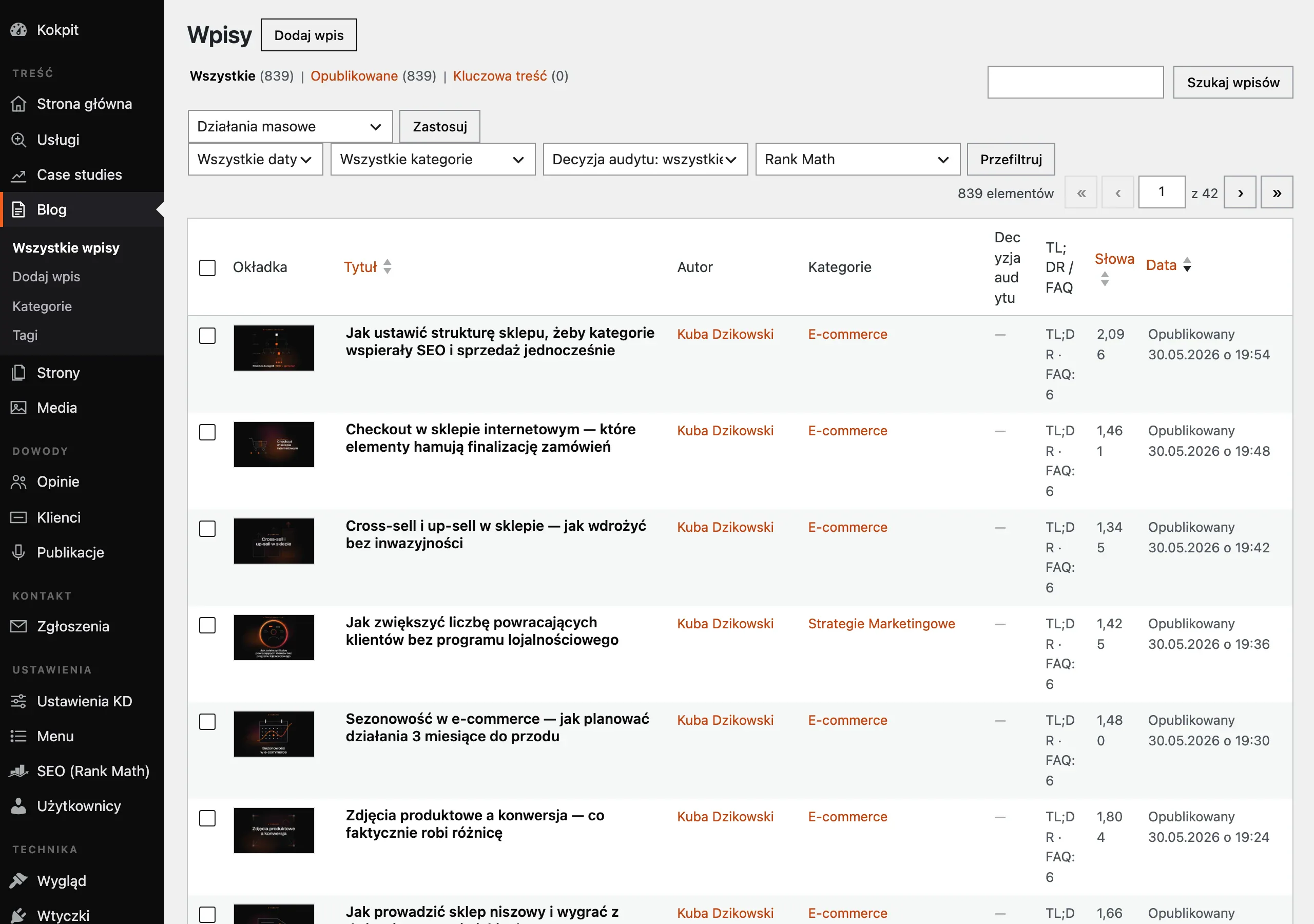
This system works best when the blog is meant to support Google visibility, traffic quality and purchase decisions. The source of data is key. It should not be only keywords, but also sales conversations, support tickets, FAQ, forms, Search Console, analytics and the state of existing content. Keywords alone are usually not enough, because they do not show the user’s full intent or the relationship between the topic and the offer. Instead of chasing a list of phrases, it is better to see what people are actually asking about and what is holding them back on the path to purchase.
In a well-structured process, each prompt produces a tangible working output. And that is not a cliché. It can be a customer questions map, a topic cluster, a shortlist of posts to publish, an SEO+UX brief or a backlog of updates to older articles. This means the content plan does not end with “ideas for posts”, but becomes a set of decisions ready to execute and then measure.
The greatest value of prompts lies in the fact that they help filter out random topics and focus on those that fit the services, the funnel stage and the team’s real capacity. The problem is that in many companies experts’ time is limited, so you cannot publish everything that sounds interesting. First the filter, then production. If a topic does not connect naturally with the offer or does not lead the user to the next step, it usually should not be a high priority. It is simple, yet it saves budget and stress.
What are the stages of turning business goals into a content plan?
The stages of turning business goals into a content plan are a sequence of 10 steps: from organising the offer and customer questions, through grouping topics and assessing their potential, to briefs, a calendar, updates and measuring results. This process starts with the business, not with SEO itself. First, you need to know which services the company wants to support, who it is speaking to and which user problems the blog should solve. Only then can you sensibly structure content that delivers traffic, builds trust and ultimately supports sales.
The first three prompts are the stage of collecting inputs. First, you organise goals, services, unique selling points and constraints, and then you translate audience groups, their level of knowledge, questions and objections into blog topic language. Next, you move into internal sources such as FAQ, emails, chats, sales conversations and service tickets to identify threads with high practical relevance, meaning those that genuinely keep coming up in client work.
Then comes organisation and selection. You group topics by service, problem and search intent so that you can build thematic pillars and sensible internal linking. The next step is to assess each topic in terms of fit with the offer, potential demand, production difficulty, seasonality, freshness and the risk of duplication. And this is exactly where most decisions are made: what to create, what to postpone and what not to publish at all.
Then production begins. Simply put. For each selected topic, you choose a format, for example a guide, checklist, FAQ, comparison or step-by-step instruction, because the format should result from the user’s intent, not from what is currently easy to write. Only afterwards do you prepare the brief: heading structure, questions, entities, examples, UX elements, CTAs and suggestions for internal links. And from the briefs, you put together a real publication calendar aligned with priorities and the team’s capacity.
The last two steps make sure the plan does not go stale after a month. Instead of churning out new texts on an assembly line, you check which existing posts are better to expand, merge or rewrite, because in many companies that delivers a better result than adding yet more articles. Finally, you assign a measurement method to each cluster, for example visibility, clicks, visits to service pages or lead quality, and on that basis you adjust the plan. A good content plan is not a closed list of topics, but a decision loop based on data and regular adjustments.
Why can’t you rely only on AI in content planning?
Because AI does not know the realities of your company. And that is not a cliché. The model does not see lead quality or which questions really keep coming back in sales and customer service, so yes, it can generate topics quickly, but without proper input data you get linguistically correct lists that are weak from a business point of view. In practice, the blog then starts to live its own life and stops supporting the offer. AI speeds up planning, but it does not replace in-house knowledge and manual verification.
The biggest problem is that topic relevance goes off track. The tool does not know on its own which services are the priority, which objections are blocking a customer’s decision and where the company has a real advantage over the competition, so if you do not provide that, you will get generic topics. And generic often means disconnected from the buying process and from the language customers actually use. The question is: why publish something that does not work towards results.
The second risk is a poor assessment of search intent. The keyword alone is not enough, because you still need to recognise whether the user is looking for a definition, a comparison, instructions, or is already one step away from contacting the company. Is this still “research”, or already a purchase decision. A good blog topic must combine three things: a real audience question, SEO value and a natural transition to a service or product.
AI also will not sense operational constraints if it is not given hard context. It does not know whether there is an expert on the team to approve the text, how long approval takes, which content must include data or examples, and whether it is more worthwhile to write a new post or improve an old one. The problem is that in many companies that very decision delivers a bigger effect than producing yet more articles from scratch.
There is also duplication and cannibalisation. The model can suggest several topics that are “obviously” different but in practice answer the same question and start competing with each other for the same keyword. Every prompt result is worth checking against existing content, in Search Console and directly in the search results.
The most sensible approach is simple. Use AI to organise data, group topics, create briefs and plan variants, but base decisions on your own sources, not on “nice-looking” suggestions. The most valuable inputs into planning are usually FAQs, sales conversations, support tickets, traffic analytics and the current structure of the offer. The better the input data, the fewer random topics and the less work there is in making corrections.
What are the key steps in creating an effective publishing calendar?
The key steps are setting business priorities, arranging topics by clusters and intent, matching them to the team’s capacity, and writing down a realistic order of work. The calendar should not be a wish list, but a plan that can actually be delivered. It should show what is being created, why it is being created, who is responsible for it and when the topic is due for production or updating.
The first step is choosing the topics that genuinely deserve publication. Do not put everything that sounds sensible into the plan, because you will quickly get stuck in chaos. First filter the topics by fit with the offer, potential demand, funnel stage, expert availability and the risk of duplicating existing posts.
The second step is setting the dependencies between texts. If you are building a cluster, first prepare the pillar post or the most important piece answering the user’s main question, and only then the supporting articles that deliver details and long tail. The order of publication matters, because it affects internal linking, cluster consistency and faster use of traffic in practice.
- Assign each topic to a service, a customer problem and a specific search intent.
- Assess whether the topic needs a new post, an update to an old article, merging several pieces of content or just sensible internal linking.
- Match the format to the goal: a guide, FAQ, comparison, checklist, step-by-step instruction or pre-sales content.
- Set priorities by business impact, seasonality and the readiness of source materials.
- Schedule deadlines according to the team’s real throughput, not an ideal scenario.
- Add status, task owner, CTA and internal linking plan.
The third step is confronting ambition with resources. Companies like to plan four or six pieces of content a month, and then after two weeks the calendar loses credibility. It is better to plan fewer topics but deliver them properly: with quality, expert review and a CTA that really leads somewhere.
The fourth step is to put not only new topics into the calendar, but also optimisation work. In practice, part of the monthly plan should include expanding older posts, tidying up links and removing duplicated topics. An effective calendar covers both publishing and maintaining content, not just producing new articles.
The final step is to tie the calendar to measurement. For each cluster, it is worth setting straight away what will count as a sign of success: increased visibility, clicks, visits to service pages, journeys between articles, or lead quality. That way, the plan can be adjusted based on data, not on which topics simply sound interesting.
A good publication calendar is useful when it helps make decisions: what to publish now, what to move, what to update and what not to do at all. If it does not support such choices, it is a sign that it is too generic or detached from the team’s day-to-day work.
How to avoid common mistakes in planning blog content?
Mistakes only disappear when each topic goes through three filters: fit with the offer, fit with user intent, and feasibility on the team’s side. If a topic does not support any service, does not answer a real client question, or there is no one to prepare it properly, it should not land in the calendar. Most problems come from publishing topics “because they sound good”, not because they help sales or visibility.
The most common mistake is planning solely on the basis of broad keywords or ideas from AI. In practice, it makes more sense to start with your own data: questions from sales, support tickets, FAQ, Search Console, analytics, and the current offer. The result is simple: the list of topics may be shorter, but it is clearly more relevant.
The second common mistake is mixing several intents in one post. An informational, comparison and sales article all at once usually fails to deliver any of them. Each post should have one main goal and one dominant funnel stage. This makes it easier to choose the format, headings, CTA and internal linking.
Many companies force themselves to plan new pieces before they have even checked the condition of the current blog. Often a better result comes from adding missing angles to an older article, merging two similar posts, or properly rewriting content that no longer matches the current offer. Failing to decide “new post or update” quickly leads to duplicate content and keyword cannibalisation. And then we wonder why SEO is going nowhere.
Another mistake is a lack of operational discipline. Without it, a “content plan” turns into a notebook of wishes. It is worth recording each prompt and each topic in a consistent structure: goal, target audience, data sources, format, priority, task owner and CTA decision. Then the content plan is not a loose list of ideas, but a working system for delivery and evaluation that can be enforced.
If a company operates in a narrow specialism, there is no point artificially inflating the calendar with topics “for everyone”. Instead of A — B: instead of generalities, content closely tied to specific client problems and the offer. It is better to publish less, but more accurately. On a company blog, relevance usually delivers more than volume alone.
How to measure and optimise the performance of published content?
Content performance starts with a simple match: the metric to the article goal and funnel stage. Then come the data and regular plan adjustments, without sentiment. An article intended to build visibility is assessed differently from one meant to send the user to a service page. Traffic alone is not enough if it does not lead to the next step. The question is whether the text is doing its job, or merely “looks nice” in the statistics.
First, assign each cluster and each more important article a main way of being evaluated. In practice, these are most often:
- visibility and number of impressions in search results,
- clicks and CTR from Search Console,
- click-throughs from articles to service or product pages,
- quality of on-page engagement, if it supports intent analysis,
- number and quality of leads, if the content is meant to support sales.
The key is not to measure all posts with the same yardstick. A top-of-funnel article may work brilliantly for reach and entries into the cluster, even if it does not generate enquiries directly. By contrast, a decision-stage post has a different job: it should clearly pass traffic on to contact, the offer or the form. Not “reading for reading’s sake”, but real transfer.
Optimisation starts with diagnosis, that is, answering the question of exactly where something is getting stuck. If an article has plenty of impressions but a low CTR, the title, meta description and alignment with the intent visible in the SERP usually need work. If it has traffic but does not lead to service pages, then the article structure, CTA, internal linking and whether the topic truly connects with the offer come under scrutiny. The data clearly shows what is not delivering.
It is also worth looking beyond a single piece of content. Sometimes one article does not deliver results on its own, but it strongly supports the whole cluster and passes traffic to a stronger article or service page. That is why it makes more sense to evaluate not only individual URLs, but entire topic groups. And only on that map can you see what really works.
An iteration should end with a decision. Expand, rewrite, merge, strengthen internal linking, or simply remove from the plan topics that are duplicating in the background. When results diverge from expectations, there is no point turning the whole strategy upside down. The best process is small, regular adjustments based on data, not one-off revolutions based on intuition.
FAQ
Frequently asked questions
How do prompts for planning content for a company blog work?
It is a sequence of precise instructions that leads from data about the offer and customers to a list of topics, briefs and a publishing schedule. Each prompt closes a different part of the process and gives a working output to review before implementation.
Why isn’t it enough to plan a company blog only on the basis of keywords?
Keywords alone do not show the full user intent or the relationship between the topic and the offer. The article stresses that better data also includes sales conversations, FAQ, support tickets, analytics and Search Console.
What stages does turning business goals into a content plan involve?
The process covers 10 steps: from organising the offer and customer questions, through grouping topics and assessing their potential, to briefs, a calendar, updates and measuring results. The plan starts with the business, not with SEO alone.
Can you rely solely on AI when planning content?
No, because AI does not know the realities of the business, lead quality or the questions that genuinely keep coming back in sales and customer service. Without your own input data, it can generate linguistically correct but business-weak topics.
How do you create an effective publishing calendar for a company blog?
First, you need to set business priorities, arrange topics by clusters and intent, and match them to the team’s capacity. The calendar should also include updates to older posts, internal linking and a plan for measuring results.
What mistakes most often appear in blog content planning?
The most common mistake is planning posts based on broad phrases or AI ideas instead of starting with company data. Another is mixing several intents in one text, failing to decide between a new post and an update, and lacking operational discipline.