

Google ranking factors are not a single secret list, but a set of signals that together help the search engine identify the best answer for a specific query. In practice, it is not just the content itself that matters, but also whether Google can fetch it, interpret it correctly and recognise it as more useful than competitors’ material. The weight of individual signals changes depending on the user’s intent, the type of page, the industry and the level of topic competitiveness. The most important principle is simple: even a technically polished page will not “win” on its own if it answers the user’s need less well. That is why it is worth treating SEO as a combination of indexing, relevance, information quality, trust and ease of use. These are the areas that most often decide whether a page grows, stands still or loses visibility.
What are Google ranking factors in practice?
In practice, Google ranking factors are signals on the basis of which the search engine assesses which page best answers a given query. They do not operate in isolation, but as a set of interconnected elements. For that reason, improving one parameter rarely brings a lasting result if the other areas of the site do not raise the quality of the outcome.
The key groups of these signals include crawlability and indexing, content alignment with intent, information quality, source authority, link profile and site usability. If Google is not able to fetch or index a URL correctly, even strong content often does not get the chance to rank. Technical performance is a condition for entering the game, while the result is usually decided by relevance, completeness of the answer and trust in the source.
The importance of ranking factors changes depending on the type of query. For informational keywords, a comprehensive and clear answer matters; for transactional ones, the offer, security and credibility; for local ones, geographic relevance; and for news topics, freshness too. That is precisely why the same page can perform very well for some queries and worse for others.
In practice, it is misguided to look for one “most important” thing that always improves positions. Google does not assess pages according to a fixed, public points table, but compares documents within a specific search context. The safest approach is to create a site that is technically accessible, substantively useful and trustworthy at the same time.
How ranking assessment works and its stages
Ranking assessment takes place in stages: Google first has to find the page, then understand it, assess its quality, and only then compare it with other results for a specific query. This matters because a problem at an earlier stage can block the effect of actions taken later. In other words, even very good content will not help if the URL is not properly accessible or has been incorrectly canonicalised.
The first stage concerns availability and crawl. Google must find the address, fetch the page code, load the necessary resources and verify that nothing is making reading difficult, for example robots.txt, server errors or JavaScript rendering issues. If the robot does not see the page as it should, the fight for ranking starts being lost before content analysis even begins.
The second stage is indexing and selecting the canonical version. At this level Google checks whether the page adds something unique to the index, whether it is a duplicate and which version of the address should be treated as the main one. Incorrect canonical tags, content duplication, thin pages and chaotic redirects can reduce the potential of even well-prepared materials.
The third stage is query matching. The system assesses the page topic, the alignment of the title, headings and main content with the user’s intent, and whether the material covers key sub-intents. When a user expects a comparison but lands on a general product description, or is looking for instructions but gets a sales landing page, the page usually loses to results better tailored to the need.
The fourth and fifth stages include assessing quality and authority. What matters here is the depth of the answer, the consistency of information, the freshness, the transparency of the author or company, as well as incoming links and the overall credibility of the site in a given subject area. Links still matter, but more often as a signal of quality and context than as a simple link count.
The final stage concerns site usability, result modifiers and quality filters. Google takes into account mobile-friendliness, speed, layout stability, intrusive elements, the user’s location, language, device and the freshness of information, while at the same time limiting the visibility of spammy and artificially optimised content. In practice, the highest positions are most often achieved by sites that move through the whole chain without friction: from indexing to a useful and trustworthy answer.
Current factors affecting Google ranking
The current Google ranking is influenced most strongly by: crawlability and indexing, content alignment with the query intent, information quality, source credibility, the link profile and the ease of using the site. These signals do not operate in isolation, but as a network of dependencies. If a page is excellent in terms of content, but Google cannot read it properly, its potential will remain untapped. First you need to ensure accessibility and indexing, but the advantage is usually built by relevance, usability and trust.
Today, the greatest importance lies in how well the page matches the user’s real intent. For informational queries, a complete and specific answer matters; for transactional ones, the offer, price, terms and trust; and for local ones, geographic relevance as well. That is why one well-written subpage does not have to rank for every related phrase. Google checks whether a given URL answers exactly what the user needs at that particular moment.
Content quality is not determined by the number of characters, but by its usefulness, completeness and coherent narrative. What matters are precise answers, up-to-date data, a well thought-out heading hierarchy and coverage of key supporting topics. Content wins when it shortens the path to solving a problem, not when it only contains keywords. Weak, duplicated or too thin pages can reduce the potential of an entire topic section, especially when the competition is strong.
Service credibility is also important. Google checks whether the author or editorial team is visible, whether the company can be verified, whether contact details are available, along with site policies and signals of accountability for the published materials. In areas that require trust, such as health, finance or law, the absence of these elements can limit visibility even with well-crafted content. Trust is not an add-on to SEO, but part of quality assessment.
Links still matter, but what counts above all is their quality, natural profile and topical relevance. A few relevant links from credible sources usually deliver more than a large number of random low-quality links. A similar role is played by the internal architecture: sensible internal linking between related pages helps Google understand the topic and priorities of the site.
Technical aspects and UX support rankings, but they usually do not replace content or the relevance of the answer. Page speed, layout stability, the mobile version, the absence of intrusive pop-ups and a clear interface matter most when several pages answer the query equally well. Structured data also mainly helps Google better understand the content and obtain rich results, but on its own it does not guarantee a higher position. Technical issues, incorrect canonicals, blocks in robots.txt or poor rendering can, however, wipe out the effects of all content work.
Which decisions are key to improving positions in search results?
Improving positions depends on decisions about which pages should answer specific intents, what requires technical correction and what requires editorial work, and how to build trust and authority in a given area. The most common mistake is trying to do everything in parallel without setting priorities. In practice, the best approach is: first remove blockers, then match pages to queries, and only then scale content and links.
The first key decision concerns architecture and intent mapping. Every important subpage should have one dominant search goal and directly answer a specific type of question or need. When several URLs compete for the same phrase, keyword cannibalisation occurs and Google does not receive a clear signal about which page to display. In such a situation, it is better to merge the materials, separate the intents or strengthen one version as the canonical one.
The second decision comes down to determining whether the barrier is a lack of content or rather the poor quality of what has already been published. On many sites, refining existing subpages brings a bigger improvement than adding more texts on a similar topic. It is worth expanding the answers with concrete variants, limitations, step-by-step instructions, comparisons and elements that the user genuinely expects after landing on the page. Not every gap requires a new URL; often it is better to strengthen a page that already has a chance to rank.
The third decision concerns technical priorities. Not every point from an audit affects visibility to the same extent, which is why the first step should be to remove problems that block indexing, disrupt canonisation, break redirects, cut off important sections in robots.txt or make it difficult to render content and links. Only afterwards does it make sense to work on lower-priority issues, such as minor code improvements or cosmetic metadata tweaks.
- First remove what limits crawling, indexing and the selection of the correct URL.
- Then align each page with one dominant search intent.
- Next, improve the quality of information, layout and completeness of the answer.
- Finally, build authority through links, citability and stronger trust signals.
The fourth decision concerns credibility. In competitive industries, content optimisation alone usually proves insufficient. You need to clearly show who is responsible for the publication, where the data come from, how the company can be contacted and why the site deserves trust. This is particularly important where the user is making a purchase decision or relying on sensitive information.
The fifth decision covers how to develop the link profile. It is safer to build visibility on materials that are suitable for citation and on industry relationships than on mass acquisition of low-quality links. A link has value when it makes editorial and topical sense, not just when it exists. Artificial actions can produce a short-term effect, but they rarely translate into stable positions.
The last important decision concerns performance analysis. Changes should be assessed at the level of queries, page types and intents, rather than only through the lens of total traffic. A drop after an update does not always mean a technical issue; often it signals that the competition is responding more accurately to the intent or presenting itself more credibly. Good optimisation starts with the right diagnosis, because without it, it is easy to fix the wrong problem, the one that is really limiting rankings.
The most common mistakes and limitations in SEO optimisation
The most common SEO mistakes involve polishing secondary signals while ignoring whether the page actually matches search intent and whether Google can index it without any issues. In practice, there are plenty of technically well-optimised sites that stand still because they answer the wrong type of user need. Another equally common problem is publishing many very similar URLs competing for the same keywords. If several subpages target the same intent, Google receives a conflicting signal and none of them uses its full potential.
Another mistake is overvaluing individual elements such as text length, keyword count, Core Web Vitals or structured data. These factors can support visibility, but they will not replace answer quality, trust or the usefulness of the page. Simply implementing schema or reducing load time will not fix a poor offer, incomplete content or a lack of source credibility.
Significant losses are also caused by barriers that block the potential of good content. The most common ones include incorrect canonical URLs, blocks in robots.txt, poor internal linking, duplication, thin content and uncontrolled filter or pagination pages. Even very good material will not be consistently visible if Google sees it as a duplicate, cannot read it properly or considers it low in usefulness.
There is also a separate category of overly aggressive actions: artificial links, anchor over-optimisation, automatically expanded content, mass pages for long-tail keywords with no real value. Such tactics can deliver a short-lived result, but they rarely translate into lasting visibility. When a site loses after an update, the source of the problem is most often quality, trust or misalignment with intent, not one “technical” parameter.
It is also worth knowing the limits of SEO, because not every drop has to mean a fault on the site’s side. Results can change because of algorithm updates, changes in SERP layout, seasonality, growing competition, the user’s location or a greater share of modules such as maps, video and zero-click answers. Position on its own is not a full measure of success, because the same ranking can bring fewer visits today than it did a few months ago.
The second limitation is more strategic in nature: SEO does not give full control over the speed at which results appear. You can improve architecture, content and trust, but Google still needs time to crawl, reassess and compare your site with the competition. That is why it is sensible to roll out changes in stages, measure them at page-type level and avoid drawing conclusions after just a few days.
What data should be monitored in practice?
In practice, it is worth tracking data that answers four questions: whether the site is accessible and properly indexed, which queries it appears for in the results, whether it brings in the right traffic, and whether that traffic delivers the business objective. An increase in the number of keywords alone proves nothing if quality traffic or conversions are not growing. The most useful comparisons combine Google Search Console, Google Analytics and technical tools.
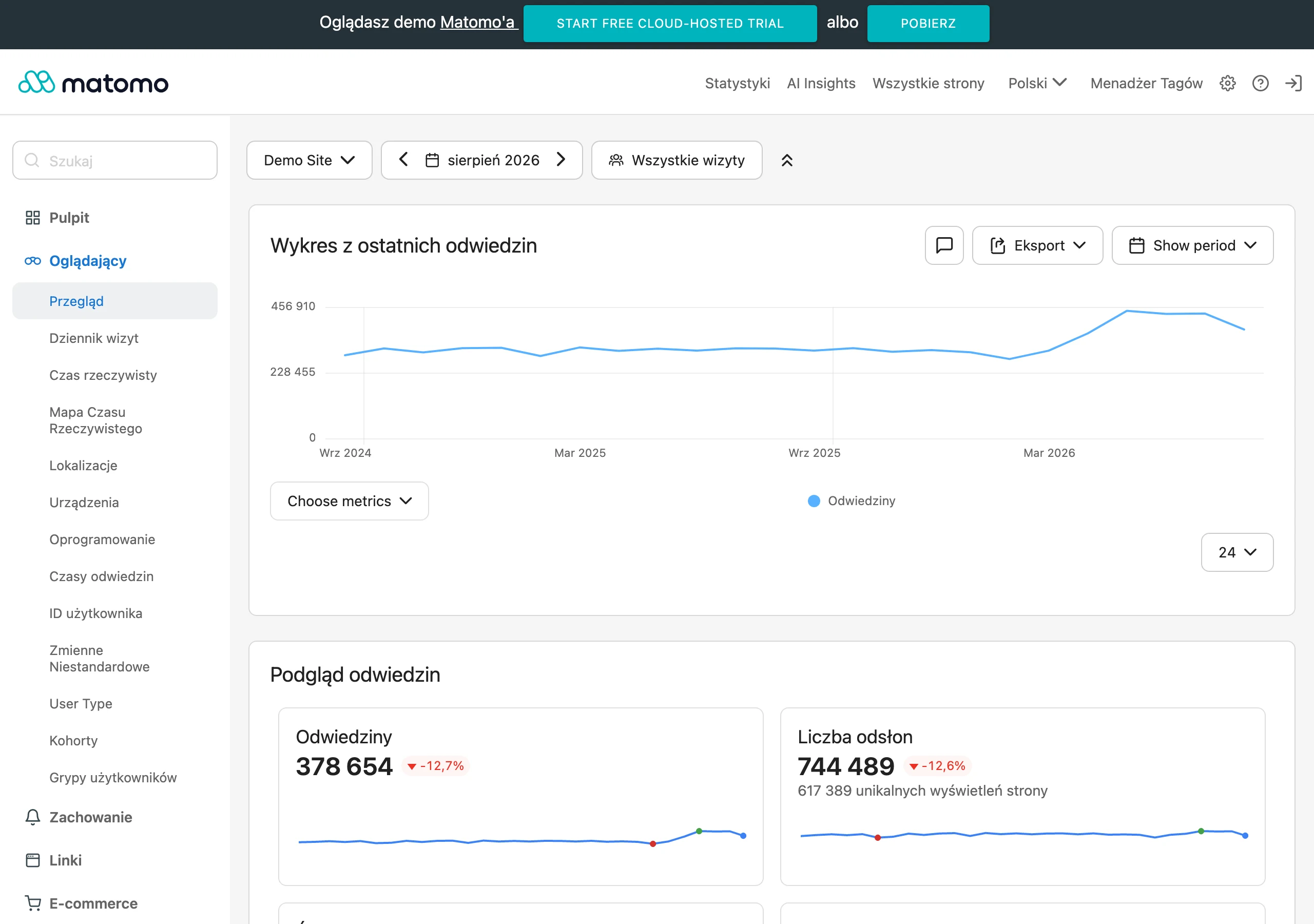
The main data groups to check regularly are:
- indexation status, number of indexed URLs, exclusions, crawl errors and XML sitemap status,
- clicks, impressions, CTR and average position for queries and groups of subpages,
- landing pages with organic traffic, engagement and goal or transaction completion,
- visibility changes by intent type: informational, commercial, local, brand,
- technical parameters affecting usability, especially mobile version, speed and layout stability,
- link profile, new links, lost links and the quality of referring domains.
Search Console is best interpreted not only from the perspective of the whole domain, but above all at the level of specific sections and page types. A drop on a blog is read differently from a drop on category pages, and differently again from a drop on local pages. If you look only at the average for the whole site, it is easy to miss that the real problem concerns one group of URLs or one type of intent.
It is crucial to combine visibility data with user behaviour data and business outcomes. An increase in impressions without an increase in clicks often means weaker CTR, a change in the results layout or an off-target title and meta description. Conversely, an increase in traffic without conversions can be a sign that the site is capturing queries with the wrong intent or is failing to complete the path after the user lands on the page.
In day-to-day work, it is better to look at trends than at single days. Compare period with period, but always taking seasonality, site changes and Google updates into account. The most valuable insights come from data at query, page type and user goal level, because only then can you see whether the problem concerns indexation, content, trust or on-page experience.
For larger sites, it is also worth monitoring server logs or at least crawl statistics. This makes it possible to check whether Google visits the key URLs and whether it is wasting crawl budget on technical pages, parameters or duplicates. This is particularly important after migrations, filter changes, JavaScript implementations and information architecture redesigns.
In the end, it is not the number of charts that matters, but whether the monitoring genuinely helps. The report should quickly answer three questions: what has dropped or grown, where did it happen and what change may have caused it. If the report does not show this, it is too broad or too generic to support real SEO decisions.
FAQ
Frequently asked questions
How does Google assess which page best answers a user’s query?
First it has to find and index the page, then understand it, assess its quality and compare it with other results. In the end, it also takes into account usability, location, language, device and how fresh the information is.
Is good content alone enough for a page to rank highly in Google?
No, because even strong content will not help if Google cannot crawl or index it properly. Relevance of the answer, trust in the source and the ease of using the site also matter.
Why does user intent matter so much in SEO?
Because Google matches results to a specific need: different signals matter for informational queries, and others for transactional or local ones. A page can therefore rank well for one keyword and worse for another.
What affects a page’s ranking in Google most, according to the article?
The strongest factors are: crawlability and indexing, matching content to intent, information quality, source trustworthiness, link profile and site usability. These signals work together, not separately.
Which technical errors can block the visibility of good content?
Problems can include incorrect canonicals, robots.txt blocks, server errors, poor JavaScript rendering, duplicate content and messy redirects. Such an error can limit ranking even before the content quality is assessed.
Do links still matter in Google SEO?
Yes, but their quality, natural profile and topical relevance matter more than the sheer number of backlinks. A few relevant links from trustworthy sources usually deliver more than lots of random low-quality links.