

Schema Markup is a convenient way to tell the search engine exactly what is on the page, whether that is a product, an article, a company, a location, an FAQ or navigation elements. This means the crawler does not have to guess how to interpret the content and the relationships between the data. Properly implemented structured data can help a page qualify for rich results and support the understanding of the entire site. Adding schema alone does not automatically deliver rich results, but the absence of correct data very often closes the door to them. In practice, the key is not the “inserting of a tag” itself, but matching it to the actual content of the page and maintaining consistency after changes. This is exactly where the devil is most often in the detail, and mistakes can later weaken the effects of the implementation.
What is Schema Markup and why is it important for visibility in search?
Schema Markup is a standardised description of page content that helps the search engine understand which entities and information are on a page. It is most often implemented in JSON-LD format, that is, as a block of data embedded in the page code. Such a description can refer to a company, product, article, breadcrumbs, a location or a questions and answers section.

The impact on visibility comes from the fact that structured data makes content easier to interpret and can qualify a page for rich results. This most often applies to products, articles, FAQ and the navigation path. It is worth remembering, however, that not every type of schema translates into a visible highlight in the results, because some tags mainly serve as additional context for the search engine.
Schema must match what the user actually sees on the page. If the tags contain hidden, exaggerated or outdated data, the search engine may ignore them. The same can happen when the content on the page communicates one thing, while the schema describes something different.
The safest approach is to base the implementation on the types supported by search engine documentation and validation tools. That is why, before implementation, it is worth checking not only which schema type theoretically fits, but also whether it has a business justification and can be maintained in an up-to-date state. Most often, the best technical choice is JSON-LD, because it is easier to maintain and less likely to conflict with HTML code than microdata.
Ultimately, the value of Schema Markup depends on the quality of the source content, the consistency of business data and how the site works. On a simple company website, the scope of implementation will usually be smaller than in e-commerce or a site with many content types. The more templates, dynamic data and language versions there are, the greater the importance of good mapping and change control.
What are the most important steps in implementing structured data?
The key stages of implementing structured data include analysing page types, selecting the right schemas, mapping data, implementation, validation and later monitoring. It is a technical task, but its effectiveness is determined above all by whether the schema actually reflects the content visible on the page. If you skip analysis of templates or data sources, problems return with every major site rebuild.
- At the beginning, it is worth inventorying the page types and templates, that is, identifying where products, articles, locations, contact, FAQ, breadcrumbs and organisation data appear.
- Next, it is a good idea to verify whether structured data is already operating on the site via the CMS, SEO plugins or earlier implementations, because duplicates and conflicting definitions are among the most common issues.
- The next step is to select the right schema types, for example Organization, LocalBusiness, WebSite, Article, Product or BreadcrumbList, but only where the content genuinely justifies it.
- Then comes field mapping, that is, assigning specific page elements to the appropriate schema properties: name, description, price, availability, author, address, opening hours, image and identifiers.
- Only on that basis is the implementation code prepared, usually in JSON-LD, and the emission conditions for individual templates and exception handling are defined.
- At the end, validation, production rollout and ongoing monitoring in testing tools and Google Search Console remain.
The most difficulty usually arises at the stage of field mapping and defining data sources. If the product price comes from somewhere other than availability, and the location address from somewhere other than contact details, it is easy for there to be a mismatch between what the user sees on the page and what the schema declares. It is worth establishing a single source of truth for key business data such as the company name, address, phone number, price or opening hours.
You also need to decide where the schema is to be generated: in the template, on the backend, via a CMS module or through a tag manager. The most stable solution is often the one that pulls data directly from the system and refreshes it automatically. With dynamic and client-side rendered content, it is essential to check whether the search engine crawler receives the final code with structured data.
Validation should not end with a single test of one subpage. A good implementation covers representative examples from each template, including edge cases such as no price, no image, empty FAQ or a location with no opening hours. It is precisely in such situations that errors in logic conditions are revealed, which are not visible on a single “ideal” test page.
After publication, it is worth keeping a close eye on the error, warning and coverage reports in Google Search Console, as well as checking what changes after site updates. A CMS migration, a new template version, URL structure changes or translations can remove schema or break its consistency, even though nothing looks suspicious on the front end. Schema Markup is not a one-off task — it requires monitoring and updates after every significant change on the site.
Which schema types are used most often and when should they be applied?
The most common schema implementations are for organisation, location, navigation, articles, products, FAQ and the website itself, but each type only makes sense when it reflects the actual content of a specific subpage. The most common mistake is choosing a mark-up based on the expected result in Google, rather than the page’s actual content. In practice, you start by reviewing the template types on the site and only then assign the relevant schema classes to them.
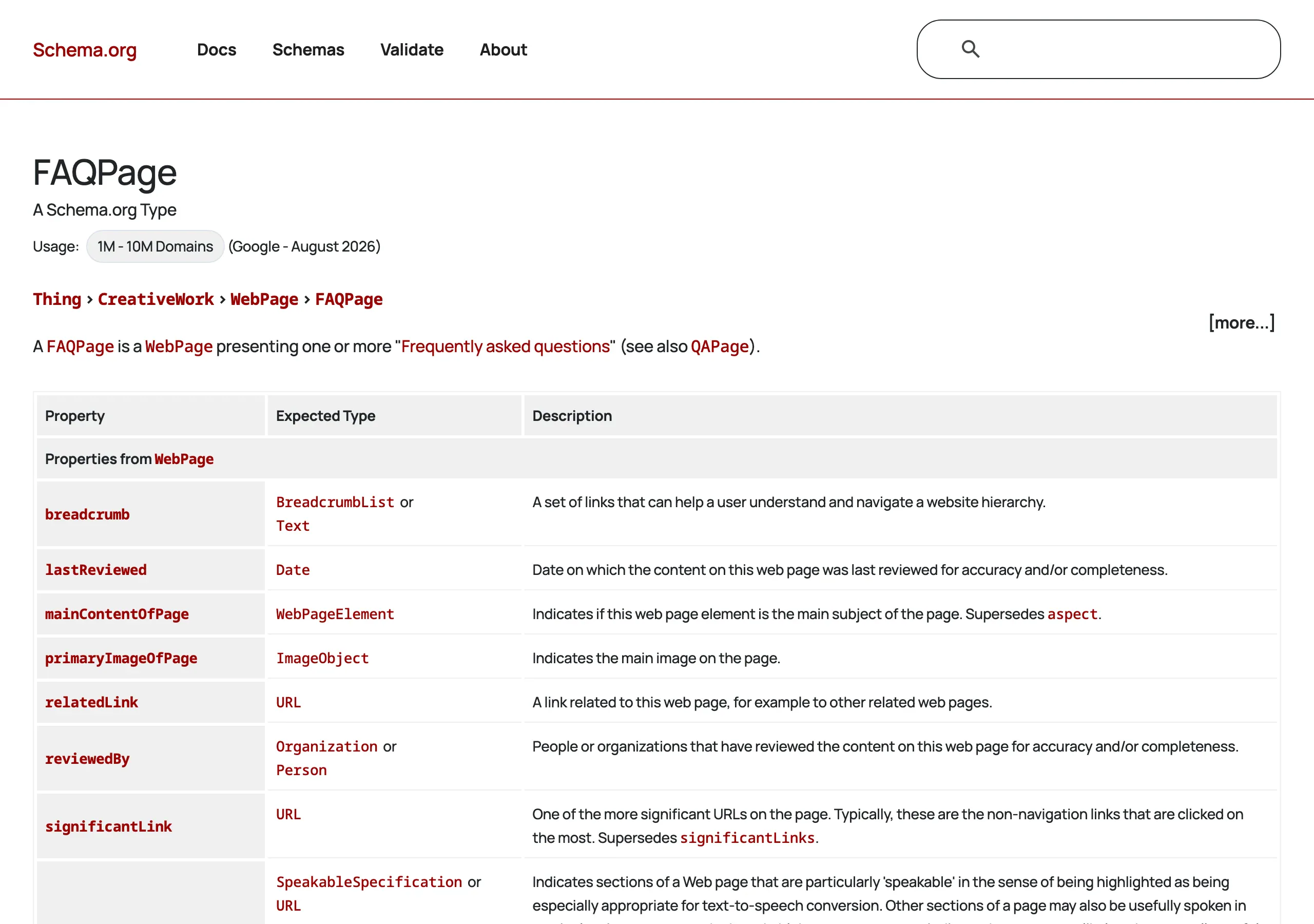
On company websites, the core types are usually Organization, WebSite and BreadcrumbList. Organization describes the company as an entity, WebSite organises information about the website itself, and BreadcrumbList helps search engines understand the site structure and navigation paths. This does not always translate into a visible enhancement in the results, but it often helps the search engine interpret the whole site better.
For local businesses, LocalBusiness is used primarily, or more specific subtype types, provided they genuinely match the business profile. Such mark-up makes sense when local details are clearly shown on the page: address, phone number, opening hours, branch name and the URL of the given location. NAP data must be consistent with the content of the page, because discrepancies between schema and what the user sees often cause the implementation to be ignored.
In content sites, Article is used most often, and sometimes its better-matched variants, if the publication structure justifies it. This type is worth implementing where the page has a clear title, author, publication date, update date, image and editorial content. If the subpage is a standard offer or a landing page, marking it up as an article usually makes no sense.
In e-commerce, Product is key, together with offer data such as price, currency and availability, provided that this information is visible on the product page. Such schema should be fed automatically from the same data the user sees, rather than added manually in the code. If the price or availability changes in the store, the schema must change with them.
FAQPage is used only where the questions and answers are actually presented to the user on the page. It is not worth adding it to every subpage just to increase the chance of a rich result. Likewise, ContactPage or location mark-ups only make sense on pages that genuinely serve that role and contain the corresponding data.
What are the best practices for implementing schema on a site?
Best practices for implementing schema include full consistency with the content visible on the page, matching types to templates, stable implementation and regular checks after site changes. The safest approach is to implement structured data in JSON-LD format, because it is easier to maintain and interferes less with the HTML code. It is worth remembering, however, that the format alone will not solve problems if the source data is inconsistent or out of date.
In practice, it is best to start with the subpages of greatest business importance and high template repeatability. This approach makes it easier to check whether field mapping works correctly and whether the implementation can be safely extended to further sections of the site. There is no point starting with single, bespoke pages if the main traffic and sales are generated by products, articles or locations.
The key is to define a single source of truth for data such as company name, address, phone number, opening hours, price or availability. When these values come from different plugins, modules or manual edits, duplicates and conflicting definitions of the same entity quickly appear. This is a common problem in CMSs where several SEO tools generate schema in parallel.
Testing should cover not just one subpage, but representative examples of each template and its variants. Problems often only appear on pages without an image, without a price, with a different heading structure or with dynamically loaded content. If schema is rendered client-side, you need to make sure that the final code is also visible to the search engine robot.
When analysing reports, it is worth separating critical errors from warnings. First, remove issues that block parsing, missing required properties and inconsistencies with the page content, and only then fill in optional fields. Not every warning translates into a real problem, whereas every technical error can limit the use of structured data.
After publication, the implementation should be monitored in Search Console and after every major change on the site. A CMS migration, template rebuild, URL changes, translations and new modules very often break previously correct schema or cause the data to stop matching the content. A good implementation is not a one-off addition of code, but an ongoing process of maintaining consistency after changes.
Finally, it is worth preparing simple documentation: which schema types work on which templates, where they pull data from, and when they should not be displayed. Such documentation saves time when developing the site and makes it easier to quickly pinpoint a problem after an update. Without it, even a correct implementation can easily go off track with the next site change.
What mistakes should be avoided when implementing structured data?
The most common missteps when implementing structured data are a lack of consistency with the page content, choosing the wrong schema type, and not controlling what ultimately ends up in the rendered code. In practice, the search engine compares structured data with what the user can see. If the schema describes an element that is not on the page, or that cannot be reliably verified, the markup may be ignored.
A common problem is implementing schema “for the effect” in search results, rather than for the actual content of the subpage. This is especially true for sites that add product, FAQ or review markup solely because they “might produce a better result”. First match the schema to the content, and only then verify whether a given type has a real chance of qualifying the page for rich results.
Another major mistake is duplication or conflicting markup. This is often seen in CMSs where a SEO plugin, a separate schema module and manually added JSON-LD are all active at the same time. As a result, the same entity receives several inconsistent definitions, different URLs, different names or inconsistent contact details. One entity should have one consistent data source, not several independent variants.
- Adding properties that are not on the page or that the company does not keep up to date.
- Using unsupported or inappropriate schema types just because they “look good” in the testing tool.
- Failing to update the price, availability, opening hours, author, publication date or address after changes on the site.
- An implementation that works only on part of the templates, even though the test was carried out on one correct subpage.
- Schema generated on the client side, which the crawler does not read correctly in the final HTML.
In e-commerce, manually entering product data directly in the code is particularly risky. When the price or availability changes in the shop system and the schema remains unchanged, a mismatch appears between the content and the markup. Dynamic data, such as price, currency and stock level, should come from the same source as the content visible on the page.
In local and business sites, inconsistent NAP data — name, address and phone number — is a common mistake. The problem appears after a change of premises, telephone number or opening hours, as well as with multiple locations, when the template inherits headquarters data on all subpages. This is not merely a technical detail, because the schema then stops correctly describing the specific business entity.
Validation should also not be treated as a one-off check. A tool can confirm correct syntax, but it will not catch every business, logical or template-related error. Valid JSON-LD does not yet mean a correct implementation if it describes the wrong entity or does not match what is actually on the page.
How should the effectiveness of structured data be monitored and maintained after implementation?
The effectiveness of structured data after implementation should be monitored through cyclical analysis of reports, tests of selected representative URLs, and checking whether the schema still reflects the site’s current content. Simply publishing the markup does not close the matter. Most problems appear later, after changes in the CMS, template rebuilds, migrations or content updates.
The foundation is constant monitoring of reports in Google Search Console and rich results tests for key types of subpages. It is worth tracking not only errors, but also sudden drops in the number of valid items, the disappearance of entire schema classes or an increase in warnings after development deployments. The most dangerous issues are not individual errors, but silent losses of coverage after a template or module change.
It is a good idea to check several sample URLs from each important template, rather than limiting yourself to model pages. Even if the homepage looks correct, it tells you very little about product cards, blog posts, locations or pagination pages. In practice, problems emerge on subpages with unusual conditions, missing images, an empty author field or in another language version.
Maintaining effectiveness also means controlling data sources. When a company changes its name, phone number, address, opening hours, URL structure or content publication model, the schema must be updated in parallel with the content. The best approach is one where structured data is fed from the same fields as the page view, because then the risk of discrepancies is much lower.
- After every major change in the site, check whether schema is still in the code and whether it has not been duplicated.
- Test mobile and desktop versions if the site uses different templates or contains conditionally rendered elements.
- Distinguish critical errors from warnings and, first and foremost, fix issues blocking parsing or missing required fields.
- Keep simple documentation: page type, schema used, field mapping and emission conditions.
- For multilingual sites and multiple locations, check each variant separately, because errors often affect only part of the site.
If you want to assess the business impact, focus primarily on changes in the visibility of rich results, CTR for relevant page groups and the stability of deployment coverage. Not every schema provides a separate highlight in the results, so the absence of a new visual element does not always mean there is no benefit. Some markup helps search engines understand content, navigation and entities better without a spectacular change in the appearance of the result.
Good schema maintenance is an operational process, not a one-off project. When the deployment is documented, linked to templates and checked after every change, structured data usually remains stable and useful as the site develops.
FAQ
Frequently asked questions
How do you implement Schema Markup on a website step by step?
First, it is worth analysing the page types and choosing the right schema for them, then mapping the data, implementing the code and validating it. Finally, monitoring in Google Search Console and after changes to the site is needed.
Does Schema Markup automatically give rich results in Google?
No, simply adding schema does not guarantee rich results. However, a lack of correct data can block the path to them.
Why must schema match the visible content on the page?
The search engine compares structured data with what the user sees. If schema describes something hidden, exaggerated or outdated, it may be ignored.
When is it worth using JSON-LD instead of microdata?
JSON-LD is most often recommended because it is easier to maintain and less likely to conflict with HTML code. It is usually the most stable technical choice for schema implementation.
Which schema types are most commonly used on a company website and in an online store?
On company websites, Organization, WebSite and BreadcrumbList are often used, and LocalBusiness in local business. In e-commerce, Product is key, and in content sites Article and FAQPage.
Which mistakes most often break structured data implementation?
The most common problems are inconsistent data, the wrong schema type, duplicate tags and a lack of updates after changes to the site. Another issue can be schema generated on the client side, which the crawler does not read correctly.