

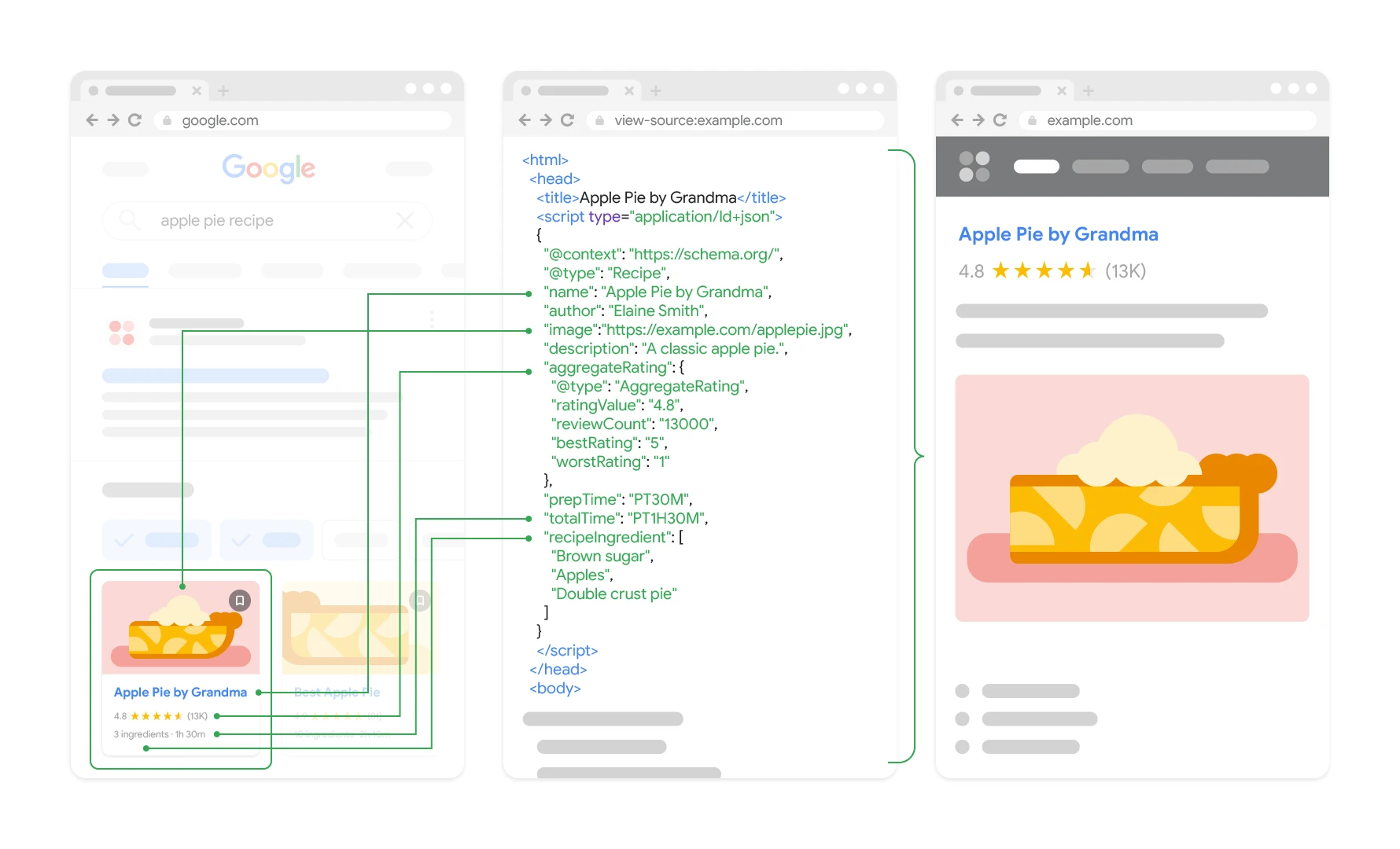
Change your approach to SEO and think about more than just the first page of Google search results. The goal should not be to appear on the first page, but to dominate it. The best way to stand out on the results page (SERP) is to secure featured snippets using structured data.
What are structured data?
The Schema.org website contains a standardised list of markup that is supported by the major search engines, such as:
- Google,
- Bing,
- Yandex,
- Yahoo.
One example of structured data is a relational database, such as a table. In this case, structured query language (SQL) is used to interact with related data in the table. It is worth remembering that Schema has many more uses, which are incredibly useful for your clients.
Before moving on to Schema.org, it is necessary to maintain a high-level definition of structured data to discover the level of its properties. Essentially, these are simply organised information. But what is the difference between structured data and unstructured data?
- 01Organised informationA defined data structure, different from unstructured data.
- 02Schema.org and markupA standardised list of markup supported by search engines.
- 03Relationships and applicationsRelational databases (e.g. SQL), many useful applications.
The key is to understand that structured data are simply organised information that helps search engines and users.
Structured data and unstructured data
If structured data are organised information, then unstructured data are everything else. They may therefore include items such as, for example:
- PDF files,
- video content,
- illustrations,
- files,
- presentations, etc.
There are certain forms of markup that you can use to help search engines gather information about these different assets. In themselves, however, they are unstructured data.
Google structured data in SEO
If you use a high-level definition, there are as many types of structured data as there are systems for organising and quickly identifying information. In the context of your SEO strategy, structured data refers to one thing: Schema.org markup.
It is worth mentioning that, technically speaking, Schema.org is not the only set of markup optimised for SEO. Some websites use Microformats.org markup for product reviews or physical locations. However, Schema.org is the most popular solution.
- 01JSON-LDRecommended by Google, easy to implement
- 02MicrodataIntegrated with HTML, requires precision
- 03RDFaAn older format, more complex
Choose JSON-LD for the easiest implementation and compliance with Google guidelines; other formats are older and more demanding.
Schema.org
Schema.org is a consistent and universal language used across all search engines. There are over 800 different definitions (or “classes”) within Schema.org. Each of them has 20 or more properties that define it. Between spring and the end of 201, four new rich results options, five Google Search Console Enhancement reports and seven vocabulary releases were added to Schema.org. However, it is the language or code that dictates how a website functions (not the search engine).
Structured data tells the search engine how they should show the page (or rather, it suggests it to them). That brings us to search engine behaviour. There is no single rule stating that all search engines must behave in exactly the same way. Webmasters agree on common code snippets, so they do not have to add, for example, 500 different snippets to every page within the site.
Supported formats
Schema.org supports many markup formats, but the most popular are JSON-LD, Microdata and RDFa. Below you can find basic information about these three leading formats of structured data in SEO.
JSON-LD
JSON-LD uses a JavaScript object to place markup in the head of your page. We recommend using this small, simple format because it can be added to a page without affecting any of its elements. It is also the format preferred by Google.
Microdata
This used to be the recommended SEO format, but JSON-LD has developed significantly since then. Using this format, structured data is integrated with the page’s main HTML. That is why there is a very small chance of breaking the page without proper implementation. If you are comfortable with code, nothing will probably be broken, but you can also use JSON-LD without harming the page.
RDFa
RDFa uses the HTML5 format to publish linked data in HMTL5 documents. This option also works well, but it is not preferred by Google.
What are structured data used for?
Thanks to the open Schema.org community, there are hundreds of types of markup. There is a strong likelihood that whatever specific markup you use falls into one of the categories below.
Rich snippets
Do you want your page to display location data, reviews or images? There are various rich snippets and styling enhancements that change the way a page is presented in the SERP. If you have ever confused “schema markup” with “rich snippets” in casual conversation, that is because rich snippets are a frequently used type of markup.
It should be noted that a featured snippet is not the same as a rich snippet. We talk about a featured snippet when Google considers your information helpful and therefore presents it at the top of the results page.
There is no structured data for featured snippets. Google itself determines the most useful content to display. Until recently, this was used as an addition to an existing position among the top ten organic search results. On 22 January 2020, Google announced that pages included in featured snippets would not appear again among the top ten search results on the first page. However, this change does not affect the structured data strategy.
Rich cards
Rich cards are a variation of rich snippets, created specifically for mobile search results pages. Of course, rich snippets still appear on mobile SERPs, but rich cards are placed there first. We recommend adding both types to provide users with the best possible experience on mobile devices.
Knowledge graph
Search Google for a person, place or company and you will probably come across a graph or knowledge panel. This is a useful collection of information gathered from sources considered trustworthy. However, you will not have control over whether Google creates a knowledge panel for your brand first. If one is created, though, it is possible to control the information provided by linking it to information on your own site using structured data.
Breadcrumbs
Some types of markup help a page appear on the SERP together with navigational links to other priority pages within the site. “Breadcrumbs” almost always appear only for brand-related searches. If the query is more specific, Google will instead send the user to the most relevant page on the site.
Interactive search results
Search on Google for a recipe, a job advert or an event, and you may find something often called a rich result. These interactive search results allow further filtering of search criteria (for example, filtering products in an online store). How does Google create an advanced filtering feature that covers thousands of different websites? It does so by allowing users to search for different properties that are specified in partially structured data elements designed for this purpose.
If you want your recipe, job advert or event to appear at the top, it is necessary to add the appropriate markup. Make sure it is as complete as possible.
AMP (accelerated mobile pages)
AMP stands for Accelerated Mobile Page. This is a lightning-fast version of your site that can replace the original page in mobile results. Such pages may appear in special AMP carousels. These are desirable placements for publishers and bloggers. First of all, however, you need to add structured data markup for the AMP page and its canonical page.
Social cards
If you create a link to a website on Twitter, Facebook, Pinterest and other social media platforms, the platform will generate a default image, title and description of the page. Such descriptions and images are not always ideal. You can control the elements displayed on social media using social cards. This is a form of structured data that communicates with social media platforms.
Common misconceptions
There are many advantages to using structured data, but it is not a cure-all. It is worth paying attention to certain common misconceptions.
First and foremost, structured data is not a direct ranking signal. However, it can improve a page’s click-through rate (CTR) in Google search results, and that can indirectly improve the page’s position in the SERP. Another misconception is that structured data changes the way a page is displayed in the SERP. In reality, only Google decides what a given result will look like, and it can change every day with each new update. So you should treat structured data as a suggestion, not a guarantee.
It is easy to see that it is not worth using every possible type of structured data. In reality, Google has strict structured data guidelines and penalises pages containing markup errors. You should focus only on the types of elements that are useful for customers.
Industries affected by structured data
If you care about SEO, then pay attention to structured data. Even so, there are specific industries and businesses where certain types of structured data have a greater impact. It is worth looking at a few examples:
- publishers: they must make sure their AMP pages work properly, and then use the Article type to mark up the pages correctly. Subtypes of articles include NewsArticle and BlogPosting,
When using AMP, implementing structured data is a little more complicated. It is necessary to include structured data markup in the AMP version and add Article markup in the canonical version.
- local business: this includes businesses with physical locations. To achieve the desired results, you need to optimise the local business profile, but structured data can provide additional local information in the SERP. The “LocalBusiness” markup lets you specify your opening hours and accepted payment methods. If you take orders or reservations on your site, the desired markup will be “OrderAction” or “ReservationAction”,
- structured data for online stores: you should include Product markup on product pages to display price information in the SERP. The Review markup allows product reviews to be displayed in the SERP. The markup pulls product reviews from your site, not from external websites. This gives you greater control over what is displayed.
In addition, structured data markup is becoming more and more specific, depending on the industry. Financial institutions can add “FinancialServices” markup to their locations. Airlines can display flight times and ticket information using “Airlines” markup. There are also markup types for creators of creative works, such as books, music and even podcasts.
The best possible thing to do is to review the full list of item types and consider which will be useful in a given industry. Again, the structured data used in your industry and by competitors in the SERP should be the top priority.
Tools related to structured data
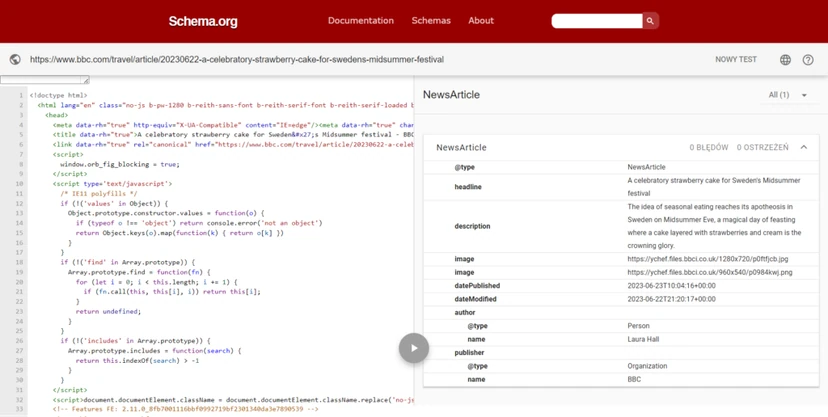
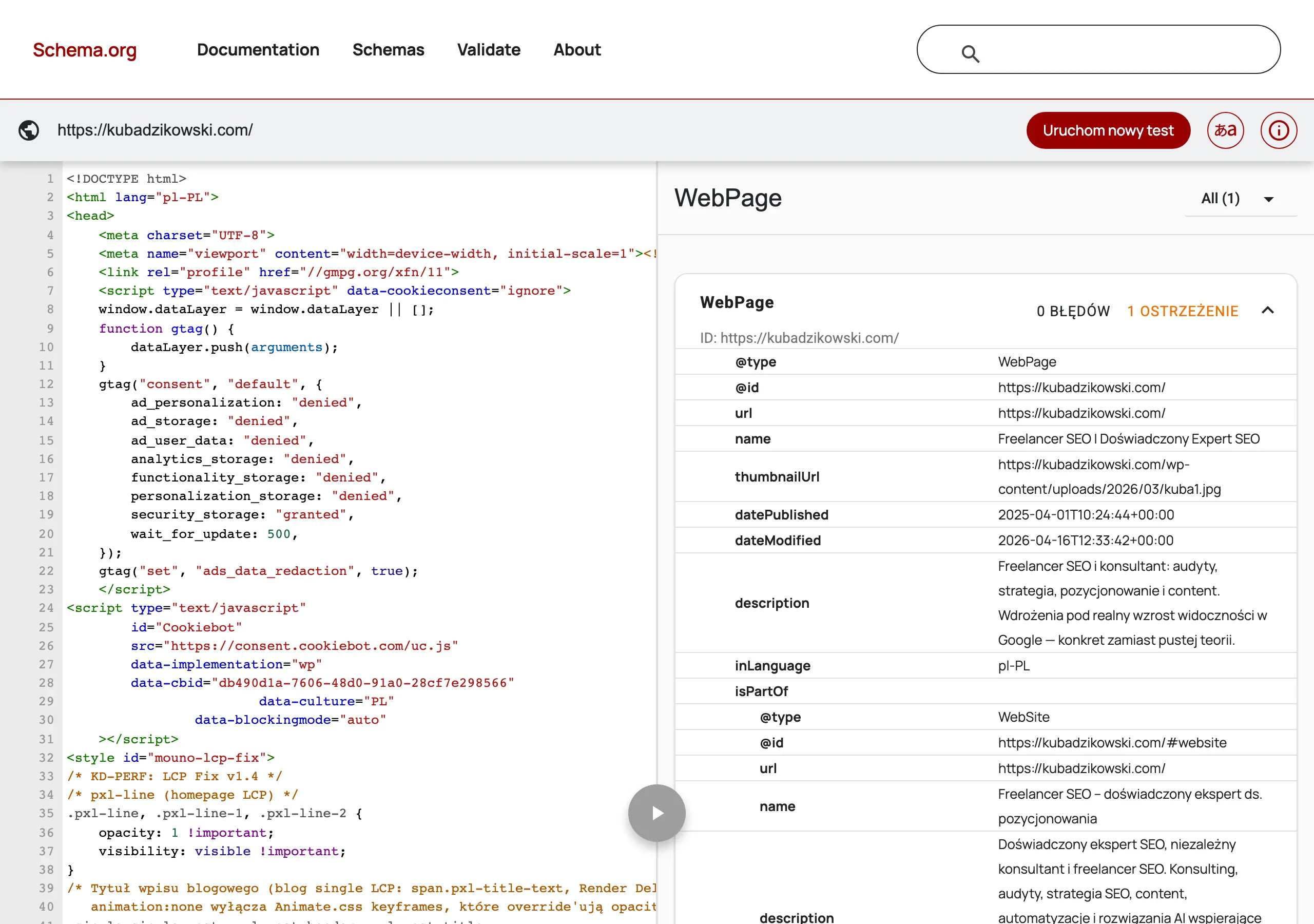
There are many tools available that can help with implementing structured data. Some of the best come from the search engines themselves, e.g.: Schema Markup Testing Tool.
Other tools can also be helpful in tasks related to structured data. These include, among others, the following solutions:
- Yoast WordPress plugin: automatically generates specific types of structured data for you, such as FAQ or how-to content,
- keyword research tools: most include SERP analysis, which reveals the types of structured data you should optimise for,
- SEO crawlers: DeepCrawl and Screaming Frog reveal the structured data recommended for your site and for competitors.
FAQ
Frequently asked questions
what are structured data in SEO and what are they used for?
They are organised information describing a page in a way that is understandable to search engines. They can help with displaying rich results and presenting content better in the SERP.
is Schema.org the same as structured data?
In the SEO context, structured data mainly refers to Schema.org markup. It is the most popular solution, though not the only one.
what structured data formats are used most often?
The most popular formats are JSON-LD, Microdata and RDFa. The article notes that JSON-LD is preferred by Google.
are structured data a direct ranking factor?
They are not a direct ranking signal. However, they can improve CTR, which may indirectly affect a page’s position.
what can be marked up with structured data on a page?
The article mentions, among other things, rich descriptions, the knowledge graph, breadcrumbs, interactive results, AMP and social cards. There are also markups for products, reviews, articles, local businesses and events.
how can you check and implement structured data on a page?
Useful tools include search engines’ tools, the Yoast plugin, keyword analysis tools and SEO crawlers such as DeepCrawl and Screaming Frog. They can reveal the structured data suggested for a page and its competitors.