Key performance indicators (KPI – Key performance indicators) are measurable indicators that measure how companies achieve a specific goal. There are KPIs for every department in a company, regardless of whether we are dealing with marketing, sales or any other department.
KPI in marketing measure how effective your marketing activities are.
Defining and tracking KPIs in marketing is important because it enables the following:
measuring progress: identifying which marketing initiatives meet or exceed expectations,
budget optimisation: directing spend towards channels that maximise return on investment (ROI),
decision-making focus: gathering data-driven insights that can influence strategic decision-making,
identifying weaknesses: determining campaigns that are underperforming or resources that can be improved.
Examples of KPIs worth looking at
There are many noteworthy KPIs in marketing and beyond. Many typical examples of KPIs in marketing include leads, conversion rates and return on investment (ROI). Such KPIs can be monitored at the level of individual channels or campaigns, as well as across the whole company.
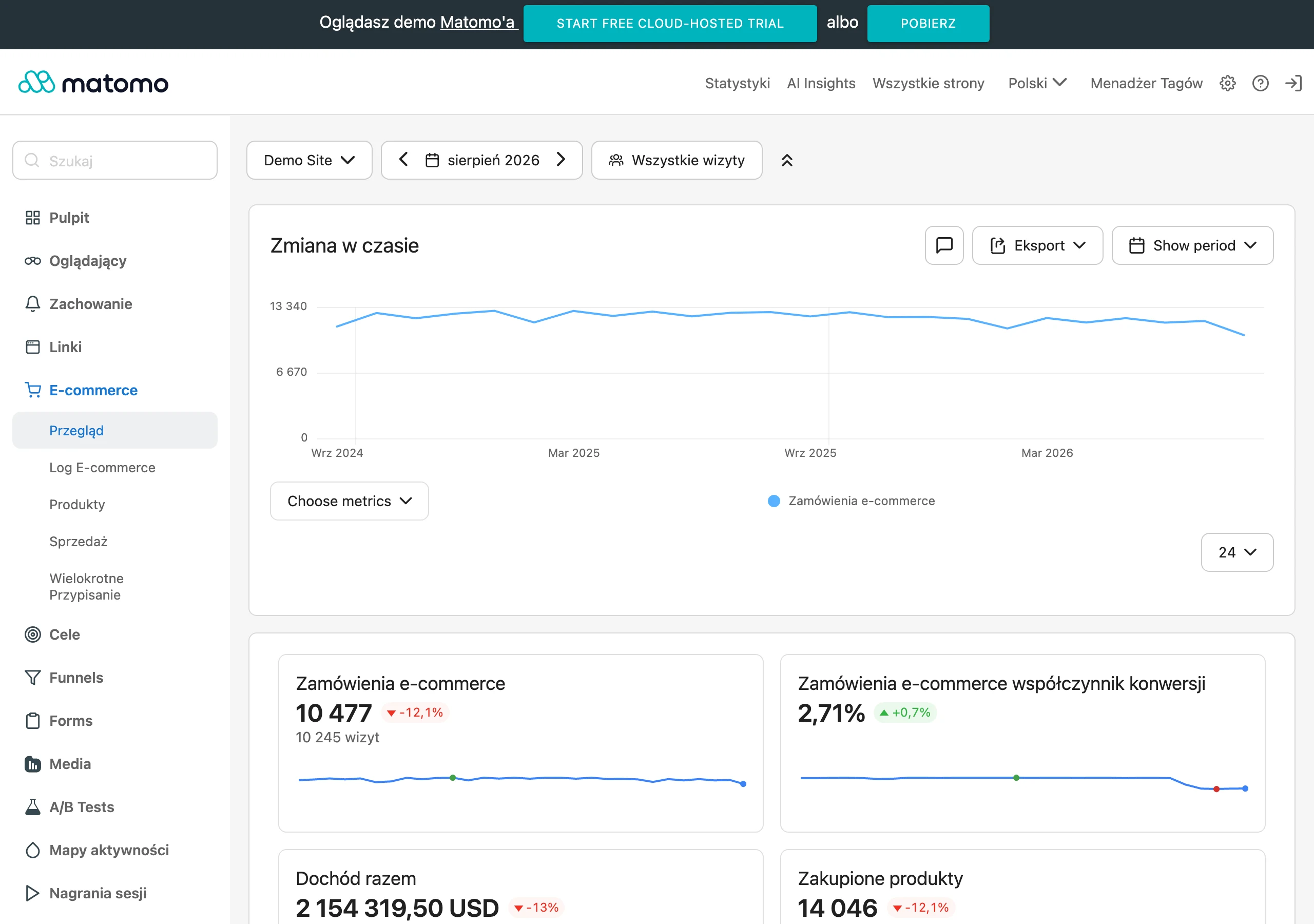
ExampleRevenue, number of orders, average order value and conversion in one view — four numbers that are the starting point for assessing sales. Matomo public demo (sample data), own screenshot
There are also channel-specific KPIs, such as organic SEO sessions or social media engagement rates. Let’s look at the most important marketing KPIs, as well as KPIs in SEO, paid advertising, email marketing and social media channels.
Blog • marketingExamples of KPIs worth looking at
01Typical marketing KPIsLeads, conversion, ROI.
02KPIs for channelsSEO, ads, social media, email.
03Definition of leadsA person or business interested in the offer.
04Scope of controlMonitoring campaigns, channels, company.
Key performance indicators (KPIs) help monitor success at different levels of an organisation.
1. Leads
Leads should be understood as a person or organisation who may become your customer, as well as someone who has expressed interest in your offer. An example might be a person who has filled in a contact form on your website or opted for a free trial period. They are a potential customer.
There are two broad categories of leads:
marketing qualified leads (Marketing Qualified Leads – MQLs) – a potential customer engaged with your marketing initiatives. An example might be downloading an e-book or clicking a Facebook ad,
sales qualified leads (Sales Qualified Leads – SQLs) – a potential customer who has shown purchase intent (for example by ordering a sample or a demo) and is ready to speak with the sales team.
Tracking the quantity and quality of leads helps determine potential future profit. A larger number of leads means a greater number of paying customers. Also monitor which channels and campaigns are generating leads. Then invest additional resources in the marketing initiatives that are particularly effective.
2. Cost per lead (Cost Per Lead)
Cost per lead (CPL) is the amount you need to invest to acquire a new lead through marketing activities. You can track CPL across different channels and campaigns. In this way, you can assess which activities generate the most leads at the lowest cost.
You calculate CPL by dividing marketing spend (overall or within specific channels and campaigns) by the number of leads generated. Analysing CPL can provide important insights. For example, a rising CPL may indicate a decline in the effectiveness of your campaigns or marketing strategies.
You can also compare your CPL performance against industry benchmarks. If your performance is lower than the industry average, you can then analyse your marketing to find out what needs improving. It may be that your ads or landing pages need refreshing, or perhaps product features need to be expanded.
3. Conversion rate
Conversion rate is the percentage of users who took the desired action after interacting with your ads, marketing campaigns and other assets. A desired action can be understood as signing up to a newsletter, making a purchase, or any other goal your audience is meant to complete.
Calculating the conversion rate consists of dividing the number of conversions (e.g. users making a purchase) by the number of users who clicked your ad or visited your landing page. Multiply the result by 100 to get a percentage value.
The conversion rate helps you understand what proportion of traffic turns into leads and how many leads become paying customers generating revenue. Monitoring the conversion rate of ads and pages also allows you to check which messages, calls to action and page designs are effective at generating conversions. You can then optimise the conversion rate later.
4. Customer lifetime value
Customer lifetime value (CLV or CLTV – Customer Lifetime Value) is the total revenue a company can expect from a customer over the course of the entire business relationship. CLV is an important metric for understanding your business. To make a profit, your CLV must be higher than the sales and marketing spend needed to acquire one customer.
Here is a simple formula for calculating CLV. Let’s assume you achieve the following values:
average transaction value = 100 zł,
average number of transactions per year = 5,
average customer retention period = 2 years.
Your CLV for this customer is 100 zł x 5 x 2 = 1000 zł
You can improve the CLV metric by nurturing prospects and upselling existing customers. In this way, you will generate greater revenue per customer.
5. Return on marketing investment
Return on marketing investment (ROMI – Return of Marketing Investment) refers to the amount of money generated by marketing activities compared with their cost. A positive ROMI indicates that marketing has a positive impact on the company balance and that you are using your marketing budget effectively.
Here is the formula for calculating ROMI for a campaign or channel:
For example, an online retailer sends a promotional email to contacts on the subscriber list. The cost is 1000 zł, including distribution and design. This leads to a profit of 20000 zł from sales at a margin of 30%.
In this case, ROMI will look as follows:
gross revenue = 6000 zł (20000 zł × 0.30),
marketing cost = 1000 zł
ROMI = (6000 zł – 1000 zł) / 1000 zł x 100 = 500%
You can compare the ROMI of different channels or campaigns to identify and improve the best performers. You may discover that Facebook ads are more effective than LinkedIn ads, or that organic traffic delivers the highest ROMI across all your channels.
A high ROMI also helps when convincing shareholders to invest more money in specific marketing initiatives.
6. Keyword rankings
The ranking of keywords is the position of your website in the search results for a specific query. An example could be an article about link building. When a user enters “pozyskiwanie linków SEO”, the article will appear at the top for that query. For keyword targeting, you can use tools such as Senuto, Semstorm, Ahrefs or Semrush.
A page can rank for many keywords. The top three organic search positions account for more than 2/3 of all clicks.
Tracking your keyword rankings as a KPI and improving them is important because it means more traffic to the site. You can find various tools online that enable you to monitor website rankings for selected sets of keywords.
7. Organic clicks from Google Search Console
An organic click refers to the moment when a user selects your website page in Google search results, going directly to it. These clicks are a key indicator of SEO performance because they show how often your page appears in search results and attracts traffic.
Google Search Console is an invaluable tool for monitoring organic clicks and other metrics, such as impressions, CTR (Click-Through Rate – click-through rate) and search position. To use Google Search Console effectively to analyse organic clicks, follow these steps:
Go to the “Performance” section in the navigation panel.
Use filters to adjust the time range from which you want to obtain data. You can also filter the data by specific queries, pages, countries or devices, which allows for in-depth analysis of organic traffic.
Focus on metrics such as clicks, impressions, CTR and position. Clicks show the number of times users selected your page from search results, which is a direct indicator of interest in your content.
Analyse changes in the number of clicks over time to identify trends and patterns that may indicate a need for SEO optimisation. Pay particular attention to changes in CTR, as a low click-through rate may indicate unsuitable titles or meta descriptions that do not attract users’ attention.
Organic clicks from Google Search Console not only allow you to assess current SEO performance, but also identify areas for improvement. Regular analysis of this data enables you to adjust your content and SEO strategy to increase visibility in search engines and attract more organic traffic to your site.
8. Backlinks
Backlinks are links found on other websites that point to your site.
Google treats backlinks as a vote of confidence in your website. That is why they are one of the most important ranking factors. They are especially important if they come from a range of domains with a good reputation rather than from a few low-quality sites.
Your website gains greater authority in Google’s eyes if it acquires more backlinks. This translates into better keyword rankings and more organic traffic.
9. Users visiting the site
Your main goal, as a marketing specialist, should be to attract people to your business. A good way to achieve this goal is to increase the number of website users. Users visiting the site are an important KPI because it can be used to track the success of many campaigns.
For example, by measuring organic traffic, you can check the effectiveness of your SEO team. On the other hand, by tracking visitors coming from social media, you can check how many people reached your website thanks to the social media team.
10. Social media engagement
Social media plays one of the main roles in marketing. One of the key KPI metrics for social media is engagement.
You can track likes, shares, comments, messages, tags or mentions. Any way in which a customer or potential customer interacts with you can be regarded as engagement. Measuring it will help you analyse the effectiveness of posts on social platforms.
11. Organic traffic
It is important in the process of measuring the effectiveness of SEO activities. To do this, you need to track organic traffic KPI and keyword performance.
Using various SEO tools (available online, among others), you can check how highly the company ranks in search engine results for specific keywords.
This KPI provides insight into the overall organic and SEO strategy.
12. Cost Per Mille
Cost per mille (CPM), also known as cost per thousand, is the amount of money spent for every 1000 ad impressions. Impressions tell you how many times the ad has been displayed and seen by internet users.
CPM allows advertisers to predict how much it will cost to reach an audience with a specific ad. It also makes it possible to plan the advertising budget. Many platforms calculate CPM automatically. One example is the Facebook Ads Manager panel (Facebook ads).
Monitoring CPM is especially useful in the process of optimising awareness-boosting ads. You can lower your CPM by targeting ads at specific audiences with particular demographic characteristics or interests. For example, adult car owners are more likely to be interested in car detailing ads than teenagers, who may not own a car at all.
Advertising platforms reward engaging ads by giving them wider reach. This in turn means a lower CPM.
13. Click-through rate
Email click-through rate (CTR) is the ratio of users who clicked a specific link in your email to the total number of recipients who opened the message.
Most email marketing platforms track this metric. CTR reveals how many people are engaged with your content and want to learn more about your offer or brand.
You can compare your CTR with industry benchmarks. For example, the average click-through rate in e-commerce is 2.01%. If you operate in this industry and have a CTR above the average, it means your email marketing campaigns are working effectively.
Writing high-quality email content can help improve CTR. Get straight to the point, create clear copy and support it with visuals. Also keep the design and the content consistent.
Take care of your marketing KPI metrics
Monitor the right KPI to uncover growth opportunities and challenges. Paying attention to one detail can help the whole business. In KPI monitoring processes, it is a good idea to use various practical tools available on the Internet.
FAQ
Frequently asked questions
01What are the most important KPIs in marketing according to the article?
The article includes leads, CPL, conversion rate, CLV, ROMI, keyword rankings, organic clicks, backlinks, website traffic and social media engagement. It also mentions CPM and CTR in email marketing.
02Why is it worth tracking KPIs in marketing?
This allows you to measure progress and check which initiatives meet or exceed expectations. KPIs also help you optimise budget better, make data-driven decisions and identify underperforming campaigns.
03How do you calculate cost per lead (CPL)?
CPL is calculated by dividing marketing spend by the number of leads generated. A high CPL may indicate declining campaign or strategy efficiency.
04What is conversion rate and how do you calculate it?
It is the percentage of users who completed the desired action after contact with an advert, campaign or website. It is calculated by dividing the number of conversions by the number of users who clicked the advert or visited the website, then multiplying the result by 100.
05What does customer lifetime value (CLV) mean?
CLV shows how much revenue a company can generate from a customer over the entire business relationship. The article says that for a company to be profitable, CLV must be higher than the sales and marketing costs required to acquire the customer.
06Which KPIs are important in SEO according to the article?
In SEO, it is worth tracking keyword rankings, organic clicks and organic traffic. The article also points to backlinks as an important ranking factor affecting site authority and traffic.