
 Customer journey KD SEO
Case study · SEO cooperation
We bet on AI and our own solutions
Equiti is a global, regulated broker present in more than a dozen markets in EN and AR. In this SEO cooperation I do not rent other people’s SaaS — I work on my own ecosystem of connected tools that do at scale what the market does by hand: from spotting a topic, through cannibalisation, to content cited in AI answers.
Updated:
- 8 AI-first tools
- Cannibalisation on 100k+ rows
- EN + AR natively
- ready article briefs (H1, meta, outline) in the content plan for 2026
- 608
- monthly search volume within reach of the mapped topics (Content GAP)
- 23.1 m
- GSC rows processed in a single cannibalisation report
- 100k+
- SERP markets served natively — EN and AR (RTL) content, without translation
- 9
A mature brand, its own visibility system
About Equiti. Equiti is a global, regulated broker (forex and CFDs) operating since 2008 — with offices in Amman, Dubai, London and Nairobi among others, a team of more than 170 people and 24/5 customer service. It is a mature brand with real market expertise: its analysts are regularly invited to Bloomberg, CNN and CNBC. Equiti operates natively in English and Arabic, in more than a dozen markets — from the United Kingdom to the Gulf states. In short: a strong foundation of credibility on which SEO makes real sense.
I work as an SEO consultant specialising in semantic search and in content designed for AI models. Most agencies sell hours in other people’s tools: a licence, an export to Excel, the consultant’s intuition. Under Equiti’s visibility I have put something different — my own, connected system in which every decision rests on real data rather than a hunch. These are solutions usually reserved for large product teams: understanding meaning through vectors, parallel AI models, in-house content pipelines and analysis of Google data at scale.
What this gives in practice. We work on the truth from Google Search Console and the real SERP, not on third-party estimates. We scale what others do by hand — thousands of keywords, 100,000+ GSC rows, semantic mapping and linking — without losing quality. And the content is designed from the ground up for the way AI models read and cite it. The result: less guessing, more repeatable, measurable moves that a competitor with five separate subscriptions cannot reproduce.
The goal of the cooperation. To build lasting visibility for Equiti in classic Google and in AI answers — on keywords that can realistically be won, in every language and in every market. This document is the map of that journey: what we are fighting for, how, and with which tools.
| Dimension | Rented SaaS (Ahrefs / Semrush / Surfer) | Equiti’s own system |
|---|---|---|
| Data | Third-party estimates and metrics | The truth from GSC and the real SERP (with AI Overview) |
| Integration | Separate tabs, manual copy-pasting | One chain — the output of one tool feeds the next |
| AI era | Designed for “10 blue links” | AI-first: built for AI Overview citations from the ground up |
| Fit | The same buttons your competitor has | Does exactly what Equiti’s methodology requires |
| Scale | Per-seat billing, logic in someone else’s box | Analysing 100 pages costs the same as 10 — no seat limit |
What we are fighting for, and against
Before we generate anything, we say plainly what is at stake and what the battlefield looks like. Without that the effect cannot be measured honestly.
Equiti plays in one of the toughest content markets on the web: forex, CFDs, indices, shares, commodities and crypto. Global brands with huge budgets fight for every keyword here, and on top of that come compliance requirements — leveraged products need clear risk warnings in every piece of content. This is not writing a blog “about anything”.
What we are fighting for — four fronts
AI answers
presence in AI Overview and with assistants — the new “position 1”
Google TOP 3
on keywords that can realistically be won, not “for everything”
Every market
EN and AR separately — more than a dozen markets, local SERPs
Recovered clicks
from cannibalisation and clean-up — without new pages
What we are fighting against — the challenges
- A crowded, global SERP. Forex and CFDs are keywords the whole world races for — you have to pick battles that can be won.
- The era of generative search. More and more answers reach the user from AI before they click a link at all.
- Multilingual content and compliance. EN + AR (RTL), mandatory risk disclaimers — without losing quality or the brand voice.
- Scale and cannibalisation. Hundreds of topics and thousands of keywords where pages can compete with one another — impossible to manage by hand.
The AI Overview era — the rules of the game have changed
Search has changed faster than most companies managed to notice — which is why the whole stack is “AI-first”, not “AI bolted on at the end”.
When someone asks Google about “what is leverage in forex” or “how to trade gold”, more and more often they do not see ten blue links at the top — just a ready answer generated by AI (AI Overview), stitched together from fragments of a few trusted sources. ChatGPT, Perplexity and Gemini do the same. The effect: being cited in an AI answer is becoming the new “position number 1”, and the user often finishes without a single click.
- of the topics in the plan are educational content — the fuel for AI citations
- 87%
- AI models queried in parallel for every brief
- 4
- quality audit dimensions, including a separate “AIO Readiness”
- 10
- visibility fronts from one text: the SERP + the AI answer
- 2
The approach — SEO based on meaning and data
Before I show the tools, a few words on how I think about SEO — because every decision in this project follows from it.
Modern search stopped “counting words” long ago. Google (thanks to models such as BERT and MUM), and AI engines even more so, understand content through meaning — through entities, intents and the relationships between them. That is why I do not optimise “for a keyword” but for the topic and the user’s intent. I assign keywords to pages using semantic vectors (embeddings), build topical authority and strictly enforce the rule one concept = one page. It is the difference between stuffing keywords and real, complete topic coverage — which both the search engine and AI models reward today.
- Semantics instead of keyword density. We understand intent and meaning rather than counting occurrences of words — the way modern ranking works.
- Data instead of intuition. Every decision is settled by GSC and the real SERP, not by “it seems to me that…”. Where others estimate, we read the source.
- AI-first, not AI bolted on. We design content for model citations from the ground up — because that is where the user’s attention increasingly goes.
The two charts below are an illustrative part of the analysis (sample data) — they show how the audit “sees” the site through embeddings: the site’s topical coherence and the quality of internal linking. These are the two things in SEO that are hardest to show, reduced to two pictures.
And these are not metaphors — this is literally how our audit “sees” the site. The first chart: I turn each page into a meaning vector and project the whole site onto one map; I calculate radius_dist — the distance to the cluster centroid — so “off-topic” is a number, not an impression. The second: for every link I calculate the cosine between the anchor and the target page; below the 0.45 threshold the anchor does not describe the target (generic “here / read more”) and lands on the list to fix. Instead of “improve the linking” you get something specific: this anchor, on this page, does not lead where it promises.
The goals we measure
The cooperation has clearly set, countable goals — not “more traffic some day”, but specific fronts on which we check progress:
AI citations
presence in AI Overview on decision keywords, not just educational ones
Google TOP 3
moving winnable keywords from page 2–3 into the top three
Zero cannibalisation
one keyword = one page; no more diluted signals
Topic coverage
a full topical map per market and language (EN/AR)
The arsenal — my own tools that do the job
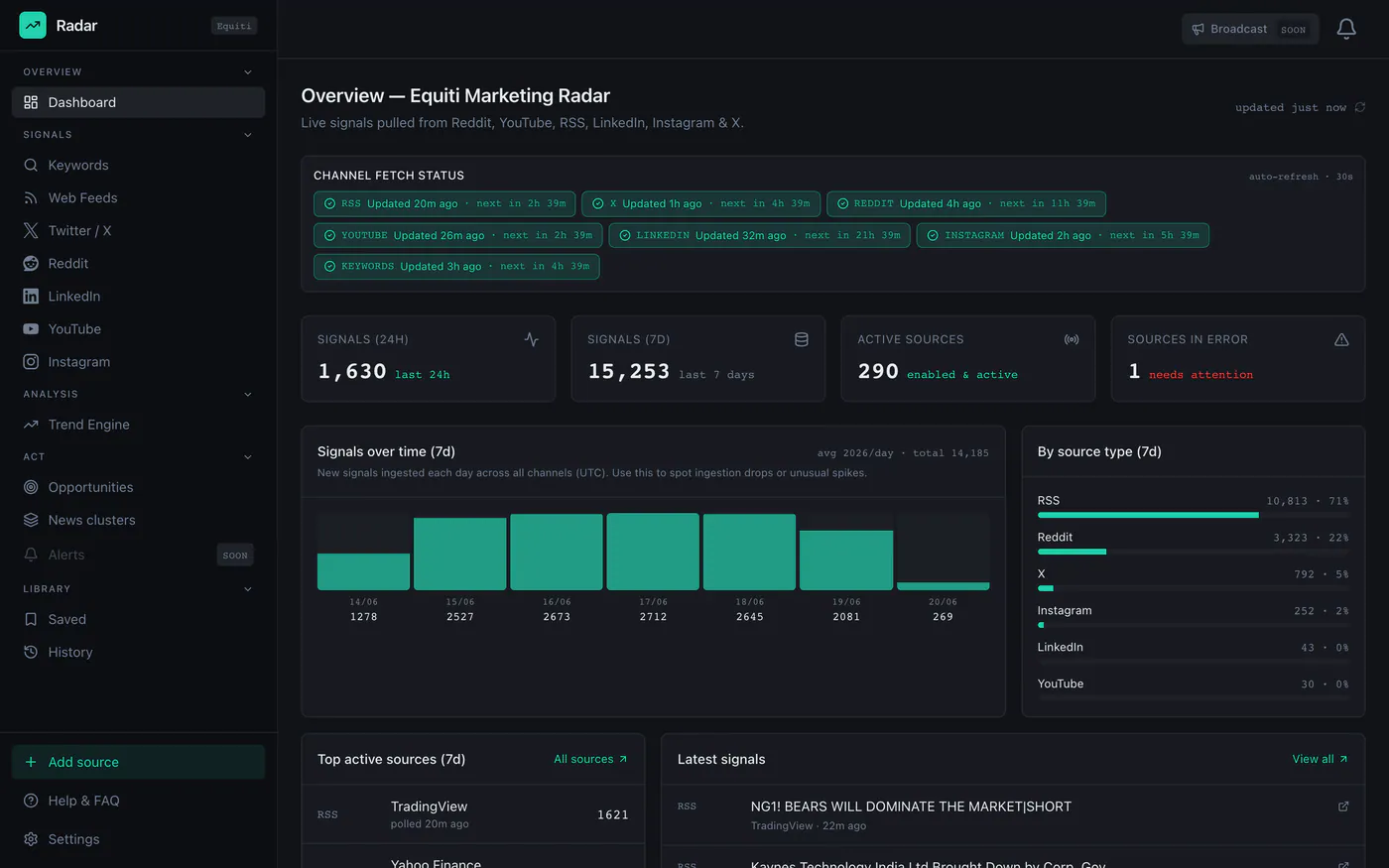
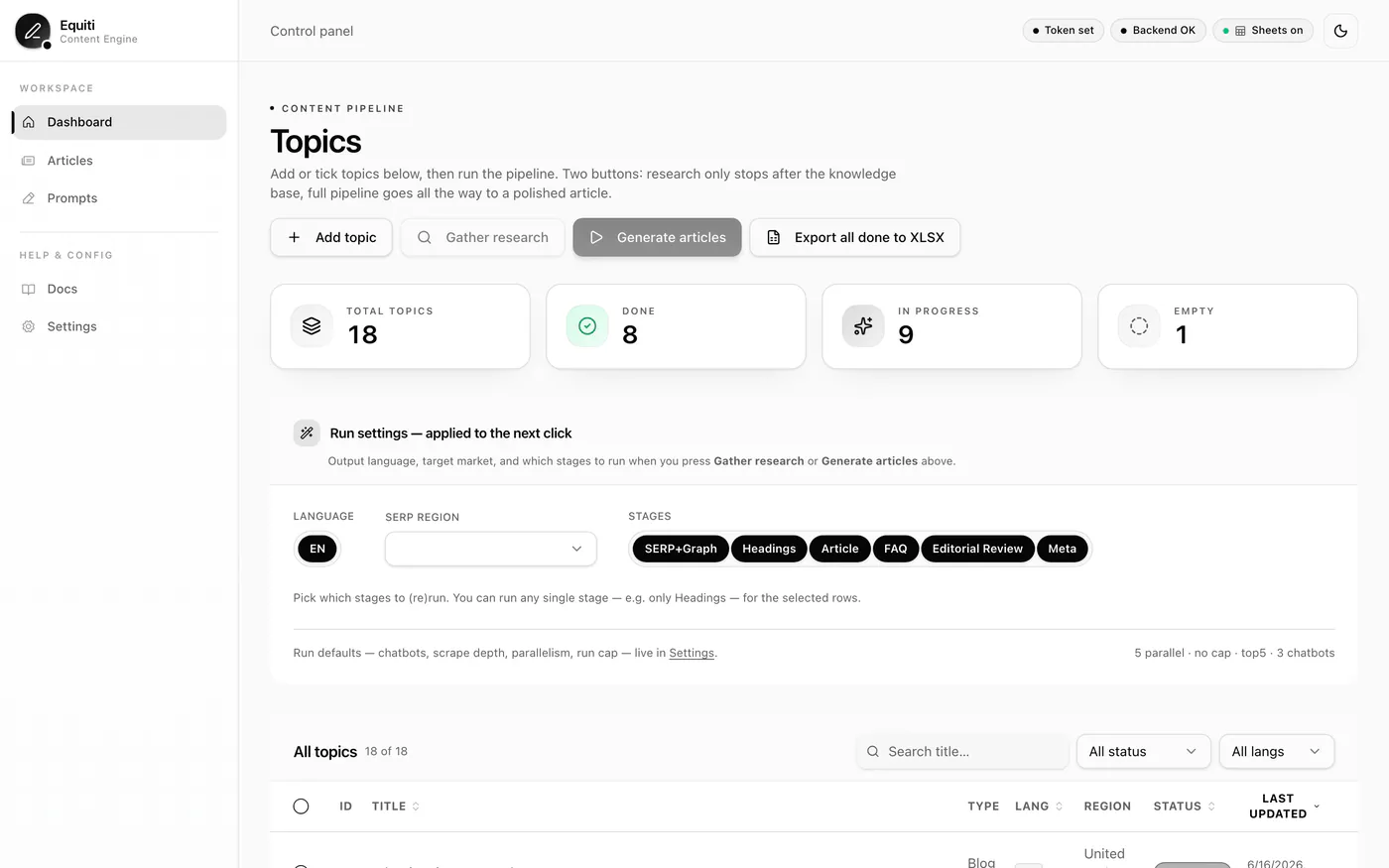
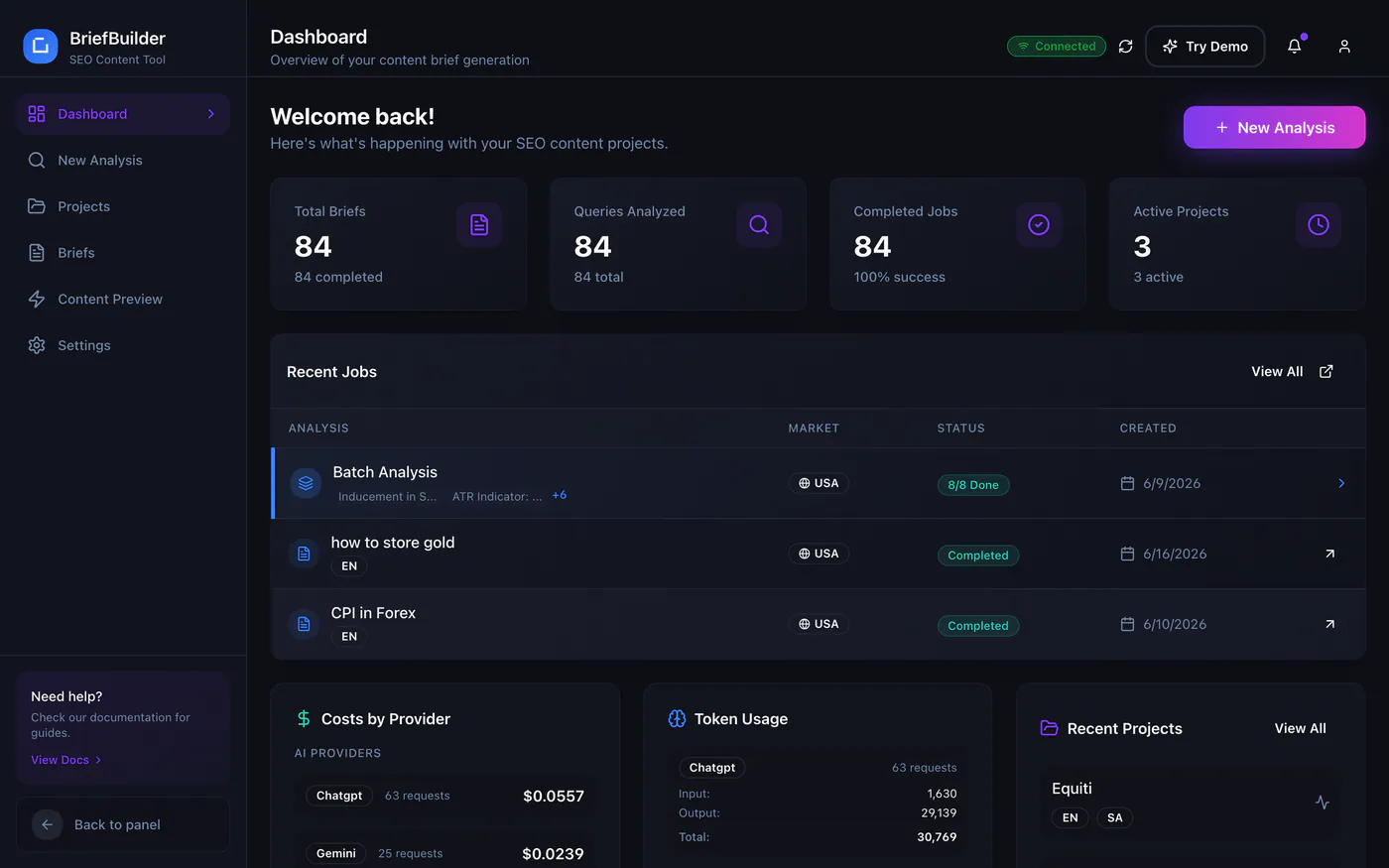
How we fight. Instead of other people’s SaaS — my own, connected tools, where the output of one is the input of the next. Below are live screenshots from the panel, on real Equiti data.
Market signal
Brief
Article
Quality audit
Linking
Clean-up
Measurement
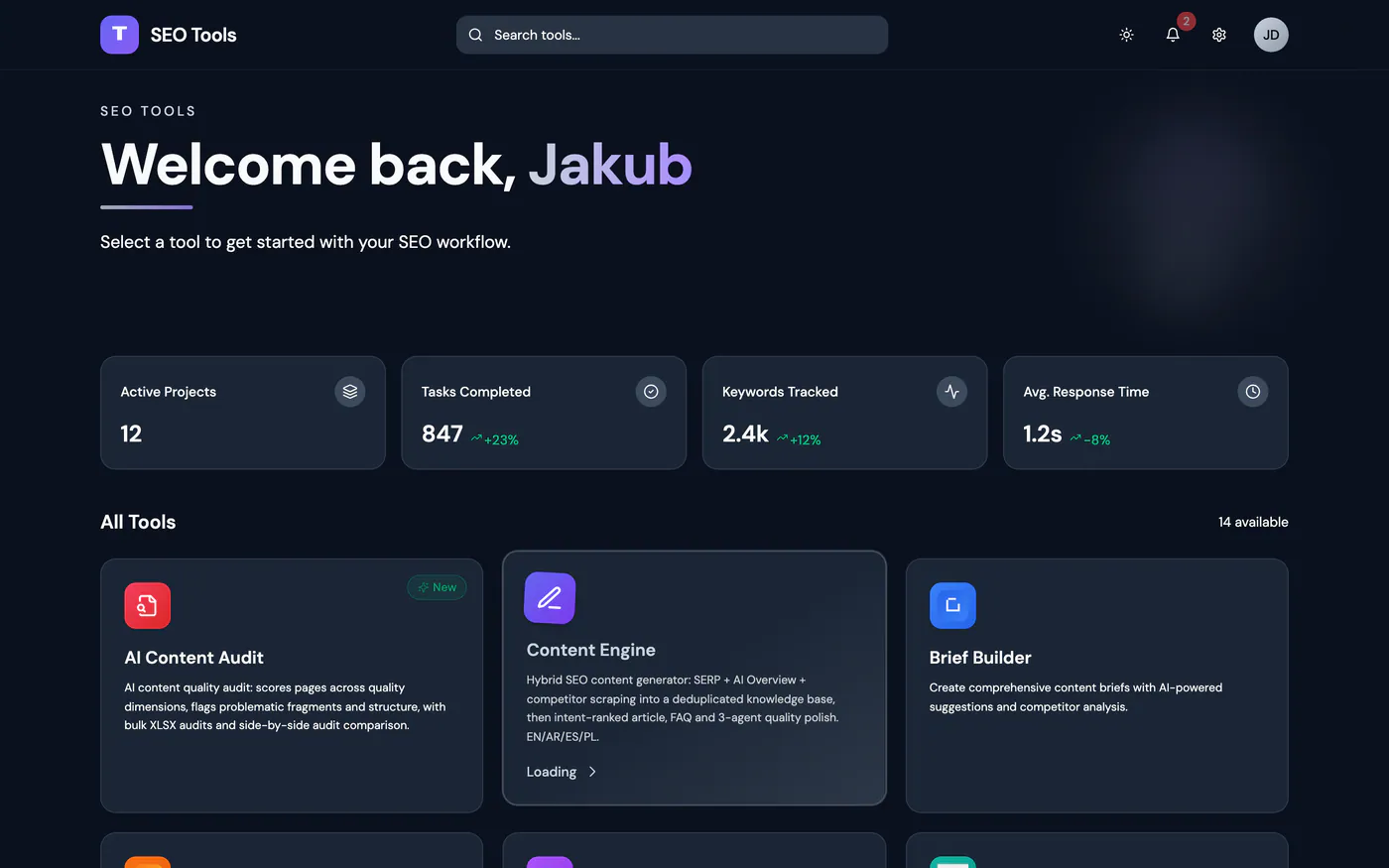
A few of them up close — these are live screenshots, not mock-ups:
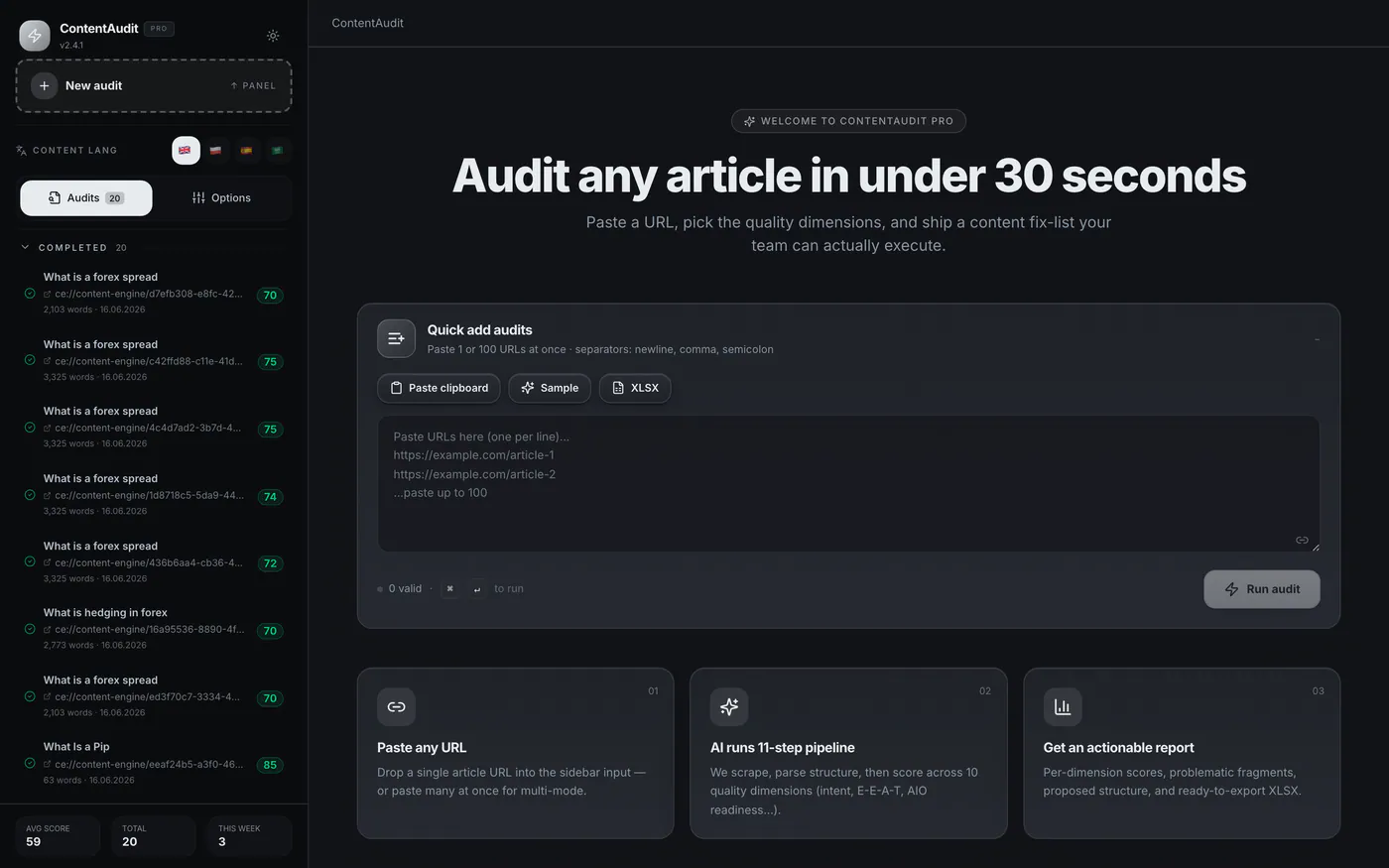
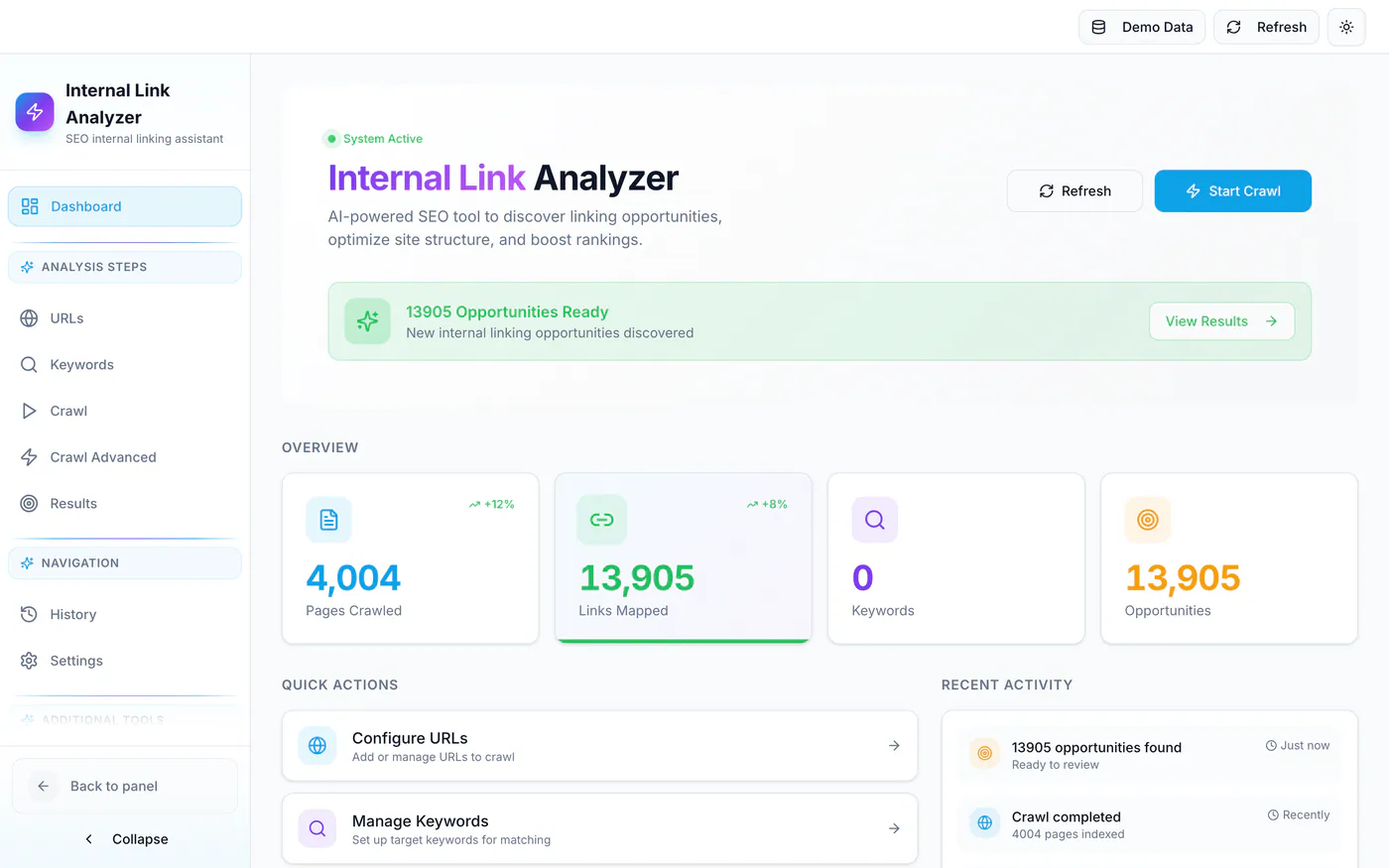
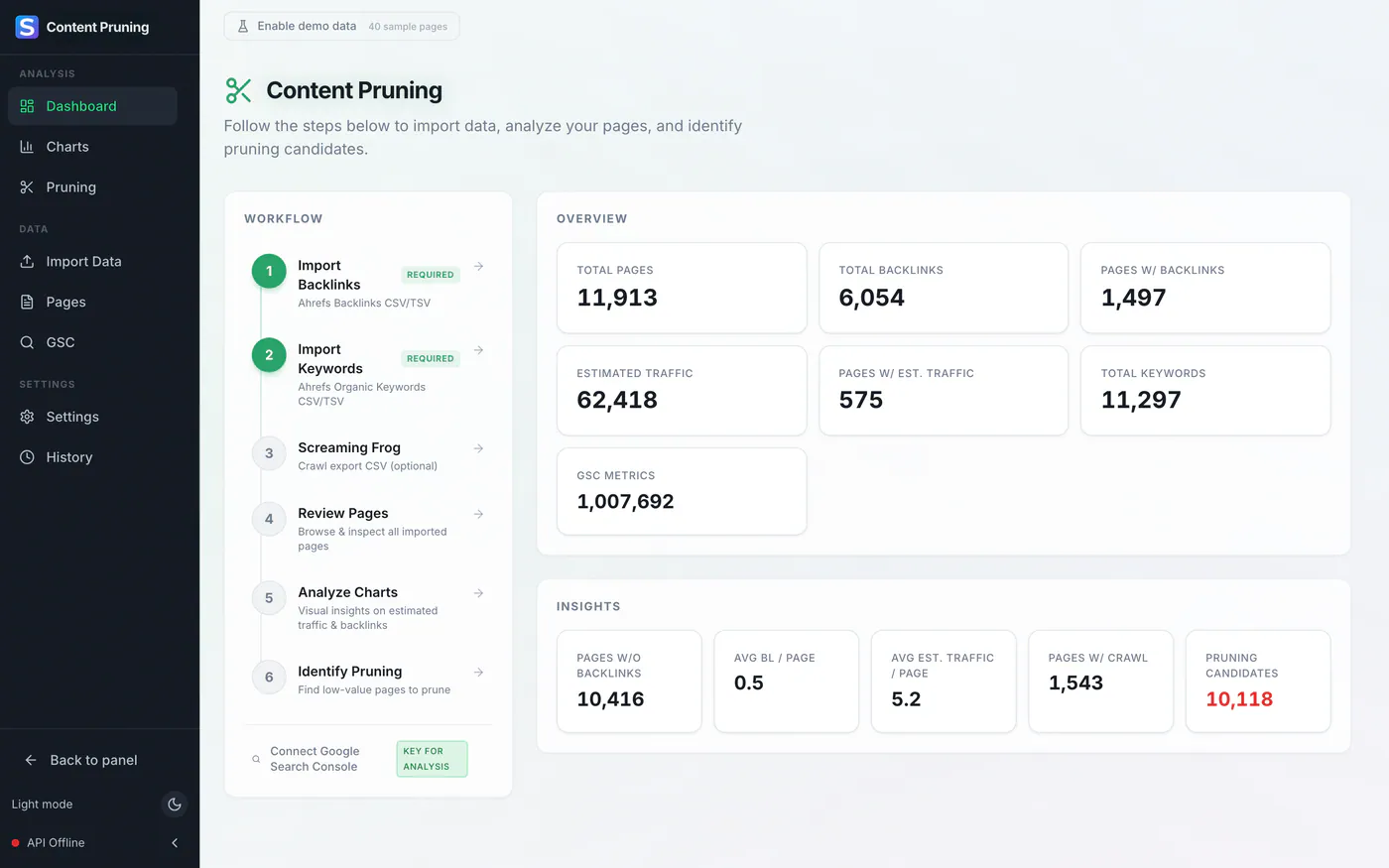
Up close: how we defuse cannibalisation
The most common hidden brake on visibility — and the hardest to spot with the naked eye. I show the mechanism step by step, because it is genuinely interesting.
Cannibalisation is a situation in which several pages of the same site rank for the same keyword. Google does not know which one to show, so it often shows none of them high up — and clicks and impressions are diluted between addresses. You pay for it with traffic that does not show on any “upward” chart.
The mechanism — 5 steps on real GSC data
Source: pulling data from GSC
OAuth2 to Search Console: query + page dimensions, clicks / impressions / position metrics for a date range.
Grouping: top 3 pages per keyword
For every keyword we count how many pages rank and which 3 collect the most — with their % share of impressions.
Filter: is it really a problem?
A competing page with < 2% of impressions = occasional ranking, leave it. Not every pages>1 is cannibalisation.
Intent: intent, not clicks
We classify the keyword (informational / transactional / navigational). Intent decides the target page — NOT the number of clicks.
Action: a specific decision
Per keyword: strengthening, canonical, 301, merge or 410 — with a “why” and an estimate of +clicks.
See it live — one keyword, three competing pages
Keyword analysed: “what is forex” · 248,400 impressions/month (GSC)
- clicks in total
- 5,120
- ranking pages
- 3
- avg. position
- 9.4
| Page | Role | GSC data |
|---|---|---|
| /education/what-is-forex | Target page | Position: 6.2 · 38% of impressions · 71% of clicks · Type: guide — matches the informational intent |
| /blog/forex-for-beginners | Competitor #1 | Position: 12.4 · 22% of impressions · 14% of clicks · Dilutes the keyword — candidate for 301 / merge |
| /glossary/forex | Competitor #2 | Position: 18.7 · 19% of impressions · 6% of clicks · Short definition — canonical to the target page |
| external competition | Other results | The remaining 21% of impressions go to competitors outside the Equiti domain |
Once the competing pages’ content is moved to the target page and redirected with a 301, the signals stop being diluted — one page climbs, takes the impressions of both and moves higher.
This is what the priority report looks like (export from the tool)
| Keyword | Intent | Priority | Opportunity +clicks | Dominant page (keep) | Top2 — action |
|---|---|---|---|---|---|
| 1. what is forex · 248,400 impressions | informational | high | +1,180 | /education/what-is-forex · guide · pos. 6.2 · 71% of clicks | 301 + merge |
| 2. cfd trading · 135,900 impressions | informational | high | +860 | /education/cfd-trading · guide · pos. 7.1 · 64% of clicks | canonical |
| 3. how to trade gold · 74,200 impressions | mixed | medium | +410 | /commodities/gold · category · pos. 9.3 · 48% of clicks | internal link |
| 4. leverage meaning · 39,050 impressions | informational | medium | +220 | /glossary/leverage · definition · pos. 5.4 · 80% of clicks | 301 of the old page |
Content GAP → Content Plan 2026
The second pillar after the clean-up. Instead of “inventing topics”, we calculated the whole content gap on real data — and turned it into a 12-month publication calendar.
The starting point: a raw list of 608 topic proposals. The problem — duplicates, off-topic entries (hundreds of “EUR/USD conversion” pages that do not build a broker’s business) and topics already covered. A raw list is not a plan. We ran it through a five-stage mechanism: currency pair filter → embeddings (recall) → LLM judge (precision) → anti-cannibalisation de-duplication → ranking business core ≫ volume ≫ number of keywords.
- NEW — clean, new topics
- 450
- UPDATE — refreshes of existing pages
- 127
- duplicates removed (the end of cannibalisation)
- 8
- slots in the calendar (20/month × 12)
- 240
| Category | Search volume / month | Topics in the plan |
|---|---|---|
| Forex | 9.33m | 63 |
| Education | 6.35m | 161 |
| Glossary | 3.45m | 119 |
| Shares | 2.47m | 97 |
| Market analysis | 0.71m | 49 |
| Strategies | 0.29m | 61 |
| Commodities | 0.23m | 28 |
Monthly search volume within reach · source: DataForSEO / Senuto
What we enjoy about this project
Because good cooperation is not only numbers — it is also the things that make the work a pleasure.
Most importantly: each of these challenges already has a mechanism assigned to it. A competitive SERP → ranking by business core. Cannibalisation → the GSC tool with a ready action. Multilingual content → native EN/AR generation. Compliance → disclaimers in the pipeline. Zero-click → content built for AI citations. This is not a list of problems — it is a list of ready levers.
What we are doing and what comes next
The order: from the things that unlock growth the most to those that scale it. First we unlock, then we accelerate.
Cleaning up the site
Cannibalization Tool + Page Pruner + Internal Link Analyzer — the end of cannibalisation, clean clusters, authority flowing to pillar pages. The fastest return.
Content Plan 2026 in motion
A calendar of 20 publications/month — starting with the categories with the highest volume and the lowest difficulty (Forex, Education, Glossary).
Production through Content Engine
NEW and UPDATE content natively in EN/AR, grounded in the SERP, with compliance — passed through editing that removes the AI footprint.
Content for AI Overview
A format built for model citations (answer-first, structure, specifics) — getting into AI answers on educational and decision keywords.
Measurement and scaling
GSC Insight Nexus measures the effect per language, market and category. What works on one cluster, we carry over to the next.
Client testimonial
The voice of the side we do this for — how Equiti’s SEO team rates the cooperation.
Jakub is one of the best SEO specialists I’ve had the pleasure of working with. What sets him apart is his highly technical approach and skill set, which he uses to build excellent tools — especially for content workflows. These tools help teams focus on high-impact work instead of repetitive tasks, while also delivering valuable insights.
Kuba is also very strong in data analysis — he’s precise, detail-oriented, and able to draw meaningful conclusions. Another key advantage is that he actively tests and implements the latest AI solutions in his projects. Importantly, he communicates his ideas clearly and effectively.
I highly recommend working with Kuba to anyone looking not just for an SEO expert, but for a partner who truly brings value to a project.
 Magdalena MroczkaSEO Manager at Equiti Group
Our own arsenal, one fight: visibility in the AI era
8 connected tools, 23m of search volume within reach, cannibalisation defused on 100k+ GSC rows and content written natively in EN/AR. Specific, based on Google data and measurable — from a market signal to a citation in an AI answer.
Porozmawiajmy o Twoim SEO