
How to avoid Google penalties when acquiring links?
You will avoid Google penalties when your links result from the real usefulness of the content for the user, rather than from the need to “insert a link”. The greatest risk is associated with link schemes whose main purpose is to manipulate PageRank, such as buying links, mass “link for link” exchanges, PBN networks, automated directory submissions or sponsored articles without the rel=sponsored attribute. A manual penalty appears as a message in Google Search Console in the “Manual actions” section and usually relates to specific linking schemes. Algorithmic drops are more often identified by comparing dates of updates and changes in the link profile, as they do not come with a single, clear notification.
If you pay for a publication, review, patronage or sponsored post, the link should have rel=”sponsored” (or nofollow if the CMS does not support sponsored). For user-generated content (comments, forums), use rel=”ugc” to reduce the risk that UGC spam will lower the quality of the link profile. Nofollow/sponsored/ugc links do not pass classic “power”, but they can still generate referral traffic, diversify the profile and signal naturalness. In practice, even a publication in a large media outlet with a nofollow link can bring leads and further organic mentions, which already tend to be dofollow.
The risk of a penalty also rises when the profile looks “over-optimised”, especially through the mass use of exact-match anchors across many domains. A safer profile is one with a majority of branded, URL and generic anchors, while keyword anchors should appear less frequently and in as natural a context as possible. There is no fixed limit for links per month, but unnatural spikes (e.g. +300 linking domains in a week for a small brand) are a risk signal, so it is worth having an “explainable reason” for growth, such as a report, study, event or major partnership. If in doubt, filter decisions with a simple question: does this link make sense for a reader looking for information, not for a bot.
- 01Real usefulness of contentValue for the user
- 02Avoid manipulationLink schemes
- 03Paid links = rel="sponsored"Sponsored articles
- 04Monitor riskGSC and updates
Focus on quality and natural linking, mark paid content and monitor Google Search Console.
Link profile audit and risk assessment
Link profile audit and risk assessment consists of collecting data about links and verifying the quality of linking domains, rather than focusing on individual URLs. The starting point is Google Search Console (Links → Top linking sites), because that is data from Google, although it is not complete. Therefore, to get a fuller picture, combine lists of linking domains with tools such as Ahrefs, Semrush or Majestic so you do not miss potential sources of risk. Start the assessment with linking domains, because hundreds of links from one domain often matter less than single links from many unique domains.
- Check the linking domain: does it contain real content and is it not overloaded with outbound links.
- Verify credibility: the presence of an “About us” section, author information and signals of regular publishing.
- Assess link placement: is it in the body of the article, rather than in the footer or in a “Partners” block with dozens of links.
- Check the domain’s indexation (e.g. with the site: command) and signs of no traffic as a proxy (e.g. in Similarweb).
- Analyse anchors: repetitive exact match or foreign-language anchors unrelated to the market are clear risk signals.
Risky patterns in practice are domains with thin content, a large number of outbound links, no authors, no traffic and no signs of editorial work, as well as networks with a similar template, language and structure. Another problem is often directing links almost exclusively to one commercial subpage (e.g. /oferta/) with an optimised anchor, because such a distribution looks unnatural. It is safer to spread linking across informational assets (guides, reports, tools) and only then internally lead the user to the offer. When assessing the profile, also pay attention to the proportions of link types and attributes, because a lack of diversity (e.g. almost only dofollow links from “guest” articles) can look suspicious.
The most accurate audit decisions are made when you divide links into safe, suspicious and toxic, and respond primarily to the weakest sources. Rather than removing everything “just in case”, many suspicious links are better monitored first, while removal or disavow should be reserved for obvious spam networks or links with a manual risk signal. Document why you considered a link risky (e.g. no indexation, outbound spam, PBN footprint), because this makes teamwork and preparing actions in the event of a manual penalty easier. In addition, check whether the linked URLs do not lead to 302s, http versions instead of https or 404s, because this disperses value and complicates analysis; Screaming Frog SEO Spider is useful for bulk verification.
Creating valuable content that naturally attracts links
Valuable content attracts links naturally when it gives others a real reason to cite and recommend your site as a trustworthy source. The safest “link magnet” is industry reports and original research, because they provide data that media outlets and blogs need for mentions (e.g. a report based on a survey of N=500 with tables available for download). Definition pages and knowledge bases also work well, as they are readily linked to in discussions and articles, especially when you pay attention to authorship, update dates and sources. If your content genuinely solves a user problem or adds data to the debate, the link usually appears as a natural recommendation rather than an element of a “scheme”.
Linkability often increases when you provide tools, calculators and checklists that make it easier to estimate quickly or make a decision (e.g. a Google Ads campaign ROI calculator in Google Sheets or on the site). In this type of material, it is worth adding an embed option and clear citation guidelines to increase the number of correct mentions and links. Templates and downloadable resources serve a similar function (e.g. briefs, specifications, budget sheets), provided you offer an editable version and a descriptive page with instructions, so that links lead to the URL rather than only to the file. Case studies are linked to more often when they contain specific metrics. When it is not possible to disclose full data, it is safer to provide ranges and describe the methodology.
Safe rankings and comparison tables are those with clearly described criteria, weights and the date of the last update, so that others can reliably cite the results. Visualisations, charts and interactive maps are linked to more often when you indicate the data sources and add a download option, and the embed code includes simple attribution in the form of a brand or URL (without forcing exact match anchors). To stop an asset losing value, update it regularly, in dynamic industries every 3–6 months, because outdated data is cited much less often. Finally, make sure the path to conversion works through UX and internal linking. The asset is meant to collect links, and only later should the user arrive at the offer as part of natural navigation.
- 01Reports and researchUnique data and analysis
- 02Knowledge baseDefinitions and trustworthy sources
- 03Tools and checklistsPractical solutions
- 04Natural recommendationValue as a link magnet
Valuable content is the safest “link magnet” that builds trust.
Effective outreach and digital PR without risk
Effective outreach and digital PR without risk is about providing editorial teams and authors with informational value, rather than asking them to place a link. Start building a contact list from places that genuinely publish in your niche and have an editorial team (industry media, expert blogs, universities, organisations), using tools such as Muck Rack, Prowly or Google News, and manual author verification. In the pitch itself, point to 2–3 key takeaways and add a link to the source on your site, and the editorial team will decide for itself whether to include a link and in what form. The safest pitch is an “information hook” (data, expert comment, case, market alert), not a request for a link.
Reactive PR based on journalists’ queries can generate citations and links without publication fees, for example through platforms such as Connectively (formerly HARO), Qwoted or Help a B2B Writer. In such responses, speed (often 1–2 hours) and a clear, concise thesis are key, and the link in the signature is best directed to an expert profile or a page with data confirming the statement. Data-led digital PR based on data and newsjacking work when you have a well-developed methodology and credible sources, because without that editorial teams usually will not use the quote. By publishing a mini study or trend analysis, you increase the chances of natural mentions that do not look like a “PageRank campaign”.
Guest posting is often safer when you treat it as an editorial collaboration with a site that has a unique audience and a real editorial team, and for sponsored content you use proper labelling. Another, often stable channel is interviews, webinars and podcasts, which generate links in episode notes and promotional materials, because the link follows from the context (guest/partner). A low-risk practice is also link reclamation: when someone has mentioned the brand without a link, you ask for the addition of a link as a convenience for readers (e.g. via Ahrefs Alerts, Brand24, Mention). In broken link building, you point to a specific broken URL (404) and propose a current resource as a replacement, and you organise relationships in a CRM (BuzzStream, Pitchbox), limiting follow-ups to 1–2 every 4–7 working days and each time bringing new value.
Building industry partnerships for safe links
Safe links from industry partnerships are most often the result of genuine business collaboration, not “SEO link swaps”. Start with places where your company’s presence is obvious: affiliate programmes for tools and expert directories (e.g. Shopify, HubSpot, WordPress, BaseLinker) as well as integrator profiles. Such a link can be long-lasting if the profile is substantive and verified, rather than just part of a mass list without moderation. The best partnerships are those where the link makes sense for the user (e.g. “recommended integrator”), rather than being a condition of collaboration.
Valuable and low-risk are also links from supplier references and joint case studies, where the client quote naturally appears on the “Customer reviews” page. If you run an affiliate programme, make sure partner links have rel=sponsored so it does not look like an attempt to manipulate rankings. In materials for affiliates, encourage traffic to informational resources (guides, comparisons) rather than solely to sales landing pages. This approach strengthens credibility and reduces the risk that the link profile becomes “too commercial”.
Partnerships can also be scaled through joint events and patronage, because event subpages, agendas and speaker lists often include contextual links to organisers and guests. Collaboration with universities and institutions can generate mentions when you bring real value (a script, dataset, tool), but such links should not be bought or pressured for. Approach membership in associations with caution: verify whether the organisation actually operates (events, announcements, board), rather than just maintaining a public list “like a directory”. Avoid simple “you link to me, I link to you” 1:1 arrangements, and instead choose co-created content where links arise from citing sources and are branded in nature.
- 01Industry tools and directoriesTool partnerships, expert profiles.
- 02Verified expert profilesLong-lasting links, substantive presence.
- 03References and joint case studiesNatural links, customer reviews.
Safe links result from genuine business collaboration, where the company’s presence makes sense for the user.
Optimising local links and NAP citations
Optimising local links and NAP citations comes down to keeping consistent company details everywhere a user might find you. Make sure the NAP (name, address, phone) is identical in Google Business Profile, on the website and in directories, including consistency in wording such as “ul.” vs “ulica”. This consistency supports local SEO and reduces citation clutter that weakens credibility. Treat NAP as a “single source of truth” and update it everywhere at the same time.
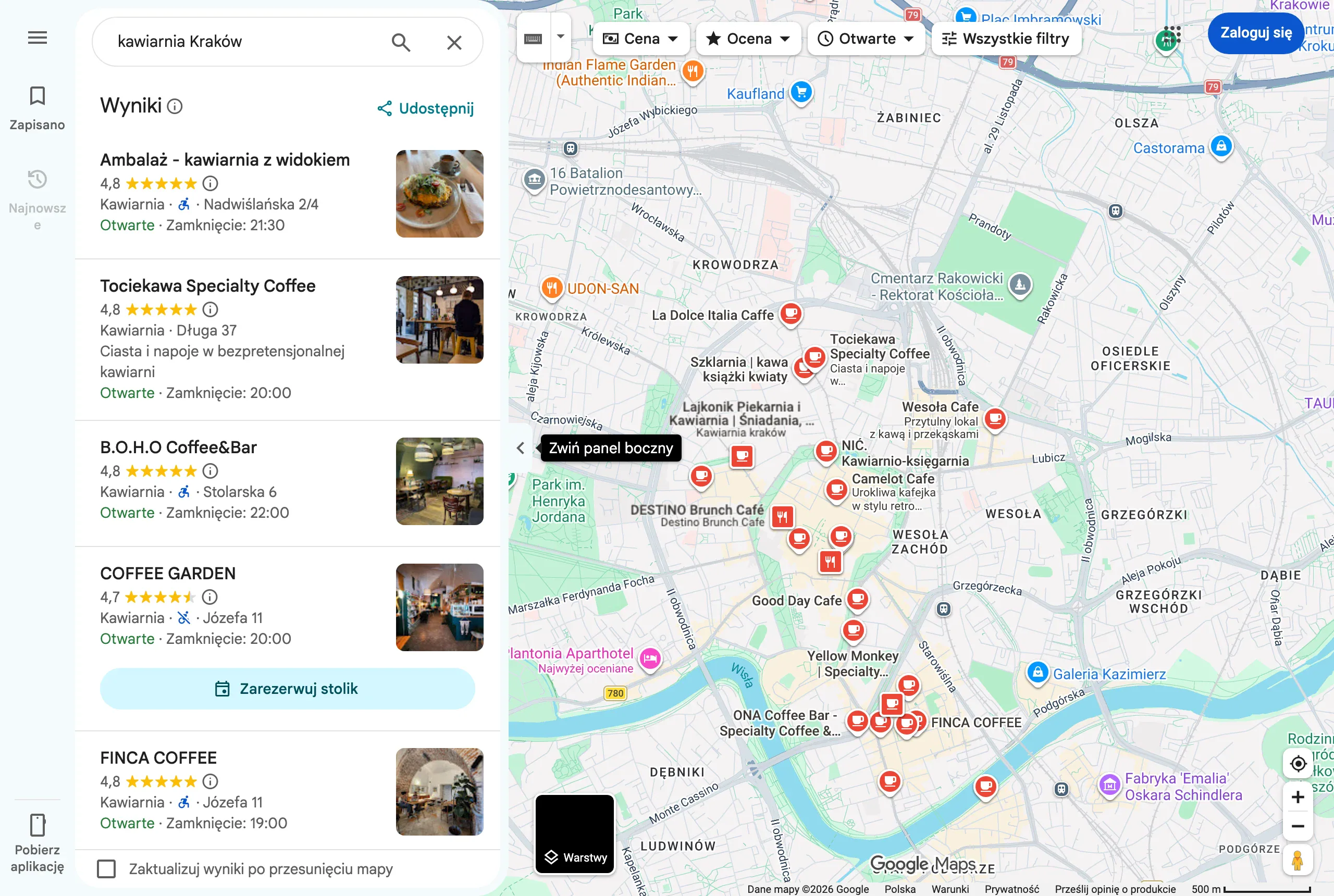
Local citations are best built in safe, genuinely used places such as Apple Maps, Bing Places, Here, OpenStreetMap and local city portals. Directories can make sense when they are industry-specific, moderated and genuinely help customers (e.g. ZnanyLekarz for medicine, Panorama Firm in selected niches, chamber of commerce directories). Avoid packages like “200 directories for 99 zł”, because such a scheme looks like mass activity without quality control. If a financial element appears at publication (e.g. event sponsorship), make sure the link is marked rel=sponsored.
A safer alternative to “buying links” is local reviews and rankings based on editorial criteria, because they stem from a real assessment and usefulness for the audience. Publications in regional media usually carry additional trust value, especially when you provide specifics (e.g. information about a new service or event), rather than purely promotional copy. It is also worth developing a “Careers” page as a resource that universities and professional communities link to, instead of relying your strategy on short-lived links from job ads. Assess the effect of local links through traffic, enquiries in Google Business Profile and improved visibility for local keywords. UTM parameters on links from partners and events, as well as the “Performance” report in GBP, are useful.
Technical aspects of links affecting their safety
Link safety largely depends on how and where it has been placed on the linking site, and whether it does not look like a transactional element or a scheme. A link placed within an article body and surrounded by thematic context usually looks more natural than a link in the footer, sidebar or in a sitewide layout across hundreds of subpages. Sitewide links can easily be read as an exchange or permanent exposure “for something”, which increases the level of risk. It is also worth checking whether the link is not crammed into blocks such as “Partners” with many links, because such a layout often goes hand in hand with low-quality activities.
The choice of rel attributes should match the intent of the link: mark sponsored publications rel=”sponsored”, user-generated content rel=”ugc”, and when you do not want to pass ranking signals — rel=”nofollow”. In practice, you may come across combinations of attributes (e.g. sponsored + noreferrer), and that is acceptable as long as the meaning of the link remains compliant with the guidelines. Equally important is URL hygiene: make sure the link leads to the canonical address (https and without unnecessary parameters such as ?ref=) and that the canonical on the destination page points to the correct URL. This way, you do not dilute value and you make it easier to analyse the link profile.
Technical issues on the target URL side can “break” even good publications, so monitor redirects and errors after migrations. When changing the site structure, set up 301 redirects from old addresses to new ones, because the lack of a 301 can trigger drops even though the linking domains have not changed. After deployments, check the “Pages” report in Google Search Console and run a crawl in Screaming Frog to catch 404s and redirect chains. If you have UGC (forums, comments, profiles), use rel=ugc by default and anti-spam mechanisms (reCAPTCHA, moderation, link limits), and when you detect copying of your graphics, recover attribution with a link to the original via Google Images, TinEye or Ahrefs (Content Explorer).
Scaling link building without automated spam
Scaling link building without automated spam relies on implementing a repeatable process for assessing the quality of publishing placements and diversifying sources, rather than increasing volume “at any cost”. Start with a checklist in Notion or Airtable that forces a business justification for each source, rather than just chasing metrics. Split campaigns into different types of activities (media PR, resource pages, partnerships, link reclamation and local citations) so the profile does not look like a series of identical publications. In this way, you reduce the risk of “monotony” (e.g. 100% guest posts), which can look like a scheme.
- Assess the topical relevance and context of the publication, as well as whether the site has a real editorial team.
- Verify indexation, the number of outbound links and the domain’s history.
- Check the rules for sponsored labels (rel=sponsored) and the risk of network “footprints” (repetitive templates, no authors, sudden topic changes).
- Record the decision and the rationale for choosing the source, so the process can be repeated and audited without any issues.
Automate only the logistics (queues, tags, follow-ups in BuzzStream or Pitchbox), not the pitch copy, because mass messages without context reduce effectiveness and quickly stick the spammer label on you. Beyond the process itself, you also need realistic KPIs: instead of “50 links/month”, it is better to set quality goals, e.g. the number of linking domains from a given niche, the number of brand mentions, referral traffic and editorial publications. For example, 10 new linking domains per quarter from the “SaaS/IT” category and 3 editorial publications is often a better goal than many random links. Such KPIs support the naturalness of the profile and make it easier to assess whether the activities have real marketing value.
Scaling will only be stable if you also manage a portfolio of content “for links”, because outreach without value quickly turns into asking for backlinks. In many companies, the following cycle works well: 1 major report per quarter and 2–4 smaller pieces (a checklist, mini-analysis, case study) that maintain publishing momentum and provide topics for pitching. When you commission link building from an agency, require a list of domains before publication, full cost transparency and clear labelling rules (including rel=sponsored), and in the contract ban PBNs, automated directories and 1:1 exchanges, as well as agreeing liability for any profile clean-up. Before you scale up, test 20–30 contacts and iterate based on what actually leads to publications without forcing anchors.