
Until recently, Google PageRank was an SEO factor that was often discussed behind the scenes. An increase in PageRank was a clear demonstration that an SEO strategy (especially a link acquisition strategy) was working properly. PageRank is mentioned less and less these days. Not because it is no longer important, but because it is no longer a publicly visible metric.
What is PageRank?
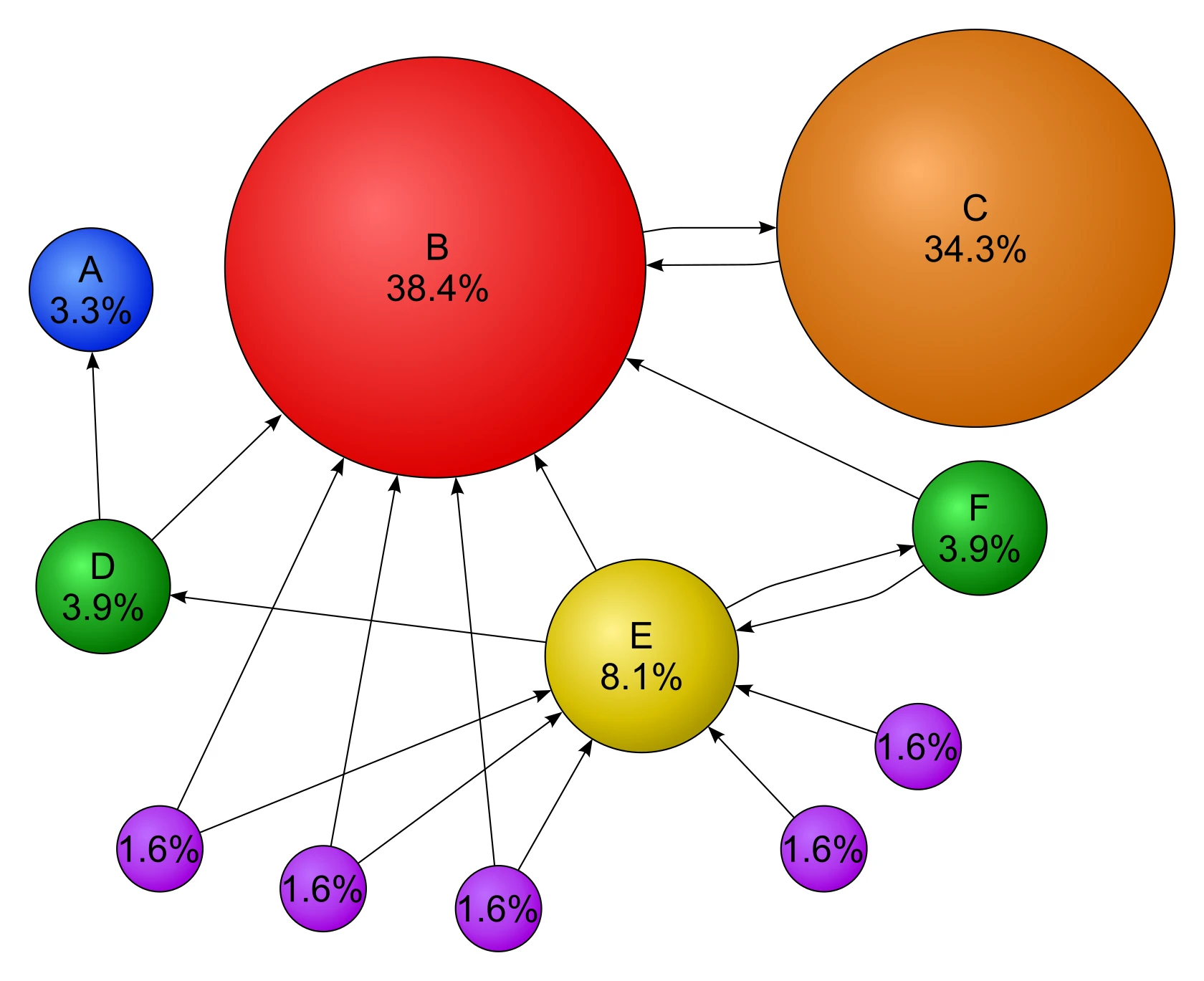
PageRank is an algorithm that measures the quality of websites based on the links pointing to them. It was often the case that pages with a larger number of links achieved higher positions in search results. Rankings were higher, especially if those links came from popular websites (e.g. sites that themselves had a high PageRank score).
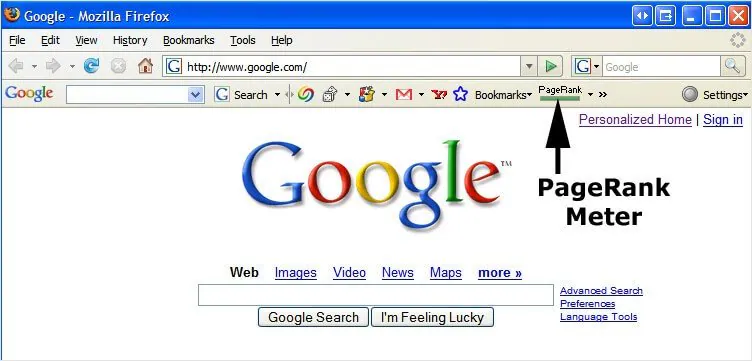
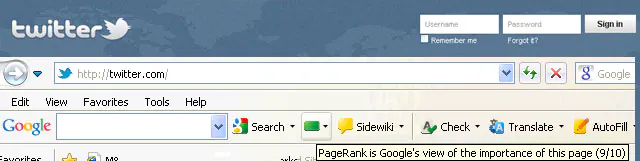
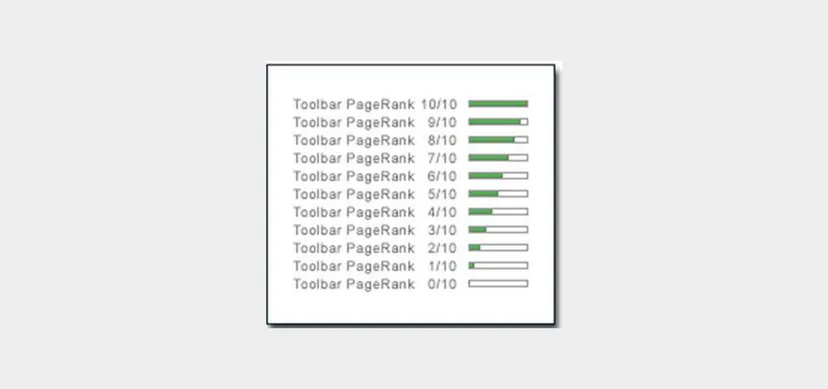
Previously, SEO specialists could observe the PageRank score of any website via the Google Toolbar taskbar. PageRank 0 (PR0) meant the lowest-quality pages. A score of 10 (PR10) meant pages with the greatest authority.
The reason SEO specialists became so interested in this metric was that PageRank passed from one page to another. This meant that a page could gain authority by being connected to another page with a higher PageRank score.
Simply put, PageRank was transferred between pages via their links. This helped a page achieve a higher position in the SERP. The algorithm was based on the concept that a page would be considered important if another important page linked to it.
- 01Website quality measurementBased on incoming links
- 02Authority influenceLinks from popular sites are more valuable
- 03Historical PR scaleFrom PR0 (lowest) to PR10 (highest)
- 04Value flowPageRank passes between pages
PageRank is a historical but still relevant concept, showing how links build authority on the web.
The history of Google PageRank
Below you can find a general overview of the history of Google PageRank:
- 1 April 1998 – Larry Page and Sergey Brin publish “The Anatomy of a Large-Scale Hypertextual Web Search Engine”,
- 1 September 1998 – Larry Page and Sergey Brin file the first PageRank patent,
- 4 September 1998 – Google was incorporated,
- 11 December 2000 – Google launches the “Google Toolbar” taskbar,
- 17 June 2004 – Google files the The Reasonable Surfer Patent patent
- 12 October 2006 – Google files the “seed sets” patent,
- 8 March 2016 – Google announces the retirement of Google Toolbar.
Introduction of the Google Toolbar
In 2000, Google introduced Google Toolbar. It was one of the most important stages in the history of PageRank. This tool allowed users to see the score of any page.
The result of this step was a significant increase in SEO specialists’ interest in raising PageRank as a method of improving rankings in search results.
The simplest explanation for the approach taken by many practitioners in the early 2000s was to focus on obtaining as many links as possible from pages with the highest possible PageRank.
Of course, this led to attempts to manipulate PageRank. Links were placed in unnatural locations and in enormous quantities.
- 01Google Toolbar debutInsight into page PageRank
- 02The rise of SEOFocus on increasing PageRank
- 03Link strategyAcquiring links with high PR
- 04System manipulationUnnatural, mass link building
The beginning of an era of intensive SEO efforts focused on the quantity and quality of inbound links, which quickly led to abuse.
Updated PageRank patent
The original PageRank patent from 1998 expired in 2018 and, to many people’s surprise, was not renewed. At the time, a former Google employee reported that the original algorithm had not been used since 2006.
This did not, however, mean that PageRank stopped working. Clearly, the original patent was replaced by a new one that Google filed in 2006.
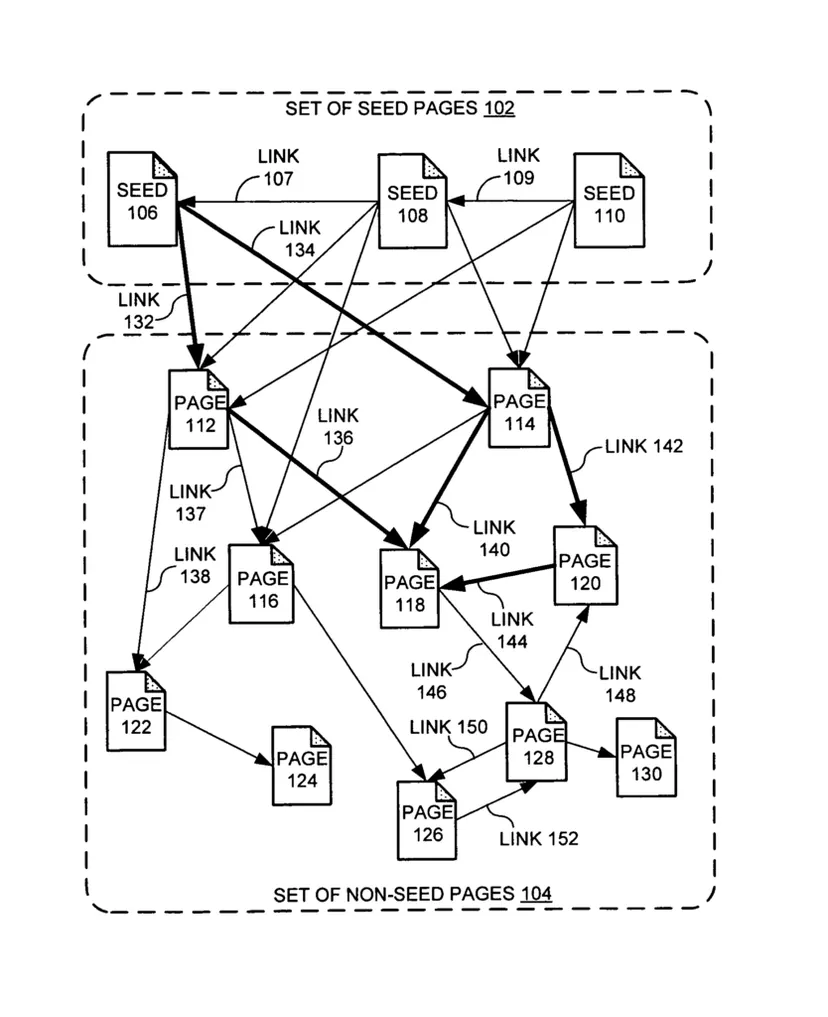
This patent covers so-called “seed sites” and “trusted seed sets” and defines them as specially selected high-quality pages that provide good network connectivity to other “no-seed” pages. Examples given include the Google Directory, which was active when the patent was filed. The second example was The New York Times website.
So-called “seed sites” must be reliable, sufficiently diverse to cover a broad range of interests, and well connected to other pages. They should have a large number of useful outbound links that help identify other useful, high-quality pages, functioning on the web as “hubs”.
The new patent provided a score for a page based on how far it is from the “seed set”. However, this patent does not actually refer to PageRank (or a revised version of the algorithm). Instead, the SEO community understood it as a PageRank modifier based on the proximity of “seed set” pages.
Google withdraws the PageRank Toolbar bar
After almost 15 years, Google stopped updating the Google Toolbar bar (the last confirmed update took place in December 2013). The company completely withdrew Google Toolbar in 2016.
Of course, this does not mean that Google stopped using PageRank as part of the algorithm. It simply meant that PageRank was no longer a publicly visible measure.
- 01Public PageRankEnd in 2016
- 02Part of the algorithmStill used internally
- 03SEO obsessionAt the expense of content quality
- 04Manipulating the scoreEasy to influence
- 05Tool withdrawalFocus on the user
PageRank ceased to be a public metric in order to limit manipulation and focus on quality for users.
Why did Google withdraw PageRank Toolbar?
SEO specialists were obsessed with PageRank. They quickly began placing the greatest emphasis on it in SEO tactics at the expense of high-quality content and proper user experience.
The problem was that the publicly available PageRank score was easier for SEO specialists to manipulate.
SEO practitioners knew they could use PageRank to achieve higher page positions in search results and took advantage of it.
From Google’s perspective, the publicly visible PageRank toolbar was a problem. Without it, there was no precise measure of a website’s authority (at least officially). That made manipulating the score obtained more difficult.
Ultimately, SEO specialists abused PageRank and used this solution to manipulate search results. That is largely why Google withdrew the toolbar in 2016.
Toolbar PageRank versus PageRank
Google was initially so proud of its algorithm that it happily shared the results of its calculations publicly. They were available to anyone who wanted to see them.
The most noteworthy presentation method was an extension in the form of a toolbar for browsers such as Firefox. It showed a score from 0 to 10 for every page on the Internet.
In reality, PageRank has a wider range of scores, but the 0-10 range gave professionals and consumers the ability to assess the importance of any page on the Internet instantly.
The PageRank toolbar made the algorithm very visible, and this led to complications. In particular, it was clear that links were the simplest way to “trick” Google.
The more links there were (or the better the links), the higher a page ranked on the search results page for any target keyword.
This meant that a secondary market emerged, where links with the PageRank value of the URL for which the link was sold were bought and sold.
This problem worsened when Yahoo introduced a free tool called Yahoo Search Explorer. It gave everyone the ability to search for links to any page.
How did PageRank revolutionise search?
Other search engines relied heavily on the individual analysis of the content of each page. These methods were poor at identifying the difference between an influential page and a page simply filled with random (or manipulative) text.
This meant that the information-gathering methods used by other search engines were easy to manipulate. Google PageRank was then a revolution. Combined with the relatively simple concept of “n-grams” helping to determine meaning, Google developed an effective formula.
Soon this solution overtook major beneficiaries such as AltaVista and Inktomi (supported, among others, by MSN).
By operating at page level, Google found a more scalable solution than the “directory”-based approach used by Yahoo and later by DMOZ. Although DMOZ (also known as the Open Directory Project) was initially able to provide Google with its own open-source directory.
How did PageRank work?
When the patent was first filed, and Google’s early algorithm was developed, PageRank was based on the theory that a link from one page to another acted as a vote for that page, confirming its authority and trust.
Therefore, the more links (votes) pointed to a page, the more trustworthy it was. This, in turn, translated into a higher position in the search results.
The initial documentation mentioned that PageRank expands its operations and does not count links from all pages equally, and normalises the number of links on a page.
This means that a link was not simply one vote for a given page. The authority of the page is taken into account. This means that a link from a page with PR6 was a more reliable vote than a link from a page with PR2. This flow of PageRank between pages is sometimes referred to as “link juice” (link equity).
Is PageRank still used?
Although public access to PageRank ended in 2016, page scoring is still believed to be available in Google.
A leak of information about the factors used by Yandex indicates that PageRank still remains one of the possible factors used.
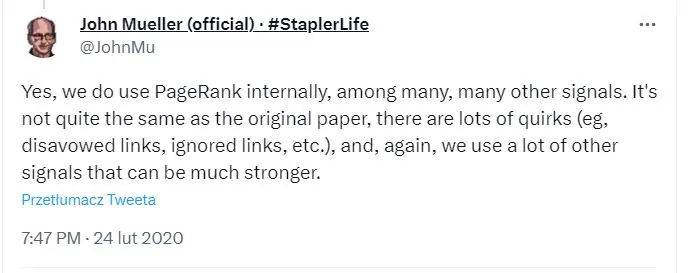
Google engineers suggested that the original form of PageRank has been replaced by something new, similar, which requires less processing power to perform calculations. The calculation formula is now less important in the SEO process, but remains the same for every page.
Regardless of what other algorithms are and will be used by Google, PageRank is probably used in many Google systems to this day.
FAQ
Frequently asked questions
How does PageRank evaluate a website?
PageRank treats a link from one page to another as a vote for its authority and trust. The more valuable links point to a page, the higher it can be rated.
Why did links from popular sites matter more for PageRank?
Because PageRank did not count all links equally, but took the authority of the source page into account. A link from a page with a higher PageRank was therefore a stronger signal than a link from a lower-quality site.
Was Google PageRank once publicly visible?
Yes, previously it could be checked in Google Toolbar on a scale from 0 to 10. This allowed SEO specialists to observe the metric of practically any website.
When did Google retire the PageRank toolbar?
Google retired Google Toolbar in 2016. The last confirmed toolbar update took place in December 2013.
Why did Google stop showing PageRank publicly?
Because SEO specialists started focusing too much on this metric and using it to manipulate search results. The public score was easier to abuse than a hidden mechanism.
Is PageRank still used by Google?
The text suggests that it is, although it is no longer publicly visible. The author also indicates that the original form of the algorithm was probably replaced by a newer solution.