

Have you ever come across the term Link Juice? If you are looking for what this term means – you are in the right place! Link Juice is a term used in SEO to describe the value passed from one page/subpage to another. What else is worth knowing about this topic? Check the article!
What is Link Juice and how does it work?
From the perspective of an average user, everyone can always find certain links within content on blogs. This practice has a positive impact on the reader experience by providing related content, but it also brings many other benefits. Such links have a positive effect on the process of SEO for websites in Google.
The term Link Juice refers to nothing more than a portion of ranking optimisation that each link passes to the target page. If you have created a post that contains links to other pages, part of your ranking potential (known as PageRank) is distributed among all such hyperlinks to other websites.
Websites use this feature of link building to gain greater authority. If a page has many links in its content, it is assessed more favourably by Google algorithms. Such links must lead to content that makes sense, for example to posts about related topics.
- 01What is it?Transferred ranking power.
- 02Distributing the powerShared across all links.
- 03Target pageGains authority and potential.
- 04SEO effectBetter positions in Google.
Key mechanism: Internal and external links pass value (PageRank), building the site’s authority in the eyes of the search engine.
The history of Link Juice
When the Google search engine was introduced to the vast search engine market, it had a revolutionary ranking algorithm called “PageRank”, whose task was to determine the authority of a website. Its name comes from the surname of one of its creators (Larry Page), so this is not about the English word for a website page (page).
SEO specialists began using many colloquial terms to describe PageRank, such as “Google Juice” or “Link Juice”, which became the most popular.
In the early years of its existence, the Google search engine did quite well with PageRank alone. This caused a significant rise in its market position.
First-generation search engines, such as AltaVista, Yahoo or Infoseek, could easily be fooled using the following techniques:
- keyword stuffing (keyword stuffing),
- hiding text,
- deceptive meta tags.
When Google grew enough to dominate the market, SEO specialists focused mainly on artificially increasing the number of incoming links (also called external links, “backlinks”). This allowed better SEO for the page in Google.
As a result, PageRank increasingly delivered poorer search results in terms of quality. This prompted Google to add more ranking signals to its algorithm.
As link power was increasingly abused, Google focused on adding additional ranking signals and advanced technologies such as AI, as well as quality concepts such as E-E-A-T. Woorank created interesting visualisations regarding Link Juice.

Distribution of Link Juice
One of the most important elements of Link Juice is the distribution of ranking value, because without it the concept makes no sense. It is worth understanding that each link used in a post passes on some ranking power. This therefore affects the target page, but it is something that can be controlled.
On the source page with links passing on part of the ranking power, you can limit the amount of that power passed to each of the target pieces of content.
This helps to achieve a more controlled distribution aligned with strategies.
To create such a restriction, you simply need to use the nofollow attribute associated with each link for which the site is not meant to use link power (Link Juice).
In practice, it looks like this: the more links there are, the less PR will be passed to them.
A significant and strong site can offer valuable PR to links. However, if it has 10 addresses on the page, the PR will be distributed among all of them. If, for example, there are only 5 links, the portion of PR passed only between 5 landing pages is much larger.
- 01Flow of powerEach link passes ranking
- 02Distribution controlManaging link power
- 03Nofollow attributeBlocking the passing of power
- 04Power dispersionMore links, less PR
The key is conscious management of the flow of Link Juice in order to effectively support SEO strategies and avoid the unwanted dispersion of ranking power.
How to get more Link Juice?
It is important to have knowledge about generating greater link power in content leading to other pages or by using such optimisation through partners.
A fundamental issue is building authority and using links on other sites in order to improve positions in search results.
Below are some practical tips for acquiring greater link power.
Create high-quality content
Among so many SEO possibilities and parameters, content quality is one of the most important and hardest goals to achieve.
There is no point in having good links, friendly URLs or implementing great keywords if the site content is poor. This is the most important ranking factor, especially in blog posts.
To avoid missing what is essential, you need to focus on certain quality parameters that classify good content:
- originality,
- relevance,
- usefulness,
- delivering what was presented in the title,
These are simple rules to follow when creating content online. If your posts meet all these parameters, they should be well evaluated and ranked by Google’s algorithms. This will increase link power and provide more good opportunities.
Working on audience segmentation
As mentioned, good content is the first step to success. It directly affects the segmentation of the site.
It is important to create good posts and arrange pages so that they are visible to people who are genuinely interested, that is, buyers. Segmentation is a very valuable parameter in SEO.
The more the site communicates with the people its content is aimed at, the greater authority it gains. Google understands this as something positive and gives the site a higher position in search results.
Such actions result in better link power being offered.
Working on guest posts
Acquiring links is very important and increases site authority. Besides that, other actions, such as creating guest posts are very valuable in marketing strategies.
Thanks to them, it is possible to develop content for your segment and observe it after publication on a partner’s blog.
The first effect is providing a greater number of readers for the site, especially if the post appears on a blog with considerable authority. In this way, you can reach a larger group of recipients and gain greater exposure in a given segment. This, in turn, affects link power.
By creating excellent content on the right page, more traffic is generated to the domain, increasing PR even further. It is always worth contacting potential partners operating in the sector.
Offering products for reviews published on the Internet
Many blogs and websites usually publish reviews of specific products and services. A good example is the technology sector, where computers, smartphones and other devices are reviewed.
There are also game reviews on blogs and other websites specialising in a given industry.
A good strategy is to send products so that specialists in a given industry can create a review.
In this way, you can attract people’s attention and ensure high-quality traffic from people interested in the product, who may be ready to buy.
More positive reviews mean more visits, conversions and better visibility in Google search results.
This whole scenario can only lead to increased link power on your pages.
FAQ
Frequently asked questions
How does Link Juice work in SEO and what does a link pass on?
A link passes part of its ranking value from one page to the destination page. In practice, this affects the page’s authority and how Google assesses it.
Why does each link get less power when there are more links on a page?
Because ranking power is divided between all the links in the content. If there are more links, each one gets a smaller share of PR.
How can you limit Link Juice being passed to selected links?
You can use the nofollow attribute for links where you do not want to pass power. This helps control the distribution of ranking value.
Is Link Juice still important in Google today?
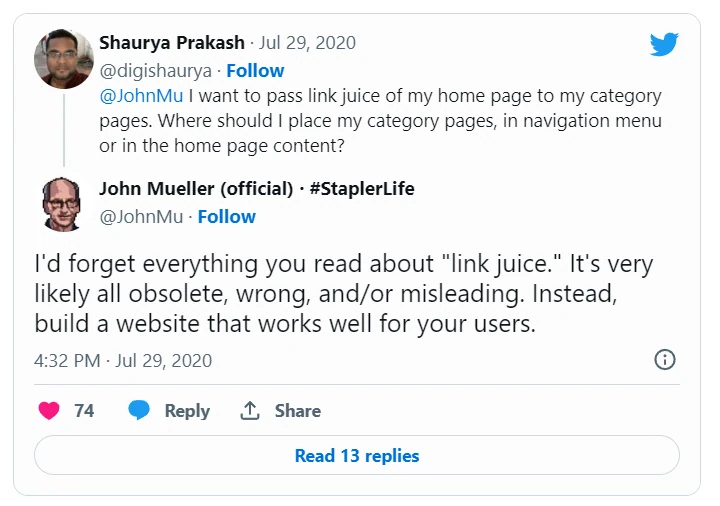
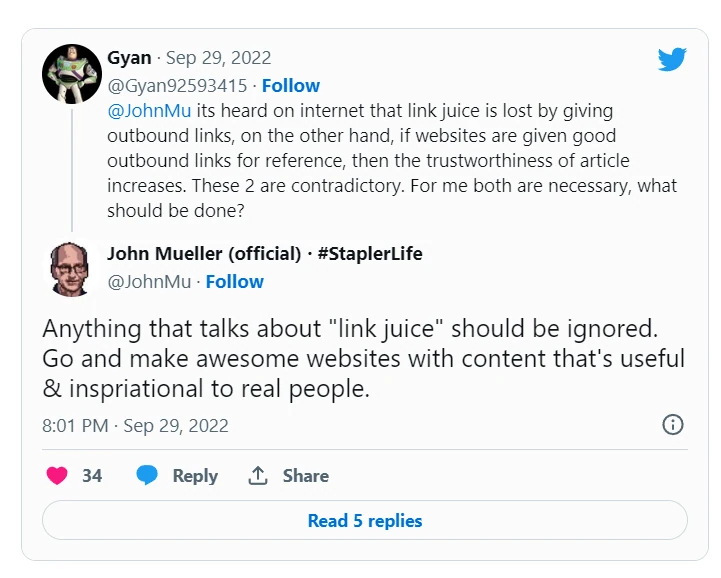
The article notes that Google has expanded its algorithm with additional signals, AI and E-E-A-T. John Mueller is also said to emphasise that it is worth focusing primarily on content usefulness.
How can you get more Link Juice on your site?
You should create high-quality content, take care to segment for your audience and acquire valuable links, for example through guest posts. Publishing product reviews online can also help.
Do guest posts help increase link power?
Yes, because they can bring more readers from the partner’s blog and increase the site’s authority in a given segment. As a result, this can improve SEO and link power.