Search engine optimisation (SEO) is a complex process. It involves many important actions. Among other things, you need to tell search engine robots how they should move around the site. Link nofollow and dofollow therefore play a very important role.
What is a nofollow link?
A nofollow link contains the nofollow attribute (rel=”nofollow”).
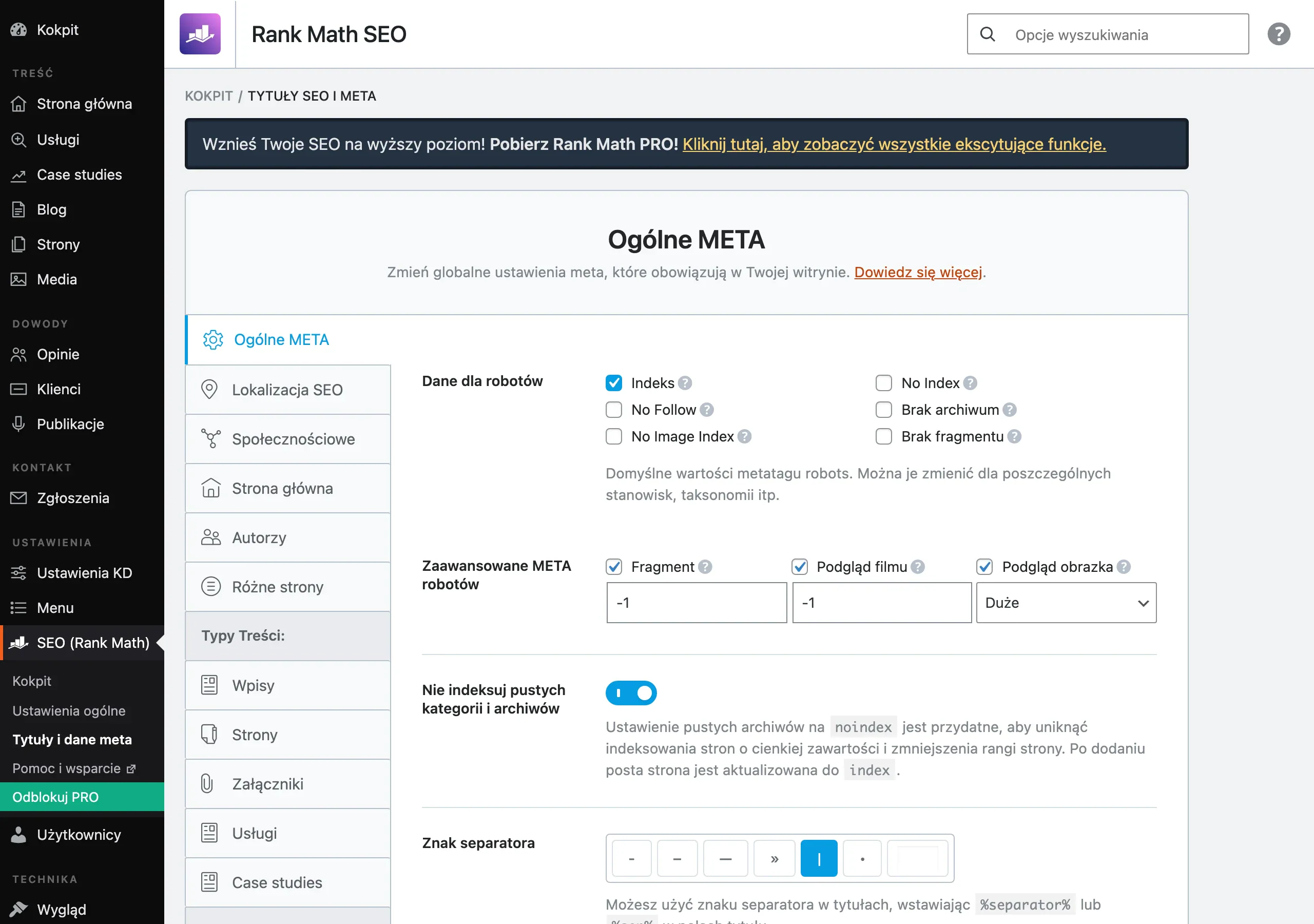
ExampleGlobal meta robots are set in one place: here you decide whether empty archives should be indexed and how long a snippet Google can show. Rank Math in WordPress (local CMS), own screenshot
The nofollow attribute tells search engines not to pass link equity. This means that the linking site does not want to pass equity to the linked site.
Google introduced the nofollow attribute (also called the nofollow tag) in 2005 to prevent manipulation using links, in particular comment spam. When a search engine robot notices the nofollow tag, it simply ignores the link for search ranking purposes.
Note: nofollow links are links with the value “nofollow” in their “rel” attribute. Technically speaking, “nofollow attribute” and “nofollow tag” are incorrect terms. However, they are commonly used and understood, so they will be used interchangeably in this article.
This is what the HTML code of a standard link leading to Apple’s homepage might look like:
<a href=”https://apple.com/”>Apple</a>
This link will pass link equity to Apple’s homepage.
The nofollow tag in this link will help ensure that search engines do not treat it as a ranking signal or pass ranking value.
Note: although there is no “follow” or “dofollow” tag here, the term “follow link” or “dofollow link” is often used to distinguish nofollow links from links that pass equity.
SEO & link buildingWhat is a nofollow link?
01rel=’nofollow’ attributeInforms search engines
02Does not pass equityThe linking site does not share ranking equity
03Prevents spamGoogle introduced it in 2005 against manipulation
04Ignored by robotsDoes not affect search ranking
Key for link strategy, but not for ranking.
Other link values
In 2019, Google introduced two new rel attribute values that do not pass link equity:
rel=”sponsored”: used for sponsored links,
rel=”ugc”: (UGC = user-generated content) used for links created by users, such as links in comments or forum posts.
The nofollow value can be used interchangeably for both rel=”sponsored” and rel=”ugc”.
Note: when the general term “nofollow links” is used in this article, it includes all links that do not pass equity (rel=”nofollow”, rel=”sponsored” and rel=”ugc”) unless stated otherwise.
There are also the rel values “noreferrer” and “noopener”. Neither of them has any impact on SEO, however. They are related to analytics and security.
How do you check nofollow links?
To check whether a specific link has the nofollow tag, you need to inspect the page source code.
Hover over the link, right-click and select “Inspect” (this element may have different names in different browsers).
If you notice the word “nofollow” in the rel attribute, it means you are dealing with a nofollow link.
SEO guideHow do you check nofollow links?
01Inspect the elementRight-click your mouse
02Find in the codeLook for the rel attribute
03Identify nofollowFind the rel="nofollow" tag
A quick way to verify a link attribute directly in the browser.
Best practices for nofollow links
Using nofollow links
Here are the most common uses of nofollow links:
linking to a site you do not want to promote. If you do not want to be associated with the linked site (e.g. you need a link to a gambling site, but do not want to identify with it), use rel=”nofollow”,
sponsored/paid links. If a link is sponsored or purchased in any way, use rel=”sponsored”. This applies to both incoming and outgoing links,
affiliate links. Similarly, in the case of such links leading to or from your site, use rel=”sponsored”,
user-generated content. For links created by users on your website, such as links in comments or forum discussions, use rel=”ugc”.
Note: a single link can have more than one value. This means that a link with rel=”nofollow sponsored” is technically correct.
For more information, you should check Google’s detailed guidelines on when and how to use nofollow links.
SEO and positioningnofollow backlinks and SEO
01Limited link powerThey do not pass PageRank, they do not affect rankings.
02Indirect valueDespite lacking direct power, they bring benefits.
03A hint for Google (2020)Used as a signal for indexing and crawling.
04Content contextThey indicate how the words in the link describe the target content.
Summary: nofollow links are not worthless; they are an important signal for Google, supporting the indexing process and understanding the page context.
When should you not use nofollow links?
In the past, the nofollow attribute was often used contrary to its basic purpose, to influence how link equity passes from a given page. For example, when trying to transfer more link equity from one’s own pages through internal links, the nofollow tag was used on all external links.
This technique (known as PageRanksculpting) no longer works. Google has changed the way nofollow links are counted towards PageRank.
Unfortunately, some people still see the nofollow attribute this way, and that leads to poor practices.
Below are two common examples of how not to use nofollow:
using nofollow for all external links. You should not use the nofollow tag on all links leading from your pages. It does not help your website, and may even harm it,
using nofollow in internal links. You should not use nofollow in internal links. If you do not want a given page to be crawled or indexed, there are better ways to achieve that. For example, robot meta tags.
nofollow backlinks and SEO
nofollow links (including rel=”sponsored” and rel=”ugc” links) do not pass link equity or the equity is limited. There is ongoing debate among many specialists, although nobody turns down a nofollow link from Wikipedia :). This means they do not improve PageRank and are not used by Google for ranking purposes.
That is why many people believe that nofollow links have no SEO value at all. However, it turns out that there are certain benefits to having nofollow backlinks.
Here are a few examples:
traffic – some sites, such as Forbes, use only nofollow attributes in external links. However, it is worth getting a backlink from them because it will drive traffic to your site,
visibility – a mention of a given site on high-quality pages has a significant impact on brand image and awareness. This, in turn, can lead to the natural acquisition of “follow” backlinks from other sites,
diversifying the backlink profile. This is important, especially if you actively acquire links. Getting too many “follow” links can look unnatural. Nofollow links help diversify the link profile.
In 2020, Google changed the way it treats nofollow links. The search engine no longer ignores them completely, but uses them as a hint for crawling and indexing purposes.
This includes informing how the words contained in links describe the content they point to. This helps Google better understand unnatural link structures.
Although nofollow links will not suddenly start to play a significant role in SEO, we know that Google pays attention to them.
What is a follow link (or dofollow)?
The terms “follow link” and “dofollow link” are often used to indicate that a link passes equity. These terms simply refer to standard links that are the opposite of the nofollow, sponsored and UGC parameters.
However, one thing needs to be clarified. There is no such thing as a “follow” or “dofollow” link attribute.
Even if you come across a link with the rel=”dofollow” attribute (which is, of course, rare), such an attribute is unnecessary and has no effect on the link.