Sometimes situations arise in which it is necessary to use the products and services of reputable local companies with good reviews. It turns out that such offers can be found via Google.
Finding local companies quickly is possible thanks to local SEO. Every company in the world can benefit from it. It is therefore worth getting to know the topic more closely.
What is local SEO?
Local SEO is a strategy that allows a company to gain greater visibility in local search results. It helps customers discover, evaluate and contact local companies that meet their needs more easily. In addition, such a strategy affects brand awareness, website traffic, leads and sales.
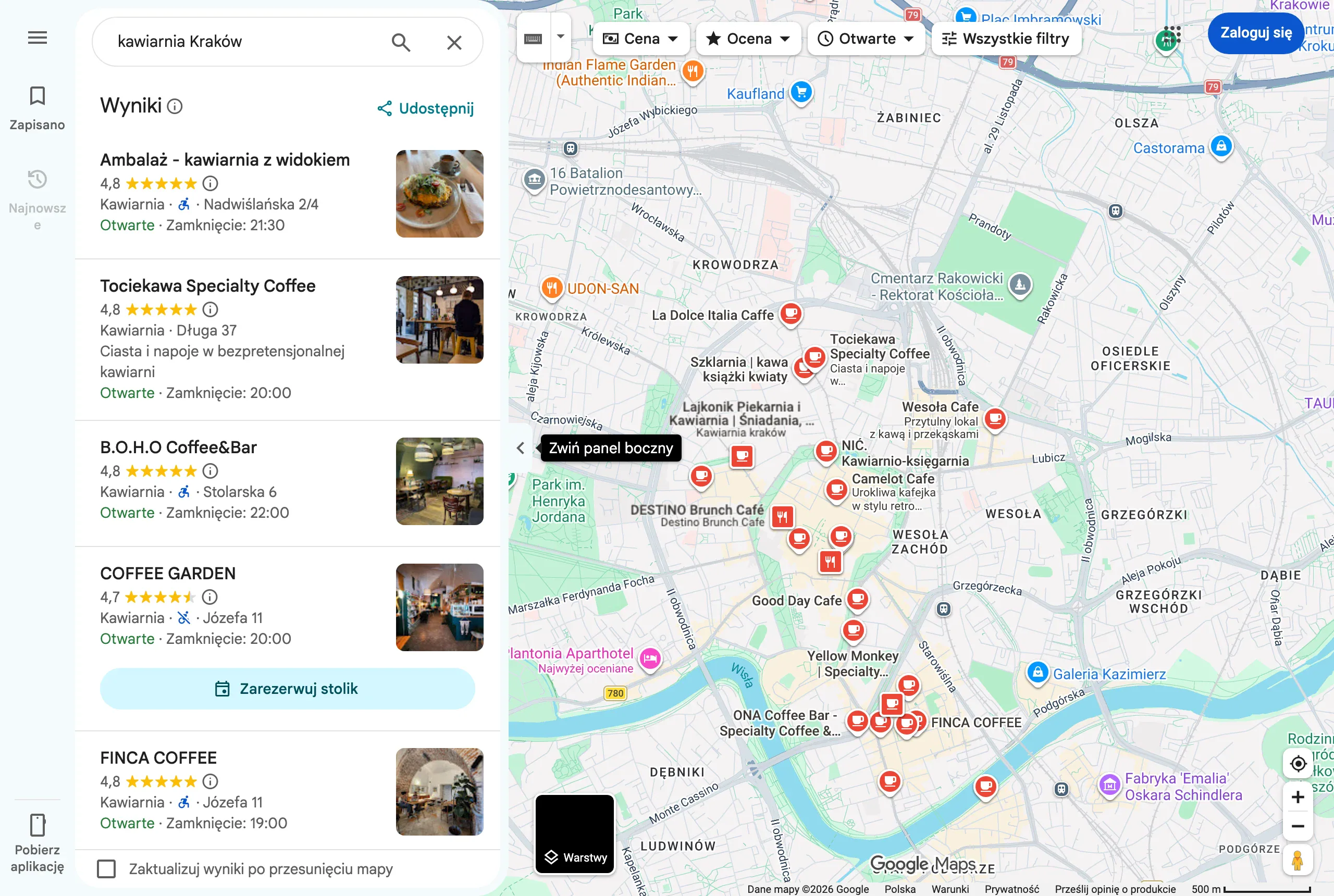
ExampleIn local results, the click is determined by profile data: rating, number of reviews, category, opening hours and photo. Google Maps, general query for cafés in Kraków, own screenshot
SEO guideWhat is local SEO?
01Greater visibilityIn local results
02Easier discoveryFor nearby customers
03Improved resultsTraffic, leads, sales
A key strategy for local companies to attract customers and increase sales.
What do local search results look like?
Search results for local companies look a little different from traditional search results, but they are not entirely different.
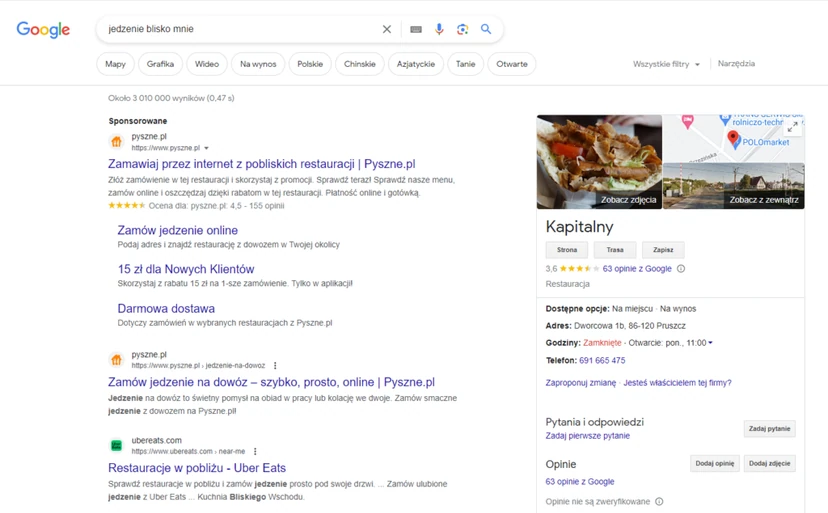
For example, Google usually shows the “Map Pack” above the results. This map displays several local companies that rank highest.
Of course, for a company website to be shown on the map, the business must have a Google Business Profile.
In addition to appearing on the map, it is important to optimise the company website to improve visibility in local organic search results. These are the results displayed immediately below the map.
Appearing in organic results is very important. Customers may see a given listing on the map and notice that the company has 4- and 5-star reviews. Then the company website will be shown in the organic results. This creates a sense of validity and trust, because users see the company not only on the map, but also high in the results below it.
It is also possible to rank a website for local organic results even if the company is not physically located in that area. In such a case, the business will not be promoted on the map, but it can still appear below it. The condition is to have local keywords on the website and unique content specific to that location.
An example of local SEO based on a query related to searching for dining venues
How does local SEO work?
Along with Google’s standard ranking factors, the search algorithm uses three main factors to match results to queries as well as possible:
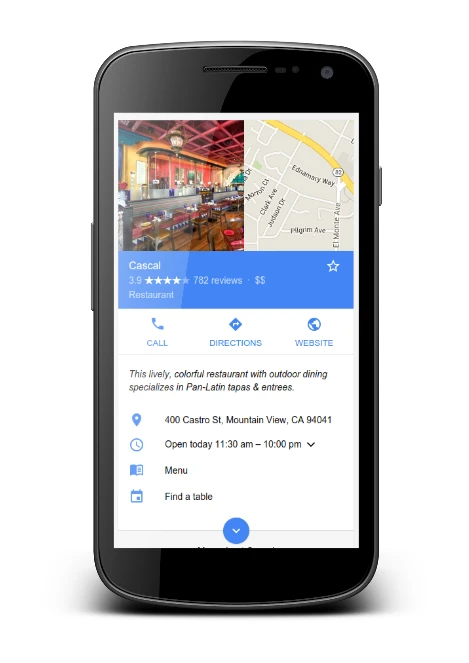
DiagramA local business card in Google: rating, category, address, opening hours and action buttons — all these fields come from data that the company fills in itself.Source: Google Search Central, CC BY 4.0
relevance (how closely the Google Business Profile searched for is related to the words used by the user in the query),
distance (how far, according to Google, the user is from the company being searched for),
prominence (how important, according to Google, the company is to its potential customers).
Next, Google displays two types of results for local searchers. These are the “local pack” (Google Maps and Business Profiles) and organic results.
Organic results are the “normal” results in the form of blue links that we usually see in Google.
The local pack (or map pack) is a Google feature showing a list of the best local businesses on the map. It is displayed right at the top, and the “normal” results are below it.
Of course, Google does not display local results only for queries containing the keywords “near me”, voivodeships or cities. They will be displayed whenever Google considers the search intent to be related to a local result. This also applies to situations where the search is not explicitly local.
For example, if you are in Warsaw and search for “hairdressers”, Google may display the local pack for hairdressing salons in the capital.
SEO guideHow does local SEO work?
01Local algorithmThree main ranking factors for query matching.
02Local packGoogle Maps and Business Profiles right at the top of the results.
03Organic resultsStandard 'blue links’ below the map pack.
The key to success is optimisation for both types of search results for maximum visibility.
How to start promoting your own business with local SEO?
There are certain things that need to be taken care of in terms of local SEO. Fortunately, you do not need to do these tasks all at once. It is enough to focus on one, and then move on to the next.
Creating a Google Business Profile
As mentioned earlier, it is essential to create a Google Business Profile. This is where you add the business name, address, phone number, industry, opening hours, website address, etc. You can also publish Google Posts from your own profile. They will be displayed in the local search results list.
Category: knowledgeLocal SEO vs traditional SEO – what is the difference?
01Traditional SEO (Broad reach)Improving organic results, national and international reach, mainly e-commerce.
02Local SEO (Local results)Local rankings, Google Business Profile, a website is not necessary.
03Difference in focusDifferent goals (general vs. local), but the processes often overlap and complement each other.
Key takeaway: Both types of SEO have common elements, but they differ in scope and strategic goals.
Checking local keywords
Keyword research is important for both local and traditional SEO. Bearing this in mind, it is worth remembering that looking for local keywords is a little easier, because all you need is a short list of keywords used by people to look for nearby businesses.
Of course, it will be necessary to use “business + city” keywords. In addition, it is worth looking for more general keywords related to the business in question.
For example, if you type the word “painter” into Google, you can get a list of suggestions. The first few suggestions are helpful, but the rest are no longer valuable for local SEO.
However, if you type “painter c” into the search engine, you can get a better list of possible options.
Once you already have some ideas, you can check them using tools such as Google Keyword Planner, for example, to get data such as monthly search range, trends and changes over time. You can also use Keyword Planner to find new keywords using the “Start with a Website” function.
You can then add the best keywords to the website and Google Business Profile. They will help you appear in front of users entering queries containing such keywords.
Ensuring consistency of business data on the Internet
Search engines such as Google want the business data of a specific company (such as name, address and phone number) to be the same across the Internet. This allows the business data to be verified and approved and helps Google rank the website higher in local search results.
Apart from your own website and Google Business Profile, you should check your details in business directories (Yelp, BBB, etc.) and on other relevant external websites.
Getting reviews about your business and managing them
Another important issue when it comes to local SEO is getting online reviews. Not only do they help search engines rank the website higher in local search results, but they also help users make the right assessment of a given business.
Once you start getting reviews, you need to reply to them. Even negative reviews have a positive impact on local SEO activities.
Regular monitoring and adjusting online business results
After carrying out the previous steps, you need to monitor how the company is ranking in local search. There are many SEO tools that allow you to track positions in the map pack and in organic search results.
Using this data, you can make changes (if necessary) to make sure the company maintains maximum visibility for customers.
Local SEO and traditional SEO – what is the difference?
When investing in search engine optimisation, the mere thought of doing a huge amount of extra work can be discouraging. However, many things are connected. That is why it is worth understanding that SEO focuses on improving all organic results, while local SEO focuses on improving local rankings.
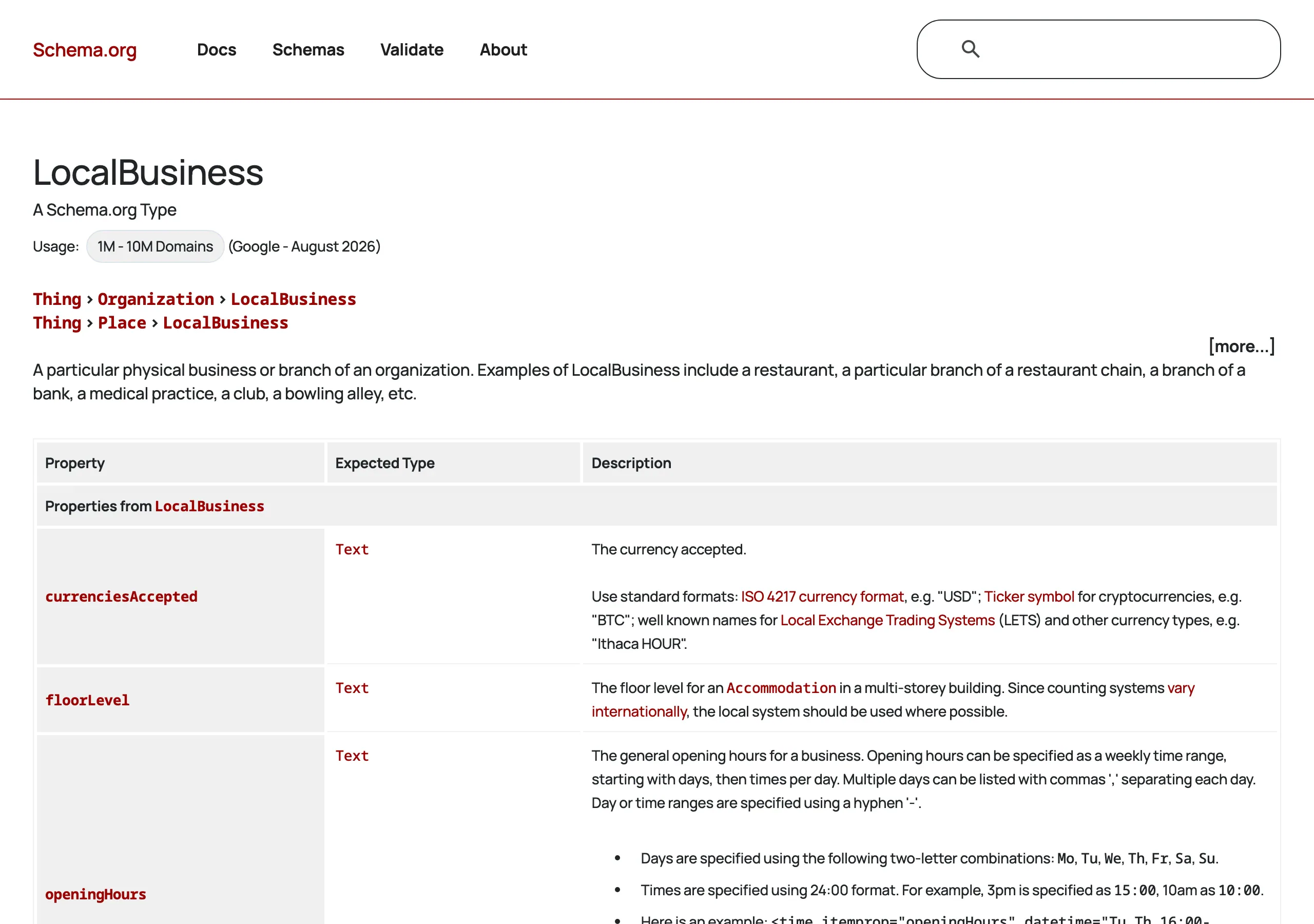
ExampleThe LocalBusiness type documentation lists properties that can be marked up: opening hours, price range, address or geodata. schema.org, own screenshot
Technically speaking, for local SEO you do not even need to have a website. A Google Business Profile is enough, and it will be ranked in the local pack.
SEO (both national and international) is about improving a website so that it ranks nationally and internationally on a broader scale. This mainly applies to e-commerce brands and websites and businesses whose products and services can be bought practically anywhere.
On the other hand, local SEO involves improving various factors to give the website and Google Business Profile the best chance of ranking for specific products or services in a defined area. It is the ideal solution for businesses such as restaurants, local shops or franchises.
For example, an e-commerce brand focuses on a high position for the keyword “sukienka midi”, while a local shop will be more satisfied with a high position for the keyword “sukienka midi w [lokalizacja]”. Simply adding a location-specific term makes the results for the above keywords differ significantly.
In local SEO, it is still best practice to do everything that is done in traditional SEO. For example, you should ensure the website is technically sound.
Who needs marketing that takes local SEO into account?
local businesses: usually brick-and-mortar locations that want to attract more customers,
SEO agencies working with local clients,
franchises and brands operating in multiple locations,
service-based businesses.
What are the benefits of using local SEO?
Marketing based on local SEO increases visibility in local search results. This solution is therefore helpful when you want to reach more people locally, attract additional traffic, generate more conversions, improve your reputation or grow your business.
Reaching a wider audience
Better visibility in local search results means that more people have a chance to discover a given business. The searcher can then go to the business website, call the business or visit it in person.
Generating more conversions
Taking actions aimed at increasing visibility in search results will naturally lead to more people visiting the business website. More traffic translates into more conversions (such as sales, subscriptions or enquiries about services).
Online customers can often find the information they are looking for in search results. This means they do not always need to visit the business website.
Improving reputation
Regardless of the type of business, a good reputation is an important condition for achieving long-term success. Carrying out local search marketing tasks makes it possible to create and maintain a positive public profile.
Regularly obtaining new online reviews is one of the most important aspects of improving your reputation online. After all, such reviews play a significant role in customers’ decision-making process. A steady flow of new reviews is also an important and proven ranking factor.
FAQ
Frequently asked questions
01How does local SEO work in Google results?
Google takes three main factors into account: relevance, distance and prominence of the business. On this basis, it shows the local pack and organic results matched to search intent.
02Do you need a website for local SEO?
No, technically a Google Business Profile is enough to appear in the local pack. However, a website also helps in local organic results.
03What actions are worth starting with straight away in local SEO?
First, it is worth creating a Google Business Profile and filling it in with the most important details. Then it is a good idea to check local keywords, business information consistency and customer reviews.
04Why are reviews about a business important in local SEO?
Reviews help search engines assess a business more accurately, and help users make a decision. Even negative reviews matter if the business responds to them.
05When does Google show local search results?
Google shows them not only for queries with a city name or the phrase „near me”. They also appear when the algorithm considers the search intent to be local.
06Which businesses need local SEO the most?
It is most beneficial for local businesses with a physical location, SEO agencies serving local clients, franchises and brands operating in multiple locations, and service businesses.