

A drop in visibility in SEO is not a “fix plan” at all, but a signal to diagnose. The biggest mistake happens when, after a few worse days, people start changing content, meta data, linking and the site structure all at once, hoping that something will “click”. In that setup, it is easy not only to make things worse, but also to take away your chance to establish what the real cause was. After a drop in visibility, you first need to confirm what exactly fell, where, since when and after which change, and only then implement fixes. A good response is not about speed, but about sequence: verification, segmentation, hypothesis, a small test, monitoring. This approach saves time, cuts through the chaos and gives you a genuinely better chance of making the right decision.
What is the decision-making process after a drop in visibility in practice?
The decision-making process after a drop in visibility is a structured analysis designed to establish what has really changed and whether it actually requires action. In practice, the point is not to “fix everything” in a panic, but to narrow the problem down to a specific group of URLs, queries, devices, countries, or to the moment of deployment. That is the difference between diagnosis and a reaction driven by nerves.
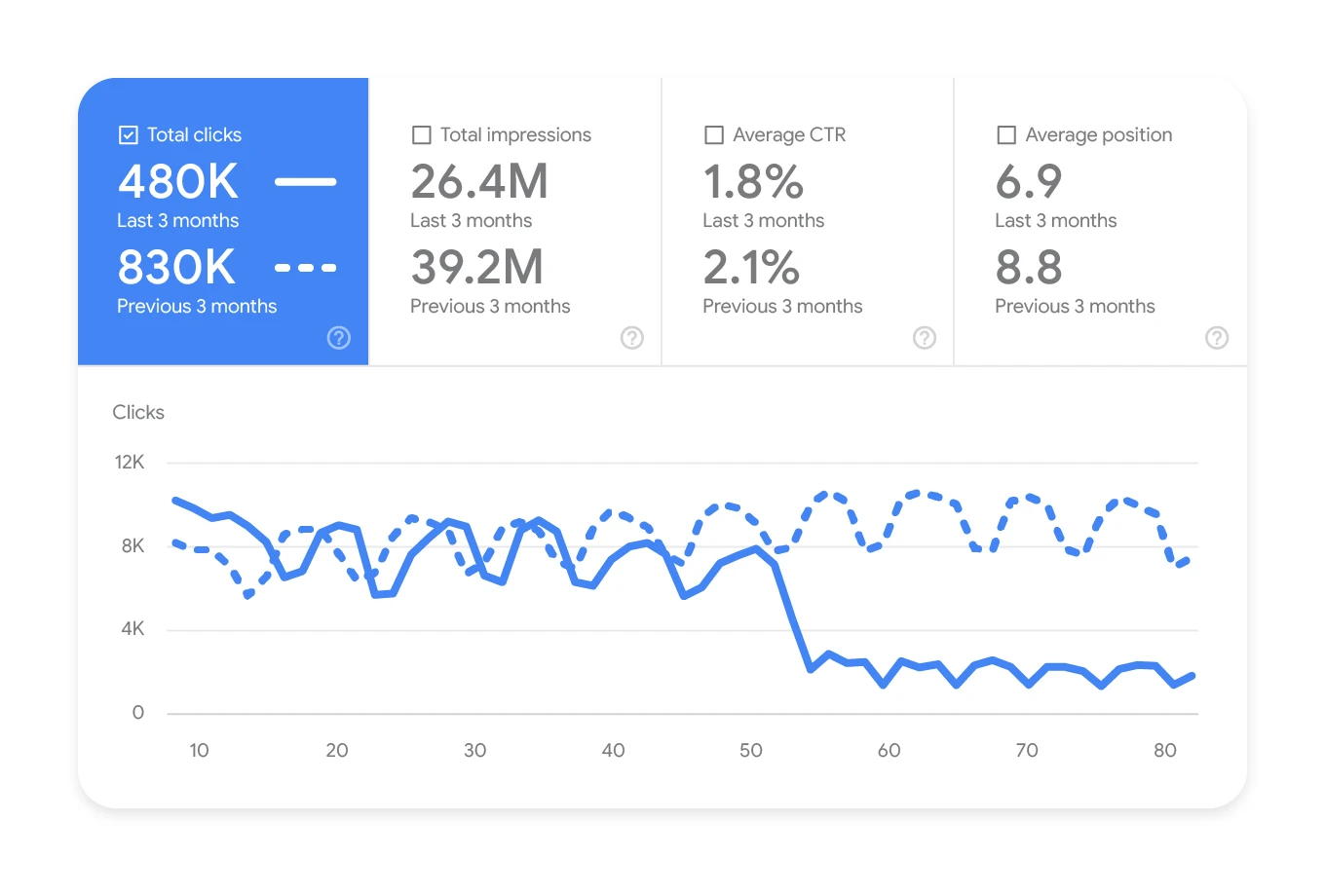
First, separate three phenomena: a drop in rankings, a drop in clicks and a drop in organic traffic. These are not synonyms, because they can have different sources and lead to completely different decisions. A drop in rankings without a drop in clicks does not require the same response as a drop in clicks with stable rankings. Likewise, a drop in traffic in GA4 does not always mean an SEO problem, because the cause may be faulty tagging, a change in cookie consent, or simply a measurement issue.
In practice, this process is based on combining several data sources. Most often this involves Google Search Console, GA4, server logs, a technical crawl and the history of deployments and changes on the site, ideally with dates. Only after combining these elements into a single timeline can you assess whether the problem concerns indexing, rendering, content, internal linking, template changes, or simply an incorrect interpretation of the report.
This approach matters because rash moves often end in making things worse. Mass rewriting of content, changing URLs or rolling back an entire deployment removes the traces needed for analysis and adds further variables that cloud the picture. The more uncoordinated changes you implement at once, the harder it is to determine what really hurt or helped. A sensible process therefore starts by reducing chaos, not by increasing the intensity of action.
Current analytical context for visibility changes
The current analytical context for visibility changes is that drops do not come solely from errors on the site. Results are also influenced by algorithm updates, changes in user intent, the restructuring of search results, seasonality, fluctuations in demand and the growing share of elements such as rich results, video, maps or forums. That means even a technically sound site can lose SERP exposure for external reasons, independent of implementation quality.
So before you make a decision, check one thing: has the drop in visibility translated into a real business problem? A rankings chart on its own does not deliver the answer. Instead of looking only at rankings, compare clicks, impressions, CTR, average position, the share of branded and non-branded queries, and the share of key landing pages in conversions. A drop in visibility does not always mean a drop in valuable traffic, and certainly does not always mean a drop in business performance.
In practice, the checkpoints are fairly concrete. You usually start with the Performance report and indexing reports in Google Search Console, then you add deployment annotations in GA4, log analysis of the server and a full technical crawl of the site. And this is where it gets interesting: compare template versions, meta data and internal linking, because many drops start with a change that, “on paper”, looked like a minor detail. If you do not align the date of the drop with the date of the deployment, it is very easy to fix the wrong problem.
Be particularly cautious when analysing after a migration, CMS change, URL structure change, deployment of a new template or a mass content edit. This is not the time for guesswork. High risk also comes from changes to canonicals, redirects, robots.txt, noindex, pagination, filters and URL parameters. The problem is that these are areas where a single error can “run through” a large part of the site. And without hard analysis, you do not know whether the issue is indexing, a loss of content relevance, or perhaps a change in how the page is rendered.
How does the process of responding to visibility drops work?
The process of responding to visibility drops consists of separating the signal from the cause and implementing only those changes that result from the diagnosis. It sounds sensible, but in practice this is usually where chaos appears. First establish whether the drop affects the whole domain, one directory, a specific type of page or only a selected group of queries. That is the basic filter, because the problem is interpreted differently on a category page, differently on a blog, and differently again when the drop concerns mobile only. The biggest mistake at this stage is treating every drop as a sitewide problem.
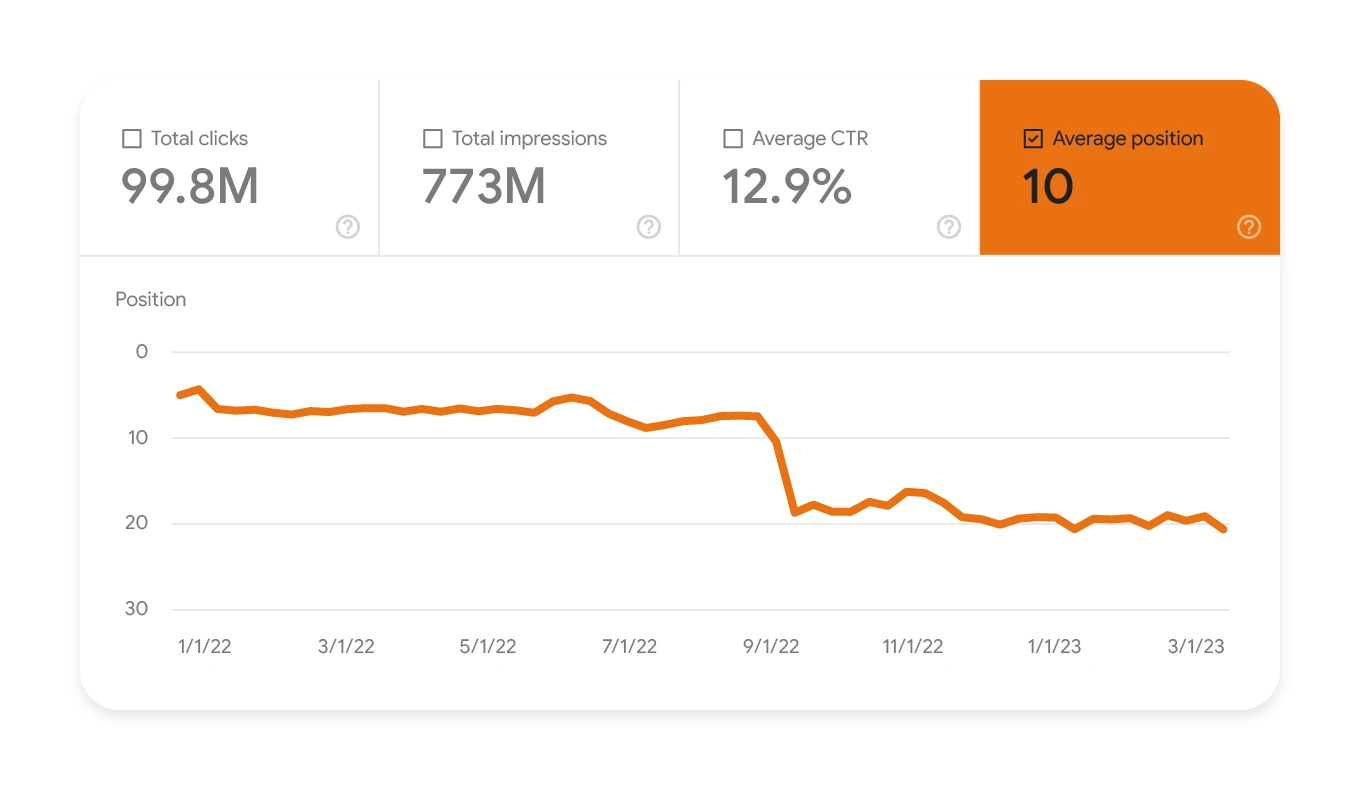
Then you build a timeline of events and compare the date of the drop with what actually changed on the site or outside it. The question is: what exactly did you touch in the code, content or infrastructure before the curve went down. In practice, you check front-end and back-end deployments, template changes, content edits, changes to internal linking, migrations, redirects, canonicals, robots.txt, noindex and hosting outages. But beware, the picture is broader: add information about Google updates and changes in search results, because some drops do not result from an error on the site’s side, but from a change in how results are assessed or presented.
The next step is segmentation. It answers the question of what exactly lost visibility and where in the funnel. You need to separate branded queries from non-branded ones, informational from transactional, and also check differences between desktop and mobile, countries, languages and SERP result types. A drop in clicks, a drop in impressions and a drop in average position do not mean the same thing, so they should not lead to the same decision. If impressions have fallen, the problem more often concerns demand or indexing. And when positions look similar but clicks are shrinking, it is usually about CTR, a change in the SERP layout or a shift in intent.
Once you know where the problem lies, the hard technical analysis begins. No fireworks. You check indexability, HTTP status codes, redirects, meta robots, canonicals, XML sitemaps, pagination, parameters, JavaScript rendering, the quality of internal linking and content accessibility for the crawler. The key is to combine data from Google Search Console, a crawl of the site and server logs, because only together do they show whether Google can find the page, fetch it, render it and treat it as the correct version for the index.
At the same time, you need to review the content against the current search intent. And this is often where things get uncomfortable. It happens that a page has no technical issue at all, but it no longer matches what ranks today for a given query. This can happen after shortening content, excessive automation, removing supporting sections, changing heading structure or after overly aggressive optimisation for a keyword. If the SERP now shows guides and your page is clearly sales-led, improving the title or H1 usually will not solve the problem. The question is whether your page is still playing the same game as the SERP.
At the end, you choose the minimum set of changes. One that has the strongest justification and can be fairly assessed after implementation. It is not worth rolling out a broad content rebuild, new internal linking, technical changes and URL modifications all at once, because then it stops being clear what helped and what hurt. It is better to deploy fixes sequentially, record them in a change log and monitor indexing, rankings, clicks, the share of landing pages and user behaviour. A good response to a drop is not a large number of actions, but the right order of actions.
What not to do after noticing a drop in visibility?
After noticing a drop in visibility, you should not roll out mass changes without confirming exactly what dropped and why. That is a straight road to chaos. The riskiest situations are those in which titles, headings, content, internal linking, structured data and URLs are changed in the same week. Such a move can not only worsen the result, but also takes away the possibility of a reliable diagnosis. If you change everything at once, you stop knowing what was the cause and what was the effect.
Do not judge the situation based on one keyword, one chart or one tool. Visibility from rank tracking, clicks in Google Search Console and organic traffic in analytics are three different frames of the same film. They may rise in parallel, but they can just as easily diverge over time. In practice, a sensible decision is made only after comparing data from GSC, GA4, a technical crawler, server logs and a manual assessment of what the SERP looks like today.
Do not automatically remove pages from the index, merge URLs or add noindex just because a group of subpages has weakened. First you need to determine whether it is actually keyword cannibalisation, duplication or low quality, rather than, for example, broken internal linking, a shift in intent or an indexing error. Overly hasty “tidying up” on a site can hurt, because it ends up losing valuable long-tail visits and destabilising the entire topical architecture.
Rolling back an old version of the site without comparing the code, configuration and indexing effects is asking for trouble. Reverting a deployment sounds like a safety net, but in practice it can bring back old errors, remove correct elements and simply blur the picture. It becomes especially dangerous after a migration, CMS change, template rebuild or editing redirect rules. Rollback without analysis is often just another form of panic, not a repair plan.
Do not automatically assume that a drop always comes from on-site SEO or external links either. The source of the problem is often more mundane: hosting outage, changes to cookie consent, JavaScript blocking, incorrect routing, product feeds, rendering or analytics tagging. And vice versa, reflexively launching disavow or rapidly expanding external link building without hard evidence are blind moves. Before you label a drop as “off-site”, make sure the site is accessible, correctly indexed and aligned with the current type of results.
Do not ignore seasonality, demand and brand share. If branded queries are falling, the cause often lies not in SEO itself, but in lower awareness, weaker campaigns or changes in user behaviour. And when a highly seasonal category dips, a month-on-month comparison can be misleading, so you need to check year on year as well as the trend across the whole market. A drop in visibility does not always mean a business downturn, and a business downturn does not always result from rankings.
Instead of hasty actions, it is better to pause larger implementations for a moment and map out a timeline of changes. Then define the segment affected by the problem, carry out a technical check, a content assessment and SERP analysis, record hypotheses and choose the smallest justified fix to implement. This approach is not spectacular, but it gives you real control over the outcome. The question is what is a symptom and what is the cause. In SEO after a drop, the winner is not the one who reacts fastest, but the one who can distinguish the two most quickly.
What implementation decisions are key in the remediation process?
Key decisions are: the scope of changes, the order of implementation, the control metrics and what you consciously leave untouched. In the remediation stage, the team that changes the most does not win, but the one that can tie every fix to a specific hypothesis. The best remediation plan is usually smaller than panic after a drop suggests.
The first decision is: does the problem cover the whole domain, or only a selected segment. If the drop affects one directory, one template type or a group of queries, the actions need to be narrowed precisely to that area. That way, the risk does not spread to parts of the site that are working properly.
The second decision is choosing reversible and measurable changes. It is better to start with fixes to titles, headings, internal linking, indexability or removing a specific technical blockage than to rebuild the entire architecture. If you cannot clearly assess the effect after deployment, the change was too broad or simply poorly planned.
The third decision concerns sequence. You should not change content, URLs, canonicals, structured data and the page template all at once, because then you lose the answer to what actually affected the result. In practice, you first fix errors critical for indexing and rendering, then issues with content matching intent, and only at the end the supporting elements.
It is equally important to decide how long to wait before assessing the effect. Some technical changes are visible quickly in logs, indexing and crawl, but improvements in rankings or clicks usually take time and require Google to recrawl the page. Without a defined observation window, you end up making nervous adjustments and lose the chance for a reliable assessment.
An implementation decision is also to pause side projects that can blur the picture. If, alongside SEO remediation, the team changes the template, consent system, routing or rendering method, the results stop being comparable. That is why it is better to keep a simple change log: what was deployed, when, on which URLs and for what reason.
Finally, you need to define a set of control metrics for a specific segment, not for the whole domain. For some sites, impressions and average position will matter most; for others, clicks, share of non-brand traffic or the share of landing pages in conversions. A good implementation decision always links one change, one segment, one hypothesis and one method of assessment.
Typical mistakes and risks associated with hasty actions
Typical mistakes are mass, non-sequential changes implemented without confirming the cause of the drop. The biggest risk is not only the lack of improvement, but the loss of comparative data and the blurring of the diagnostic trail. After a few parallel moves, the team often no longer knows what the original problem was and what was the result of its own actions.
- Mass rewriting of content after a drop in several keyword groups. The problem is that it is easy then to lose intent matching, break the logical structure of information and worsen quality on pages that were previously simply working.
- Changing many elements at once: title, H1, content, linking, URL and structured data. The side effect can be painful, because afterwards you cannot fairly assess which adjustment helped and which directly harmed.
- Removing pages, adding noindex or merging URLs without diagnosing cannibalisation and indexing. This is a straightforward route to permanent loss of topical coverage and weakening of internal linking, and therefore two things that are built over months.
- Rolling back to an old version of the site without comparing code and configuration. It sounds like a quick “let’s roll it back”, but in practice it also reverts correct elements and can add fresh technical conflicts.
- Assessing the situation on the basis of one keyword or one tool. The data clearly show that this is often a reaction to noise, not to a real trend visible only when several sources are compared.
- Sudden off-site actions such as disavow or rapid link acquisition, without strong grounds. The risk is simple: you are treating the wrong cause when the problem lies in indexing, content or changes in the SERP.
Another common mistake is confusing signals. A drop in rankings, a drop in clicks and a drop in organic traffic do not mean the same thing, because the result shifts due to CTR, seasonality, the share of branded queries and the restructuring of search results. What use are rankings standing still if the SERP has been rebuilt. If you analyse only one metric, it is easy to fix the wrong problem — not the one that actually occurred.
A separate risk appears after migrations, CMS changes, a new template and mass edits. At such moments, the problem often lies in canonical tags, redirects, robots.txt, noindex, JS rendering or changes to internal linking, rather than in the quality of the content itself. The key is therefore to start with the technical side, not with cosmetic tweaks. First you check what may be blocking indexing or weakening crawl, and only then do you fine-tune the rest.
In practice, ignoring external factors is just as dangerous. A change in user intent, a bigger share of SERP features, or the arrival of forums, video or local results can reduce visibility even without an error on the site’s side. The question is: does the drop result from your changes, or from the fact that the stage in Google has been rearranged. Fixing a site against the wrong hypothesis usually costs more than the drop itself.
The safest approach is to limit operational chaos. Instead of responding to a drop with a series of big moves, it is better to freeze side deployments, map out hypotheses, implement the smallest justified fixes and monitor indexing, rankings and user behaviour. It sounds less dramatic, but it works. In SEO, after a drop, the most expensive thing is not the mistakes themselves, but the mistakes made in a hurry.
FAQ
Frequently asked questions
How do you check what really dropped after a drop in visibility in SEO?
First, you need to separate a drop in rankings, clicks and organic traffic, because these are not synonyms. Only then is it worth establishing whether the problem affects the whole domain, a specific directory, a group of queries, or a chosen device or country.
Can you immediately change content, meta data and internal linking after a drop in visibility?
No, because changing many elements at the same time makes diagnosis harder and can make the situation worse. It is better to carry out verification, segmentation and a small test first than to roll out mass fixes blindly.
Why does a drop in traffic in GA4 not always mean an SEO problem?
Because the cause may be incorrect tagging, a change in cookie consent or a measurement issue. That is why you need to compare GA4 with Google Search Console, server logs and deployment history.
When does a drop in visibility not have to mean a real business problem?
When rankings or visibility fall, but this does not translate into clicks, impressions, CTR or conversions. The position chart alone does not yet show the impact on business results.
Which technical changes are the most risky after a drop in visibility?
The greatest risk comes from changes in canonicals, redirects, robots.txt, noindex, pagination, filters and URL parameters. An error in these areas can affect a large part of the site.
Is rolling back to an older version of the site after a drop in visibility a good idea?
Only if it is preceded by an analysis of the code, configuration and indexing effects. Reverting a deployment without checking can bring back old errors and blur the picture of the situation.