

Customer journey · car electronics
Site migration and SEO: +49% clicks from Google and ×2.4 visits from ChatGPT, Gemini, Claude and Perplexity
OEMATIC repairs factory-fitted car radios, navigation units and amplifiers for drivers from Poland and across the EU. I led the SEO of the new website — from planning the structure, through the migration, to an AI assistant. The year-on-year results are already strong, and this is only the beginning.
Updated:
- Full SEO migration
- English version /en/
- AI assistant (RAG) with a dashboard
- Information architecture: brand → model → device
- clicks from Google year on year (Search Console, August–October 2026 vs 2025)
- +49%
- visits from ChatGPT, Gemini, Claude and Perplexity year on year (GA4, May–October)
- ×2.4
- keywords in Google’s TOP 10 year on year (Senuto, 1 Nov 2026 vs 1 Nov 2025)
- ×1.9
- keywords in Google’s TOP 3 year on year (Senuto, 1 Nov 2026 vs 1 Nov 2025)
- ×2.2
- impressions in Google year on year (Search Console, August–October)
- ×1.8
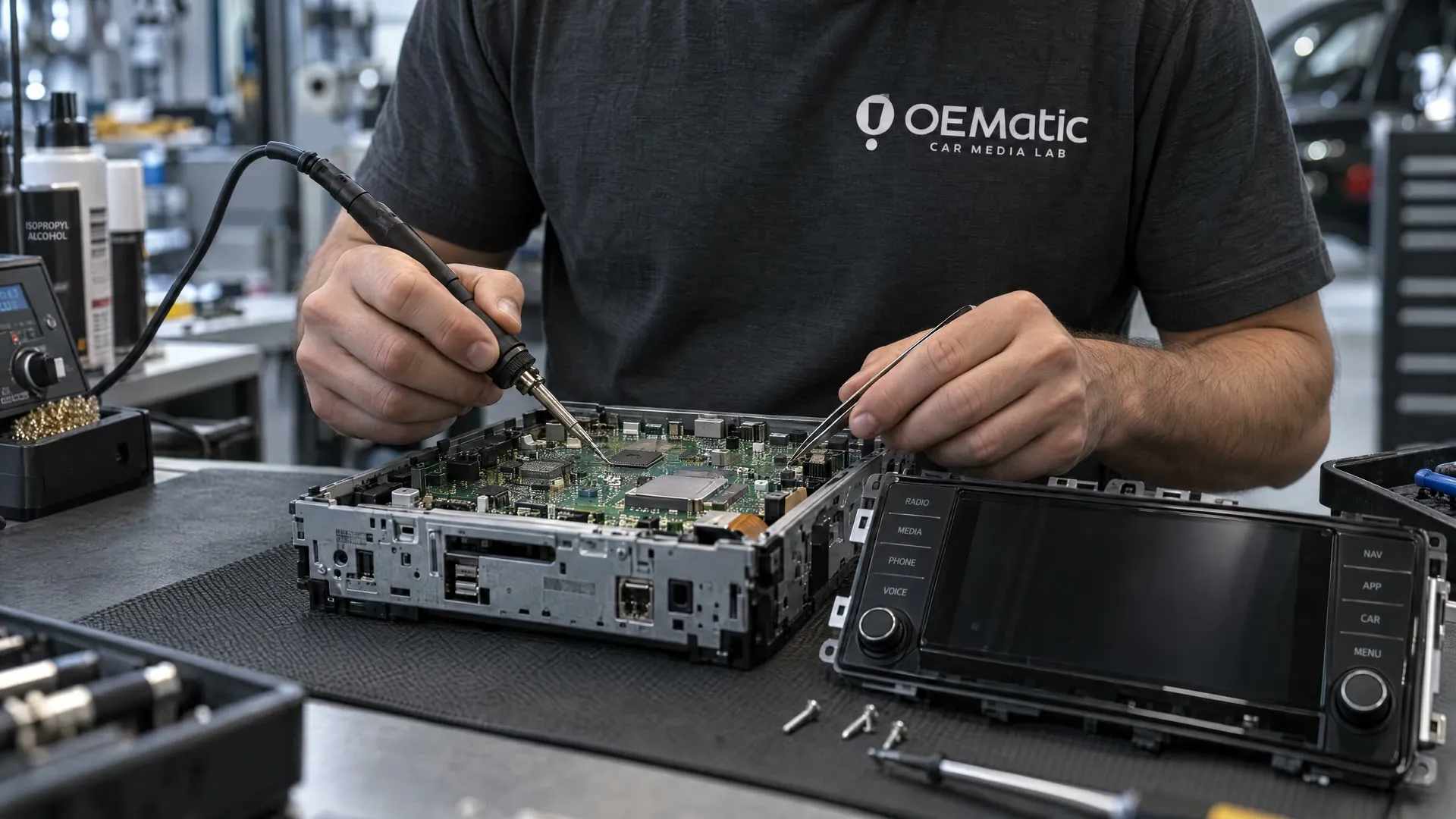
A workshop that fixes what others won’t touch
Factory-fitted radios, navigation units and amplifiers from cars across Poland and the whole EU. My job was to make sure drivers with exactly that problem went from Google straight to OEMATIC.
Key points
What the cooperation has delivered for the client, in five points. The numbers come from Search Console and GA4, which the owner can access directly, and from Senuto.
- A migration from planning to post-launch checks: co-designing the structure from September, a staging audit and fixes before launch. In the 12 days after launch, clicks from Google were up 38% (Search Console, first signal), and the traffic that had been growing before did not disappear.
- A brand → model → device information architecture: 37 car brands and 213 car models with their own pages, descriptions and FAQs. Across the whole site, almost twice as many keywords in the TOP 10 and more than twice as many in the TOP 3 year on year (Senuto).
- An AI assistant (RAG) with a dashboard: it answers from the workshop’s own knowledge and leads to a free quote; the first enquiry from abroad came in through the chat.
- Visibility in AI assistants: 2.4× more visits from ChatGPT, Gemini, Claude and Perplexity year on year (GA4).
- An English version and clients from across the EU: a complete /en/ section with hreflang, sitemaps and a translation panel for the owner.
Starting point
In 2026 OEMATIC moved to a completely new website. A new design, a new URL structure and a new content system are the quickest way to lose rankings during a migration, so SEO joined the project before launch, not after it.
OEMATIC works in a niche where customers don’t search for “electronics repair” in general. They search for a repair of a specific radio, navigation unit or amplifier in a specific car, and they often describe the symptom: a black screen, no sound, the radio asking for a code. Whoever answers that question best gets the job — often from the other end of Poland or from another EU country.
The old website had a history in Google: posts, case studies and service pages that customers had been landing on for years. Changing the site put that track record at risk, and the new site had no content yet for brands, models and devices. My task therefore had three parts:
- move all Google traffic across without losses,
- build an architecture and content that answer drivers’ questions,
- prepare the site for customers from the EU and for search in AI assistants.
Full SEO migration
I joined the project at the planning stage, not after launch. From September 2026 I co-designed the structure of the new site, audited the staging environment and checked every change in the data, so that customers kept going from Google straight to the workshop.
This is how the SEO migration went, step by step, from planning to post-launch checks.
September: structure plan and data model
I designed the device data model: brand → device → vehicle models, with vocabularies (device type, vehicle class, brand), content rules and readiness statuses. The brand, model and device pages of the new site were built on it.
September: staging audit and structured data before launch
I compared the old site with the staging version of the new one. The new site was missing, among other things, the properties of the company entity, FAQ markup and service markup on the local landing pages. I prepared a specification and, the same day, implemented and checked the first sections on staging.
September–October: pre-launch audit of the new site
An inventory of every page (type, URL, H1, content length, meta), a visual audit on desktop and mobile, and an audit of interactions and contact. The result: more than 100 tasks with priorities and implementation instructions.
October: fixes on staging
Before launch I implemented the fixes: a single H1 and a clean heading hierarchy, semantic HTML, accessibility (focus, screen-reader labels, button sizes), forms, tables on mobile and structured data.
27 October: launch and checks
On launch day I saved the state of production as a baseline. Then I checked the old URLs Google was still crawling, added the missing redirects and submitted the new sitemaps in Search Console. I limited the indexing of filters and technical URLs.
After launch: smart redirects for URL variants
Google remembered hundreds of variants of the old URLs: typos and shortened versions of post addresses. I wrote a module that, on a 404, compares the URL with published content and sets a 301 redirect only when the match is unambiguous. When in doubt it stays a 404, so nobody lands somewhere random.
Tests before every change
I tested every fix first on a local copy and on staging, and before deploying to production I backed up the database and files.
The result of the migration: instead of the usual drop after a site change, Google traffic grew straight away. In the first 12 days after launch, clicks from Google were 38% higher and sessions from search 35% higher than in the 12 days before launch (Search Console and GA4, first signal). Even before launch, on the old site, clicks were growing 49% year on year and impressions 1.8× (Search Console, August–October). The new site took over that growing traffic instead of losing it.
Information architecture and content
A driver doesn’t search for “electronics repair” — they search for a repair of the radio in their car. That is why the site got an information architecture that mirrors how customers search: car brand → model → device and fault.
Every level of this structure has its own landing page for long-tail keywords: from general brand queries, through specific models, to device names and fault symptoms. The pages are connected by breadcrumbs and internal links up and down the tree, so both Google and the driver always see where they are and where they can go next. This skeleton was filled with content based on the workshop’s expertise: descriptions and FAQs, not generic filler. More on how I design site architecture.
- tree: brand → model → device
- pages for 37 car brands with a description and FAQ
- pages for 213 car models with a description and FAQ
- device pages with a description of common faults
- breadcrumbs and internal linking across the whole tree
- specialist expert articles in a niche industry
- a home page section for car audio keywords
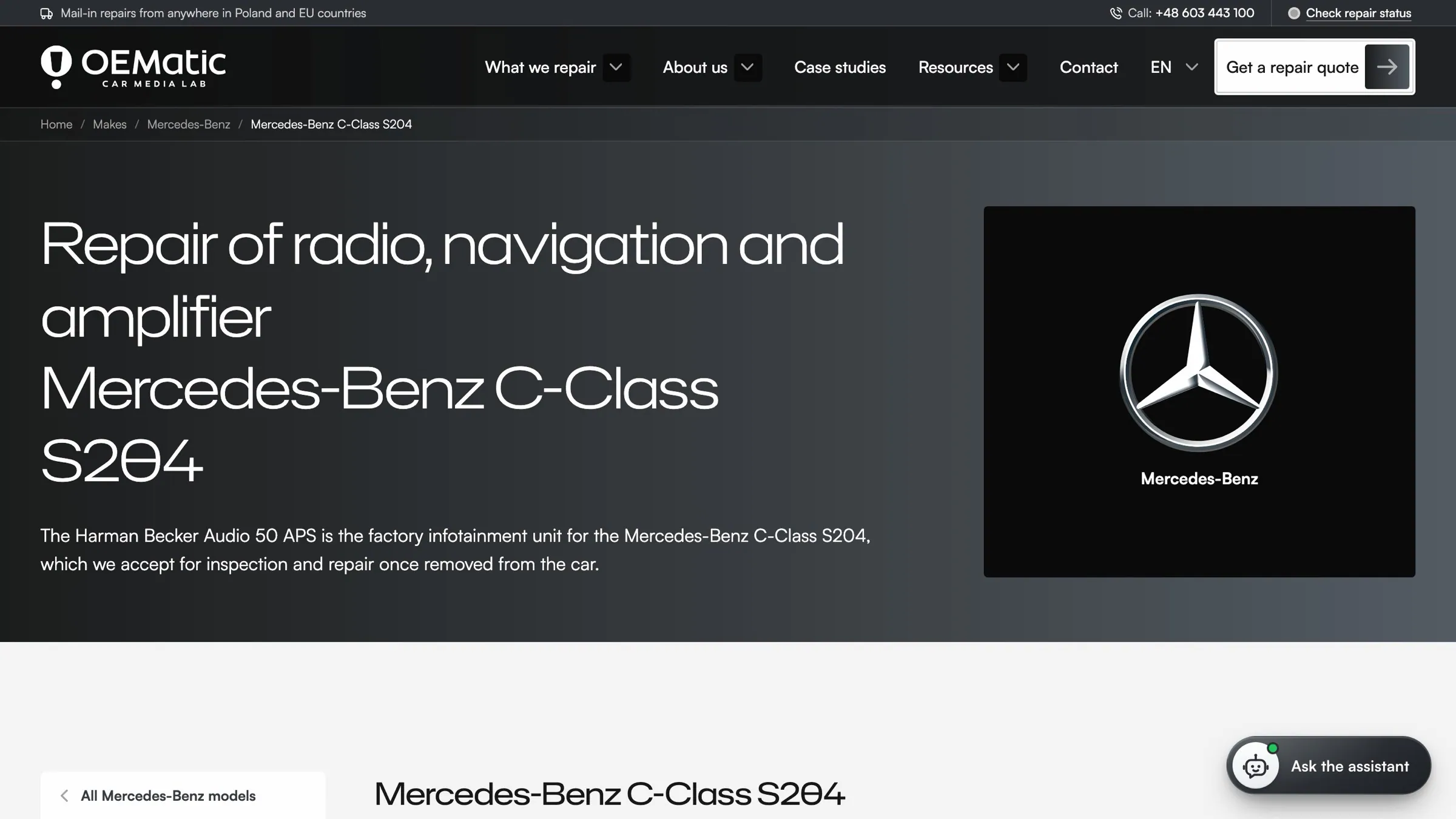
Structured data and semantic markup
Google and AI assistants understand a site better when it describes itself. Every page type got its own structured data in JSON-LD, so that when someone asks about a specific car and device, the search engine points to OEMATIC.
| schema.org type | Where | What it tells Google |
|---|---|---|
| Service + Offer | service pages | what the repair is and who it is offered to |
| Brand + Vehicle | car brand and model pages | which cars the repair applies to |
| FAQPage | brands, models, services | customers’ questions and answers |
| ItemList | lists of brands, models and case studies | what a given list contains |
| AutoRepair + ContactPoint | the whole site | who the company is, where it is and how to get in touch |
| WebSite + SearchAction | home page | the site name in Google results |
| BreadcrumbList | subpages | the page’s place in the structure |
English version
The workshop accepts devices from across the EU, so the site got a complete English version under /en/.
Translations are handled by a custom plugin: every page has an English counterpart, a PL/EN language switcher and correct hreflang tags. The English version has its own sitemaps and is indexed in Google. In WordPress the owner has a translation panel where he can edit the texts himself, without writing to a developer.
The effect was visible from the first days: on 12 November a driver from Romania asked the assistant about a radio repair and a moment later sent the quote form.
OEMATIC assistant (RAG) with a dashboard
The site runs an assistant that answers customers’ questions solely on the basis of the workshop’s knowledge: service pages, FAQs and documented repairs.
The customer asks
E.g. “the radio is asking for a code” or “how much does a Bose amplifier repair cost”. Ready-made questions are waiting on every page.
The assistant searches the knowledge base
The system retrieves the passages of the site’s content closest in meaning (RAG) and builds the answer only from them.
An answer with a link
A short, factual answer with a link to the service and an invitation to a free quote. When something isn’t covered in the content, the assistant says plainly that it doesn’t know.
A dashboard in WordPress
Conversation log, settings and a cost limit. Email addresses and phone numbers in the log are masked, and conversations are deleted after 90 days.
This is what a real conversation looks like, recorded on 24 Nov 2026 on the English amplifier repair page. A driver asks about a BMW F10 with a Harman Kardon sound system that stopped playing after water damage. Within seconds the assistant:
- confirms in English that the workshop repairs BMW F10/F11 Harman Kardon amplifiers after water damage,
- quotes the fixed price and the 24-month warranty exactly as they appear in the workshop’s offer, and says the final scope is confirmed after checking the module,
- gives the typical repair time of 2–5 days,
- leads to the quote form in one click,
- shows the sources of the answer: a BMW amplifier case study and the car model page.
Traffic from AI assistants (ChatGPT, Gemini, Claude and Perplexity) is 2.4× higher year on year, and this is only the beginning of work on this channel. Implementations like this are part of my work on visibility in AI assistants.
- first enquiry from the chat
- 12 Nov
- a driver from Romania asked about repairing the radio in a Lexus IS and sent the quote form
- visits from ChatGPT year on year
- ×3.2
- GA4, session source, May–October 2026 vs 2025
- average cost of a single answer
- ≈ $0.003
- approx. 1 grosz (PLN 0.01) per question, within a fixed monthly limit
Forms, contact and analytics
SEO brings the traffic, but an enquiry only arrives when the site guides the customer to the goal.
I went through the whole new site through the customer’s eyes and listed 111 things to improve in a single spreadsheet. Based on that, I improved the quote forms and the mobile menu, the legal details, the description of the repair process, the contact FAQ, the Google Business Profile reviews and the footer. I redesigned the repair status page from scratch (repair code field, progress bar, a five-step timeline, FAQ), and the blog and case studies got a new look with a table of contents.
WhatsApp is an exceptionally important channel for OEMATIC to reach potential customers. A driver with a fault would rather write and send a photo of the device than call, so the WhatsApp button is visible in the key places of the site, and I track every click in GA4 as a conversion.
Analytics and Google Ads audit. I checked what the ad account and GA4 actually counted as a conversion, and separated real contacts (phone, form, WhatsApp) from mere views of the contact page. This way budget decisions can be based on customers, not clicks.
Results
Numbers from Google tools the owner can access directly. A comparison of the same months year on year: August–October 2026 vs 2025.
| Metric | Period | Source | Change |
|---|---|---|---|
| Clicks from Google | Aug–Oct 2026 vs 2025 | Search Console | +49% |
| Impressions in Google | Aug–Oct 2026 vs 2025 | Search Console | ×1.8 |
| Sessions from search (Organic Search) | Aug–Oct 2026 vs 2025 | GA4 | +37% |
| Keywords in Google’s TOP 10 | 1 Nov 2026 vs 1 Nov 2025 | Senuto | ×1.9 |
| Keywords in Google’s TOP 3 | 1 Nov 2026 vs 1 Nov 2025 | Senuto | ×2.2 |
| Visits from AI assistants (ChatGPT, Gemini, Claude, Perplexity) | May–Oct 2026 vs 2025 | GA4, session source | ×2.4 |
Keywords at the top of Google year on year
The number of keywords for which OEMATIC ranks in Google’s TOP 10 and TOP 3, according to Senuto. On 1 Nov 2026 there were almost twice as many keywords in the TOP 10 as on 1 Nov 2025, and more than twice as many in the TOP 3. In November 2026 the number of keywords in the TOP 10 reached its highest level since measurements began in 2023 (362 keywords, Senuto). Google’s November core update (rolled out from 10 Nov 2026) is still in progress, and I will add a full summary once it is complete.
- TOP 10
- TOP 3
| Metric | Period | Source | Change |
|---|---|---|---|
| Keywords in the TOP 3 | 1 Nov 2026 vs 1 Nov 2025 | Senuto | ×2.2 |
| Keywords in the TOP 10 | 1 Nov 2026 vs 1 Nov 2025 | Senuto | ×1.9 |
Two key keywords for the company’s core business are now in Google’s TOP 3. These are exactly the queries drivers use to look for the workshop: car radio repair and amplifier repair.
#1position in Google
car radio repair
Core service
#2position in Google
car amplifier repair
Core service
For me, you can tell a good IT person by the fact that they know which tools to use to solve a specific problem. That is exactly what Kuba Dzikowski from KDSEO is like. He’s a freelancer who, if he doesn’t have the right tool, will simply build it himself. He just wants to know how something works and why.
I saw this for myself while working on the new OEMatic website. Kuba took the time to understand what a radio repair looks like from the workshop’s side and what drivers ask us about. Those questions and our repair descriptions became the basis for his SEO work on the whole site. He also built an assistant that uses our workshop’s knowledge to answer customers directly on the website. I was especially pleased that the first enquiry from abroad came in through that very chat.
Kuba, huge thanks for all your help with the website. I’m glad I found you! I recommend him 100%!
 Tomasz MazurkiewiczHead Manager, OEMatic Car Media Lab
What’s next?
The cooperation continues, and this is only the beginning. The next steps are based on data from the first weeks of the new site.
Shipping costs for EU customers
This is what the first driver from abroad asked about, so the information will go on the site and into the assistant.
Chat notifications
A notification for every conversation that didn’t end with a form, so that no enquiry gets lost in the dashboard.
Expanding the architecture
Pages combining a service with a car brand, a device and a city.
Internal linking on the blog
How-to articles should lead to service pages and the quote form.
Changing your website and worried about your rankings?
I will carry out the migration URL by URL, verify it in Google’s data and build visibility on the new site that brings in enquiries.
Let’s talk about your migration