
For many people, it is “an alternative to ChatGPT”, but in practice what matters is that some models are made available as open-weights, meaning they can be run locally or via API. For this reason, DeepSeek attracts both people building applications and teams that want greater control over data processing. In the article, I explain exactly what DeepSeek AI is, what capabilities it offers and where it is most commonly used in business. I also point out the typical implementation decisions: model selection (general, code, reasoning) and access method (API vs local). If you need a practical overview of “what it is and what it is actually good for”, the sections below answer that directly.
definition and functions of DeepSeek AI
DeepSeek AI is both a company and a family of LLM models used to generate text, code and step-by-step reasoning. Unlike “just a chatbot app”, the core is the model itself, which can be plugged into products via API or run on your own server (e.g. via vLLM). In some variants, DeepSeek is available as open-weights, which makes it possible to run inference locally without sending data to an external cloud. It is worth distinguishing open-weights from “open source” understood as full transparency of the training data and training process, because these elements are not always publicly available.
The three most common model directions are: general-purpose (for conversations and text tasks), strictly for programming (e.g. DeepSeek-Coder), and reasoning-focused (e.g. the R1 line and distilled variants). In practice, the choice depends on the nature of the task: for code, Coder is usually chosen; for logic and mathematics, reasoning models; and for more universal use cases, the base/“chat” model. The cost issue also comes up often: downloading open-weights may not require a fee, but hardware and energy costs still apply, while in API use you pay for tokens according to the provider’s pricing. When someone says “DeepSeek”, it is worth specifying the exact checkpoint, size (e.g. 7B/32B) and mode (base vs instruct/chat).
- 01Family of LLM modelsText generation, code, reasoning
- 02Local inferenceOpen weights, greater privacy
- 03Main directionsGeneral, Programming, Reasoning
DeepSeek models are the foundation of flexible AI solutions, from API to your own servers.
business applications of DeepSeek AI
DeepSeek AI is used in business to automate work with text and code, including document analysis and building Q&A assistants with a proprietary knowledge base (RAG). The most common deployments include support for developers (code generation and refactoring), content creation, document analysis and answers based on company sources. If you are asking “is it suitable for a company?”, the answer is: yes, but it usually requires setting privacy policies, logging and content filters. In practice, to reduce “hallucinations”, in helpdesk work it is worth adopting a simple rule: if there is no source in RAG, the model should answer “I don’t know” and ask for clarification.
- Customer service and helpdesk: answers based on FAQ/procedures with citations from sources (RAG).
- Document automation: field extraction (e.g. dates, amounts), creating summaries and comparing versions. In contracts, an initial risk screening is possible, but this does not replace the work of a specialist.
- Sales and RFP: preparing draft proposals in an agreed format and responses based on company documents, with compliance rules (without claiming features the product does not have).
- Programming and DevOps: generating tests, scripts and action proposals. When working on logs, secret redaction is necessary (tokens, passwords).
- HR, education and marketing: job descriptions, mini-courses and onboarding, content variants for marketing with tone of voice control and a list of prohibited phrases.
In implementation practice, the biggest difference is made by the decision whether the model should run in the cloud (API) or locally, and whether it should use company data through RAG instead of “memory”. If the assistant is to perform actions (e.g. call CRM or a ticketing system), an application layer handling tool calling and permission control is needed. In projects based on documents, imposing an answer format and a citation method can be crucial, so that the user can easily verify the content. Where security and compliance matter, DeepSeek should be treated as process support rather than an automatic decision-maker.
DeepSeek model family and its architecture
The DeepSeek model family includes different variants optimised for different tasks, so the choice of a specific model type should depend on whether the priority is text, code, or multi-step inference. General-purpose models (chat/instruct) are trained to work like an assistant, meaning writing, summarising and translating, and quality (including in Polish) depends on the version and size. Code models, such as DeepSeek-Coder, are geared towards code generation and completion and working on repositories, often with Fill-In-the-Middle (FIM) support. Reasoning models (e.g. the R1 line) are better at mathematics, logic, planning and analysing contradictions, but they still require result verification.
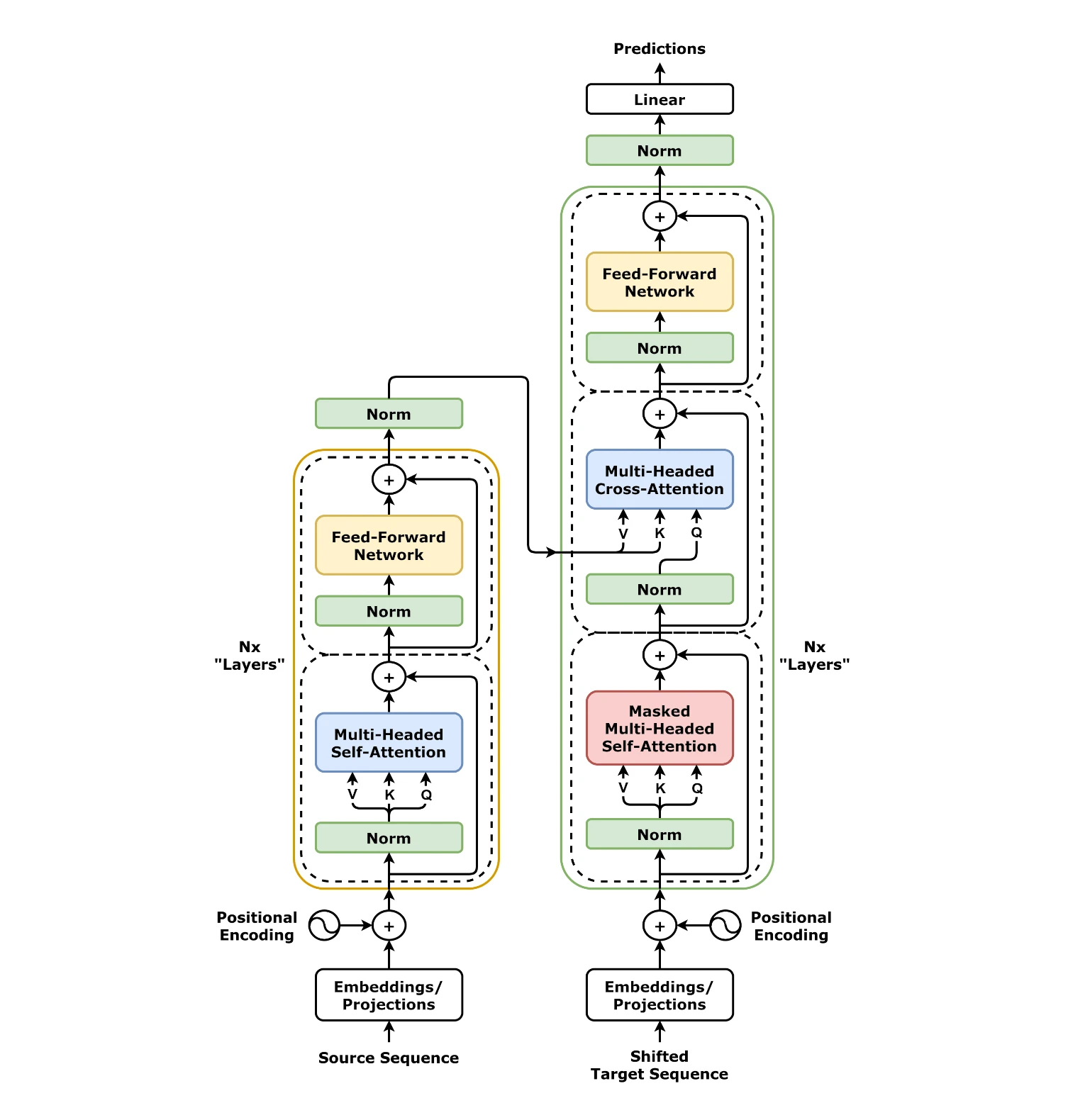
The architecture of some DeepSeek models uses MoE (Mixture of Experts), an approach in which not all parameters are activated for every token, which improves compute efficiency. For this reason, in practice inference can be cheaper than in “dense” models of similar quality, because only part of the “experts” is activated. If you care about the quality/cost ratio in production, pay attention not only to the model name, but also to whether it uses MoE and how it behaves with your type of queries. In company deployments, architectural differences translate into throughput, latency and hardware requirements.
Labels such as 7B or 32B roughly indicate the number of parameters (in billions), which usually goes hand in hand with quality and hardware requirements. When working with longer materials, the context window is also important, i.e. the limit of tokens that can be included in a single prompt, and with very large documents it is still often necessary to split them into chunks and use RAG. “Chat/instruct” models are fine-tuned to follow instructions (instruction tuning), and reasoning capabilities are often strengthened through reinforcement learning (RL) on tasks requiring correct answers. In practice, distilled variants are also encountered, which transfer the “skills” of a larger model into a smaller one at the cost of some reasoning ability.
The compromise between quality and hardware requirements is often achieved through weight quantisation (e.g. 8-bit or 4-bit), which makes it possible to run larger models on weaker configurations. Quantisation usually slightly reduces precision, especially in maths and code, and the scale of the differences depends on the method used (e.g. AWQ, GPTQ, GGUF Q4_K_M). At the same time, smaller and heavily quantised variants may be perfectly sufficient for simpler tasks, especially when the retrieval layer in RAG provides the key information. That is why in practice choosing the “largest” model does not always make the best economic sense if you can reduce the problem’s complexity with better context and prompt format.
- 01General-purposeCHAT / INSTRUCT: Writing, summarising, translating.
- 02Code generationDEEPSEEK-CODER: Generation, completion, repositories.
- 03Advanced reasoningREASONING (R1 LINE): Mathematics, logic, planning.
- 04MoE architectureMIXTURE OF EXPERTS: Efficiency through specialisation.
The choice of model depends on the priority: text, code, or complex analyses. The MoE architecture increases performance in selected variants.
how DeepSeek works in practice
DeepSeek generates answers as the most likely continuation of text, which means it can sound very confident even when it lacks solid foundations. That is where hallucinations come from, so in fact-focused use cases it is worth requiring sources and comparing answers with documents. In business settings, RAG or a search engine is often used so that the model relies on supplied excerpts rather than “guesswork”. If the answer has legal or financial significance, treat the model’s output as a suggestion to verify, not as automatic authority.
In reasoning tasks, effectiveness usually improves when you ask the model for a plan, assumptions and correctness checks instead of limiting yourself to the final result alone. At the same time, it is not always necessary to show the user the “steps”; in business, generating the final answer is more often the right approach, while keeping the reasoning trace in internal logs. Even reasoning-oriented models can make mistakes, so it is sensible to test them on typical cases and compare them with tools (e.g. a calculator or a solver). This approach also helps maintain a consistent answer format in operational processes.
In Polish, DeepSeek models usually perform well on general tasks, but they can mix registers (formal/informal) or lose correct inflection in long legal sentences. For texts such as contracts or terms and conditions, a sensible standard is to check them against your own templates and enforce the style in the prompt (e.g. official language, no anglicisms, a specific structure). When working with code, the model can be helpful in generating functions, unit tests, refactoring suggestions and translating errors from logs. It works best in combination with tools (running tests, a linter, static analysis) and when you provide minimal reproductions of the problem.
In document analysis, DeepSeek can summarise, compare versions and extract fields (e.g. tax ID, dates, amounts), and the quality clearly improves when you predefine the output format and limit the length of excerpts through chunking. The model does not “remember” your materials by itself, which is why RAG is commonly used for company data: embeddings + a database (e.g. FAISS, Milvus, pgvector) + a prompt with citations. In real deployments, tool calling is also useful, i.e. invoking tools such as a search engine, CRM or ticketing system, and then composing the answer based on the returned results. To reduce “filler” and errors at integration points, a format is often enforced (e.g. JSON) and the output is validated with a parser with automatic retries when the structure turns out to be invalid.
The safest way to assess DeepSeek’s performance is on your own data, because public benchmarks (e.g. MMLU, GSM8K, HumanEval) do not reflect the specifics of your documents and processes. In practice, it works well to build a small evaluation set (e.g. 50–200 real questions from the company) with expected answers and measure accuracy, time and token cost. Such tests make it possible to quickly catch regressions after changing the model version, prompt or context settings. This means deployment decisions are based on measurable results rather than a few “nice” answers in chat.
access to DeepSeek: cloud, API and local deployment
Access to DeepSeek is most often implemented in two ways: via a cloud API or by local deployment (on-prem) on your own hardware. API is a sensible choice when a quick start, easy scaling and no need to maintain GPUs and update models on your side are what matter. In practice, questions about API “stability” come down to checking rate-limit thresholds, SLA terms and the ability to choose the data processing region. If data cannot leave the organisation (e.g. legal or medical documents), local deployment remains the typical choice.
Local deployment requires matching the model and configuration to the available resources, because the model size and context length directly affect VRAM requirements and performance. As a hardware guide: 7B models usually fit within 8–16 GB of VRAM, 14B models around 16–24 GB, and larger reasoning/coder variants sensibly need 24–80 GB or several GPUs (depending on quantisation and context length). In production environments, model serving commonly uses vLLM, Hugging Face TGI or LMDeploy, while lighter deployments use llama.cpp and Ollama (often with the GGUF format). Choosing the runtime and weight format (HF vs GGUF, as well as GPTQ/AWQ) matters, because not every architecture has full support in every environment.
- Check performance metrics: tokens/s, time‑to‑first‑token, cost per 1M tokens (API) and VRAM usage.
- Keep in mind that a long context increases memory usage through the KV‑cache, which means performance can drop even on a powerful GPU.
- If it “is slow”, the most common causes are too long a context, a batch that is too small, no KV‑cache, the wrong quantisation or CPU‑only.
- In production, version the checkpoint, tokenizer and inference parameters (e.g. temperature, top_p), and introduce changes only after A/B tests.
- Log metadata (time, tokens, errors, model version), and content only when it is justified — after redaction of PII and with clear retention rules.
When downloading models and their derivatives, it is worth using sources such as Hugging Face or GitHub repositories, but choose official accounts/organisations and verify the licence and tool compatibility (tokenizer, conversions). In monitoring and debugging, it is safer to store the conversation trace as identifiers and metrics rather than full request/response, especially when the data falls under GDPR. If you need debugging without logging data, typical practice includes PII redaction, hashing identifiers and a separate test environment with synthetic data. This approach also makes it easier to control risks related to telemetry and accidental leakage through monitoring systems.
- 01Cloud APIFast start, easy scaling, no GPU.
- 02Stability factorsLimits, SLA, choice of data region.
- 03Local deployment (on-prem)Data privacy, control, security.
- 04Hardware requirementsVRAM, model size, context length.
The choice depends on scaling needs, budget and data security requirements.
integrations and tools for developers
DeepSeek integrations for developers boil down to connecting the model to the application pipeline (RAG, tools, tests) and to the working environment (IDE) in a repeatable, measurable way. For document workflows, LangChain or LlamaIndex are often used; they support, among other things, chunking, embeddings, retrieval, reranking and answer generation, although a custom implementation is enough for simpler projects. In some projects, a vector database is the key element: FAISS locally, Milvus at larger scale, or pgvector when you want to keep everything in PostgreSQL. When search results are too generic, relevance is improved by reranking (e.g. bge‑reranker) combined with better chunk preparation (headings, overlap, boilerplate removal).
When working with code, DeepSeek‑Coder is sometimes integrated with VS Code or JetBrains using plugins that support local endpoints (e.g. OpenAI‑compatible API) or tools such as Continue.dev, which improves autocomplete even offline with low latency. In practice, many runtimes (e.g. vLLM) expose endpoints compatible with the OpenAI API style, so migrating an application often comes down to changing the base_url and model name, but it still requires checking tokenisation and tool formats (tool calling). On the production deployment side, containers (Docker) remain standard, and under heavier load Kubernetes with autoscaling and GPU limits is used. To keep OOM in check, maximum context limits, batch control and a request queue (e.g. Redis + worker) are used. If you expect machine-processable responses, implement guardrails: schema validation (JSON Schema), content rules and PII redaction.
Quality and stability of integrations are easiest to maintain through tests and observability, rather than relying on manual “clicking around in chat”. For evaluating RAG, Ragas can be used (citation relevance, faithfulness), and for comparing prompts and models on fixed test sets — promptfoo or DeepEval, which makes it easier to catch regressions after changes. In LLM observability, tools such as Langfuse or an approach based on OpenTelemetry are used to collect traces, costs, latency and prompt versions. Such a trace later makes it possible to determine which data reached the context and where latency increased, without needing to store the full content in production. As a result, DeepSeek integration in an application is more predictable and easier to maintain as the system grows.
comparison of DeepSeek with other LLMs
DeepSeek should be compared with other LLMs through the lens of whether you need local hosting, how you account for costs, and what tasks you have (text, code, reasoning). ChatGPT (OpenAI) often wins on the maturity of its ecosystem, tools and enterprise features, whereas DeepSeek is often chosen because of its favourable cost and the availability of weights for on‑prem deployment. Claude is valued for working with long documents and the “culture” of its answers, but in practice RAG, validation and regression tests are still useful. Gemini fits neatly into the Google ecosystem, and DeepSeek is most often deployed as a text model, although image support depends on the specific checkpoint.
If privacy and data residency are the priority, the on‑prem approach has the advantage (e.g. open‑weights models), because it reduces the need to send information to an external API. It is worth remembering, however, that local hosting alone does not “solve” full GDPR compliance. The legal basis, data minimisation and retention policy are still crucial. In terms of cost, API usage is often favourable at the start, but at high volume (e.g. millions of tokens per day), your own GPU can work out cheaper, provided you have a team to maintain it. That is why the comparison is best based on measurements on your own prompts: latency, token cost and response stability.
For specialist tasks, matching the model to the problem usually wins: a separate model for code, a separate one for mathematics/logic reasoning, and a separate one for embeddings in RAG. In the open‑weights ecosystem (e.g. Llama and popular fine‑tunes), it is easier to find guides and ready-made integrations, whereas DeepSeek is often chosen for specific performance in code or reasoning in particular releases. In practice, “one model for everything” rarely holds up, so routing is used in applications: a cheaper model for simple matters and a stronger one for harder ones. Regardless of the provider you choose, the maturity of enterprise support and tools usually means less work on your side, while with open‑weights you organise more elements yourself (deploy, monitoring, updates).
security, privacy and compliance with DeepSeek
Security and compliance with DeepSeek mainly come down to controlling input and output data, logs and the permissions of tools invoked by the model. You should not send PII or trade secrets to an external API without a data processing agreement and clearly defined retention rules, and in sensitive processes local deployment is often considered. GDPR requires minimisation, purpose limitation and restricted storage periods, so logging full conversations should have justification as well as anonymisation and retention mechanisms. If you want to reduce risk, start with the principle: collect metadata and metrics, and content only where it is operationally necessary.
Prompt injection in RAG is a real risk, because malicious text in documents or from a user may try to override the assistant’s operating rules. Defences are based on separating system instructions, filtering documents, an allow-list of tools and validating responses (e.g. whether they cite only permitted sources). If the model calls tools (tool calling), you need a least privilege approach and auditing, because in practice it is the application layer that performs actions in your systems. In addition, companies often deploy content filters and their own moderation (rules, word lists or a separate classifier), because the availability of “built-in” moderation depends on the usage channel (API vs hosting).
Compliance also applies to open‑weights model licences, which can limit commercial use, require attribution or include clauses relating to use cases, so you need to verify the terms for a specific checkpoint and its dependencies. A common source of leakage is not the model itself, but the request/response logs and telemetry sent to external monitoring tools, so PII redaction, disabling content logging in production or encryption combined with access control (RBAC) are used. GPU infrastructure should have network isolation, regular driver updates and access control, because vulnerabilities in the stack (Docker, CUDA, kernel) sometimes become an attack vector. In regulated processes, auditability is key: store metadata on which documents and prompts entered the context, together with the model version and inference parameters.
FAQ
Frequently asked questions
What is DeepSeek AI and what is it for?
It is a company and a family of LLM language models that generate text, code and perform step-by-step reasoning. They can be used as support in applications via API or locally on your own server.
Is DeepSeek AI a good alternative to ChatGPT?
In the article, DeepSeek AI is presented as an alternative to ChatGPT, but above all as a model that can be deployed flexibly. What matters is not so much comparing the name, but the specific model, size and way it is run.
What are the most important types of DeepSeek models?
There are general models, code models and reasoning-focused models. For programming, DeepSeek-Coder is usually chosen, while for logic and maths, reasoning-line models such as R1 are used.
Can DeepSeek AI be run locally?
Yes, some models are made available as open-weights, which allows them to be run locally without sending data to an external cloud. However, local installation requires the right hardware resources and configuration.
When is it worth using DeepSeek AI in business?
It is useful for automating work with text and code, analysing documents and building Q&A assistants with your own knowledge base. The article also mentions use cases in helpdesk, sales, HR, education and DevOps.
Why can DeepSeek AI make mistakes and how can this be reduced?
The model generates answers as the most probable continuation of the text, so it can produce hallucinations and sound confident despite being wrong. This is reduced through RAG, sources, a prescribed answer format and verification of results.