

A/B tests allow you to verify whether a specific change on a website genuinely improves results, rather than relying on opinions or gut feeling. It is one of the most useful conversion optimisation methods, but it only makes sense when the experiment is sensibly planned and accurately measured. In day-to-day work, headlines, CTAs, forms, offer layout, cart steps or onboarding are most often tested. The most common mistake is testing random changes without one clear hypothesis and one main metric. In such a situation, even an apparently good result does not provide a solid basis for implementation. In this article, I’ll show how to run tests so that they lead to a decision, not just a chart.
What are A/B tests in practice?
A/B tests in practice are a controlled comparison of two versions of a page, screen or message on real user traffic. One group of people sees the current version, i.e. the control, while the other sees the modified version, i.e. the test variant. The aim is not to determine “which looks better”, but to check which version more effectively achieves a specific business goal. Most often, such a goal is a purchase, form submission, clicking a CTA or account activation.
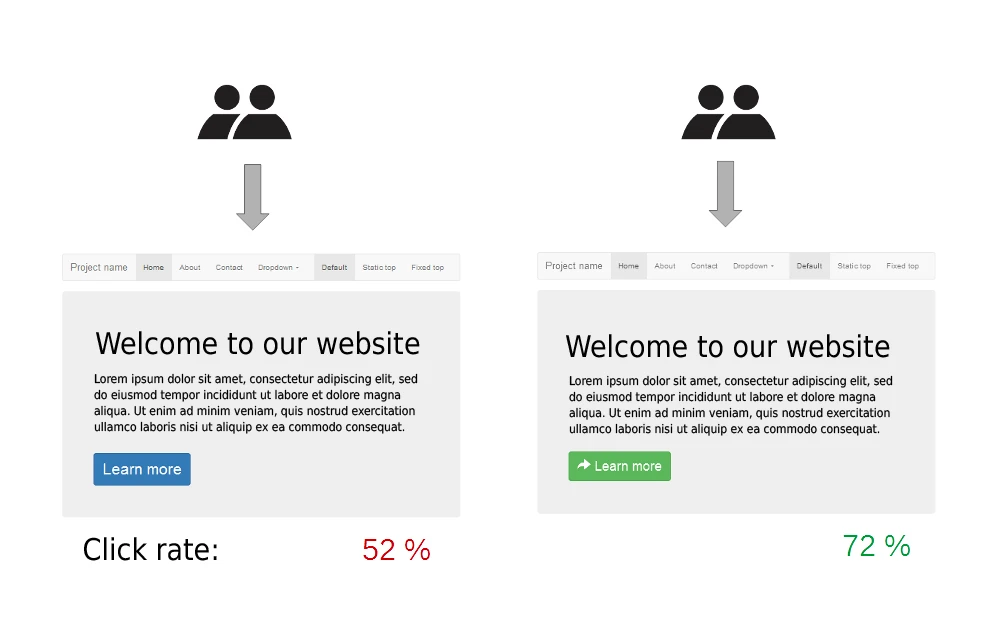
You test elements that genuinely influence user decisions. This could be the headline, the way the price is presented, the order of information, the length of the form, the button copy or the layout of the offer section. A well-prepared test checks one relationship: if we change a specific element, the user will more often complete the desired action. This makes the result easy to interpret unambiguously and turn into action.
In practice, an A/B test is not just about launching a tool. You need to define the test area, prepare variants, set up measurement, verify tracking accuracy and monitor data quality after launch. Only then can you assess the result and decide whether to implement the change, reject it or plan the next experiment.
The key point is that the outcome of a test should not be the report itself. The outcome should be an operational decision that changes the website, process or priorities for further optimisation. If, after the test, it is not clear what to implement or what no longer needs testing, the problem usually lies in a poorly formulated hypothesis or a poorly chosen metric.
What factors affect the effectiveness of A/B tests?
The effectiveness of A/B tests is most strongly influenced by data quality, the relevance of the hypothesis, the choice of metric and the conditions under which traffic is collected. Even a good idea for a variant will not help much if conversion tracking is incomplete or users are allocated to variants in uneven proportions. Common obstacles also include cookie consent, script blocking and discrepancies between the testing tool and analytics. That is why simply launching an experiment is no longer enough.
It also matters a great deal whether the test covers an area that genuinely affects results. Changing the colour of a button rarely delivers as much as refining the offer, the form, the checkout or the value proposition. The best tests start with a funnel problem, not a creative idea. When you do not know where and why users are dropping off, testing quickly turns into guessing.
The result also depends on traffic volume and the number of conversions. With low traffic, it is harder to separate a real effect from random fluctuations, so it is often more worthwhile to narrow the test to one key element or choose points with the biggest share in the funnel. Not every business has the conditions to test everything. Sometimes it is more sensible to run tests less often, but at critical stages of the user journey.
Reliability is also affected by external factors that are easy to overlook. Promotional campaigns, seasonality, price changes, product availability, technical errors and differences between devices can heavily distort the result. The same applies to traffic from different sources, because a user from paid ads often behaves differently from a user from SEO or returning traffic.
Increasingly important is also analysis of results by segment. One variant may work well on mobile and poorly on desktop, or increase clicks but lower lead quality in the CRM. A successful A/B test assesses not only the uplift in the main metric, but also the side effects further down the process. Only then can you consider the change to genuinely support the business, rather than merely improving a single on-screen indicator.
How is the A/B testing process carried out?
The A/B test process includes setting the goal, writing down the hypothesis, preparing variants, correctly implementing measurement, checking data quality and making a decision once the experiment is complete. At the start, you need to name the business problem very specifically, for example a low form submission rate or poor movement from the product page to the basket. Next, you choose one main success metric and a few supporting indicators that will show any side effects. If the main metric is not clearly defined before launch, the test result usually does not provide a basis for a sensible decision.
The next stage is to analyse the area that is actually worth testing. In practice, the funnel, session recordings, click maps, event analytics data and the points where users most often drop off all work well. On this basis, a hypothesis is created in a simple framework: what we are changing, for whom, what result should improve and why. This structure organises the experiment and keeps random ideas from being tested.
Next, the control variant and the test variant are prepared so that they differ only in the elements resulting from the hypothesis. This is important because piling up changes at once makes conclusions harder and then it is difficult to pinpoint what really determined the result. At the same time, the method of random traffic split, the rules for assigning a user to a variant and the compatibility of the test with analytics, devices and critical areas of the site, such as the form or checkout, are defined. Before launch, full QA has to be done, because faulty tracking or a non-working variant can invalidate the whole experiment.
Once the test is live, it is not enough to just watch the growth or decline chart. You need to check whether traffic is distributed correctly, whether conversions are being attributed to both variants, whether there is any conflict with other deployments and whether the data is consistent between the testing tool and analytics. During the test, the variants should not be modified either, because then the result is no longer suitable for a reliable comparison.
The final stage is evaluation and the operational decision. You check not only the main metric, but also user segments, the next steps in the funnel and the quality of the business outcome, for example order value or lead quality. A well-run test ends with a decision: we implement the change, reject it or prepare the next iteration based on what the data taught us.
What are the current challenges related to A/B tests?
The biggest challenges in A/B tests today concern data quality, measurement limitations and the proper interpretation of results in a changing business environment. Increasingly, the problem is not the idea for the variant itself, but whether all visits and conversions are being recorded with similar accuracy. Cookie consent, script blocking and differences between browsers mean that some users do not appear in the data or are only partially visible. Today, the reliability of a test very often depends more on measurement quality than on the creativity of the variant.
The second challenge is linking the experiment result to a real business effect. A rise in CTA clicks alone does not have to translate into higher sales, better leads or higher account activation. That is why more and more often you need to combine data from the testing tool with event analytics, CRM, a sales system or information about returns and cancellations. Without this, it is easy to roll out a change that improves a proxy metric while harming performance further down the line.
The third difficulty is too little traffic or too few conversions for the result to be stable. In such a situation, there is no point testing minor cosmetic tweaks, because the chance of a clear result remains low. It is better to focus on elements with a big impact, such as the offer, form, price, checkout layout or value proposition. With low volume, simple tests on key elements work better than complex experiments with multiple changes.
The context that is not visible at first glance also has a strong influence on the test result. Traffic sources, seasonality, promotional campaigns, price changes, product availability, technical faults and differences between mobile and desktop can alter user behaviour more than the variant being tested itself. That is why it is worth comparing the findings with the marketing activity calendar and the list of changes on the site, rather than interpreting them in isolation from the rest of the business.
Segment analysis is also playing an increasingly important role. The same variant may perform well among new users from paid campaigns, and worse among returning users from organic traffic. The same applies to devices, traffic sources and stages of the relationship with the brand. An average result for all traffic can be misleading, so in practice it is worth checking at least the differences between mobile and desktop and between new and returning users.
What decisions are key in A/B tests?
The most important things are the decisions about which single business problem the test is meant to resolve, which metric you will use to measure it and which rules you will use to make the decision once the experiment is over. When these three elements are not clarified before launch, the result creates more questions than answers. In practice, it most often comes down to a purchase, form submission, adding to basket or account activation. Supporting metrics are necessary, but they should not replace the main goal.
The second important decision concerns the scope of the change. The best thing to test is the element that genuinely influences the user’s decision, for example the value proposition, CTA, form or checkout stage. The more clearly the variant corresponds to one specific hypothesis, the easier it is to understand the result and define the next step. With limited traffic, it is better to focus on one strong element than to compare several large versions at the same time.
It is equally important to define who the experiment covers. The same variant may behave differently on mobile and desktop, differently for new users, and differently again for people returning or arriving from paid campaigns. A good test does not have to be a test for everyone, only for the segment where the problem actually exists and where the change can be measured reliably.
Technical decisions are no less important. You need to establish whether assignment to a variant takes place at user or session level, how to reduce measurement errors and whether the experiment will not slow the site down or distort analytics. If the testing tool shows growth, but the CRM or sales data does not confirm it, the decision to roll out should be cautious. In practice, it is increasingly the final outcome visible further down the funnel that is assessed, not a single click.
The last key decision concerns when to end the test and how to evaluate its result. This is not limited solely to the question of whether the variant won, but also whether the result is repeatable, whether the data is complete and whether there was any side effect, for example lower lead quality or a lower basket value. Before launch, it is worth setting the test stop conditions and implementation criteria, because that helps avoid decisions based on temporary fluctuations in the reading.
What mistakes should be avoided during A/B tests?
The most common mistakes include testing too many elements at once, inaccurate measurement, stopping the experiment too early and assessing the result without looking at the rest of the funnel. In the tool, everything may look correct, yet the test still does not provide a basis for a sensible decision. Usually, the problem is not the method itself, but imprecise preparation.
- Do not combine several different hypotheses in one test, because you will not know what actually affected the result.
- Do not launch an experiment without verifying tracking, forms, checkout and the correct assignment of the user to the variant.
- Do not change the content, layout or logic of the variant during the test, because you lose comparability of the data.
- Do not end the test just because the result looks promising for a few days.
- Do not assess success solely by clicks if, from a business point of view, what matters is a sale, lead or activation.
Another mistake is choosing tests of marginal importance. Changing the colour of a barely visible button or a small icon rarely leads to useful conclusions, especially with limited traffic. With a small number of users, it is better to focus on points that determine progression to the next stage instead of looking for growth in cosmetic tweaks. If traffic is limited, test less, but more important things.
A frequently overlooked mistake is ignoring external disturbances. The test result can be distorted by a price promotion, changes in traffic sources, stock shortages, payment failures or parallel changes on the site. If such factors appear during the experiment, they need to be taken into account in the assessment or the test may even need to be repeated. A chart on its own will not answer whether the uplift came from the variant or from the surrounding conditions.
It is also worth avoiding an overly simplified interpretation of the result. A variant may increase the number of forms while at the same time reducing lead quality. It may improve CTR, but worsen sales or increase abandonment further down the line. A good A/B test result is one that improves the main metric without damaging important secondary indicators.
The last mistake is a lack of documentation. When the team does not record the goal, hypothesis, test conditions, limitations and final decision, the same ideas come back a few months later and take time again. A failed test also has value if it is clear exactly what it concerned and why it did not work. This means that subsequent experiments run faster and are based on real knowledge, not on the team’s memory.
How to analyse A/B test results in practice?
A/B test results are best assessed by comparing the main metric, the quality of the data and the impact on key segments, rather than by interpreting a single chart. At the start, you need to make sure the test is actually answering the question it was launched to answer. If the goal was an increase in purchases or form submissions, then that is the metric that should determine the outcome. The most common mistake is assessing the test by an intermediate metric, such as a CTA click, even though business-wise only the purchase or lead really matters.
In practice, it is a good idea to start with three questions: did the test variant improve the main metric, does the result hold over time and are the data complete. A percentage uplift on its own can be misleading when traffic was distributed unevenly, some conversions were not recorded or the test took place during an unusual campaign period. A good result is one that can be defended not only numerically, but also operationally.
The next step is to check whether the result is not merely apparent. You need to verify the correctness of assigning users to variants, the consistency of the data between the testing tool and analytics, and whether disturbances such as a price change, technical issues, product unavailability or a major promotional campaign occurred. If these factors changed the conditions of the test, the interpretation should be cautious, even if the numbers look favourable.
After assessing the main metric, it is time for secondary indicators and further funnel stages. A variant may increase the number of clicks or next-step visits, while at the same time worsening lead quality, average basket value or final sales. The winning variant is not the one that generates more reactions, but the one that improves the result without harming the rest of the process.
Segment analysis is also very important. The same variant may perform well on mobile and poorly on desktop, or help new users while hindering returning ones. That is why, after assessing the overall result, it is worth checking the most important traffic splits: devices, traffic sources, new and returning users. Segments are not there to force a winner, but to check whether the average result is hiding important differences.
Finally, the result should be compared with the hypothesis. If the test won, but for a different reason than expected, it is still worth noting what may have actually influenced user behaviour. Such an interpretation is needed for future experiments, because the result alone, without understanding the mechanism, has limited value.
The decision after analysis should be clear: implement the variant, reject the change or test it again in a narrower scope or in a different segment. There is no point in leaving the test with the conclusion “something moved”, because that does not organise subsequent actions. Every test should end with a recorded decision, limitations and a short recommendation for the next step.
FAQ
Frequently asked questions
How do you run A/B tests so the result is reliable?
First, you need to clearly define the goal, the hypothesis and one main success metric, and only then prepare the variants and measurement. After launching the test, you should monitor data quality and end it with a decision: implement the change, reject it or run another iteration.
Can you change several elements at once in A/B tests?
It is better to avoid this, because then it is hard to tell what actually influenced the result. One test should cover one relationship arising from one specific hypothesis.
Why is an improvement in clicks not enough in A/B tests?
Because an increase in CTA clicks does not have to translate into sales, better leads or account activation. That is why you need to look not only at the main metric, but also at side effects further down the funnel.
When does an A/B test make sense with low traffic?
With limited traffic, it is harder to distinguish a real effect from random fluctuations, so tests of small changes usually do not give clear conclusions. It is better to focus on elements with a large impact, such as the offer, form, checkout or value proposition.
What has the biggest impact on the effectiveness of an A/B test?
The most important factors are data quality, the validity of the hypothesis, metric selection and the conditions under which traffic is collected. Cookie consent, script blocking, seasonality, promotional campaigns and differences between devices also matter a great deal.
What mistakes most often ruin A/B tests?
The most common problems are testing without one hypothesis, inaccurate measurement, ending the experiment too early and changing the variant during the test. It is also a mistake to assess the result only by clicks, without checking the impact on sales, leads or activation.