

A/B testing is one of the most practical methods of increasing conversion because it allows you to verify changes on a site in a controlled way, rather than relying solely on the team’s opinions. In short, you set the current version against a new variant and measure which one delivers the goal more effectively, such as a purchase, form submission or button click. This approach works both in e-commerce and on lead-generation sites, landing pages or contact forms. The key thing is that a test only makes sense when you have correct measurement and a clearly defined business goal. Simply launching an experimentation tool will not help if you are not sure what exactly you want to improve and by which metrics you will assess the result. A well-run test gives you not only a verdict of “won” or “lost”, but also insight into how users react to a given change.
What is A/B testing and how does it work in practice?
A/B testing is a controlled comparison of two versions of a page element or two coherent page variants, which lets you check which version delivers a specific goal better. Most often the focus is on headlines, CTA buttons, forms, section layout, trust elements, the way pricing is presented, the basket or the checkout. In practice, it is not about the “prettier” version, but the one that generates more valuable user actions.
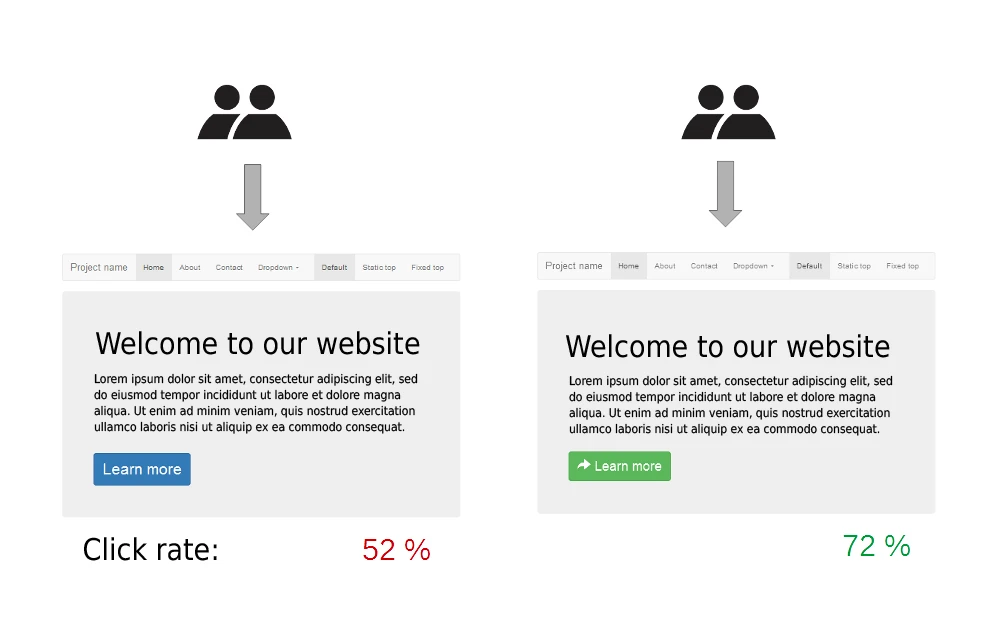
The process starts with choosing the main goal and supporting metrics. The goal can be a purchase, form submission, proceeding to the basket or clicking an important button, while supporting metrics help you assess whether growth is happening at the expense of quality. If you do not know what decision is meant to be made after the test, it means the test has been planned incorrectly.
The next stage is data analysis and formulating a hypothesis. Rather than shooting in the dark, you check where users drop out of the funnel, what they are not clicking, where they abandon the form and what errors appear on the site. A good hypothesis has a simple structure: we change a specific element, expect a specific effect and can justify it with data.
Next, the variant is prepared, the experiment is implemented and traffic is split between the control version and the new version. At this level, technical details matter: correct tracking, display rules, excluding internal traffic, checking behaviour on devices and browsers, and verifying whether other scripts are affecting the test run. The safest approach is to test one significant change or one coherent variant, because then you know what actually influenced the result.
Once the test has started, it is not enough to glance at an early conversion uplift. You need to monitor the quality of the data, traffic distribution, errors, impact on user segments and any side effects, for example a drop in basket value or poorer lead quality. In the end, a decision is made: implement the winner, reject the hypothesis or prepare the next iteration and record the findings in the test backlog.
- 01Variant comparisonTesting two versions.
- 02Choosing the goalMain and supporting.
- 03Verifying valueMore valuable actions.
In practice, it is not about the “prettier” version, but the one that generates more valuable user actions.
What factors influence the success of A/B tests?
The success of A/B tests is influenced above all by data quality, a well-chosen goal, the right traffic volume and the absence of disturbances during the experiment. If any of these elements is weak, the result may look promising and still lead to a poor decision. For that reason, test effectiveness more often comes from good preparation than from the variant creative itself.
The starting point is reliable measurement. Tracking consents, script blocking, misconfigured events, duplicated conversions or an incorrect traffic split can completely distort the result. The most common practical problem is not that the variant is weak, but that the data does not allow you to assess it fairly.
It is also important exactly what you are testing and at what traffic volume. Sites with a low number of transactions rarely provide quick answers at the purchase level, which is why it often makes more sense to test micro-conversions, form steps or higher-intent segments. With limited traffic, it is better to focus on the biggest barriers rather than break experiments down into insignificant details.
The result is also influenced by the implementation method. Client-side tests are easier to launch, but they can cause content flicker and worsen user experience, especially on slower devices. Server-side implementation provides greater control over what the user actually sees and how it is measured, however it requires smoother organisation on the technical side.
Not every variant behaves identically across all user groups. Mobile and desktop often respond differently, as do traffic from paid campaigns, organic visits, new users and returning customers. The globally winning variant may lose in the most important segment, which is why segmentation is part of the analysis, not an add-on.
Business context, which does not result directly from the test itself, also matters. Promotions, price changes, product availability issues, seasonality, other UX deployments and parallel ad campaigns can improve or worsen the result regardless of the variant being tested. That is why, before interpreting the result, it is worth checking whether the experiment has not been affected by concurrent events.
In practice, the success of tests is most often determined by a few recurring rules:
- test pages and funnel stages with real business significance, rather than random elements,
- build hypotheses on data from analytics, session recordings, click maps and drop-offs,
- do not launch an experiment without QA on devices, browsers and different traffic sources,
- do not end a test after the first positive signal, but wait for a stable data picture.
The best results come from consistency, not a single “brilliant” idea. Each test should end with a conclusion that feeds the next hypotheses and organises knowledge about what actually increases conversion on a given site. This makes A/B testing a process of making better decisions, rather than a one-off optimisation action.
Stages of the A/B testing process step by step
The stages of the A/B testing process step by step include: setting the goal, verifying the data, formulating the hypothesis, deploying the variant, quality control, analysing the result and deciding on further action. In practice, this is not merely a comparison of two page versions, but an ordered procedure designed to lead to a reliable business conclusion. If you do not define one key conversion and a clear success criterion at the outset, it will be hard to defend the test results.
The first step is choosing the main goal and supporting metrics. The goal may be a purchase, form submission, CTA click or moving on to the next stage of the funnel. Supporting metrics help assess whether an improvement in one metric has not come at the expense of other areas, for example lead quality, basket value or the number of errors.
The second stage is data audit and problem diagnosis. It is worth confirming that analytics is recording events correctly, there are no duplicate conversions, internal traffic and bots are excluded, and user paths can be traced in reports. Only then does it make sense to look for friction points based on the funnel, click maps, session recordings, cart abandonment, form errors and user behaviour on mobile and desktop.
- Hypothesis building consists of writing down the planned change in a simple scheme: what we are changing, what effect we want to achieve and what data we are basing this assumption on.
- Prioritisation helps choose tests that have a business rationale, are technically feasible and do not carry excessive risk.
- Variant design includes preparing the copy, layout, trust elements, form logic or changes to the basket and checkout.
- Implementation is the configuration of traffic split, version display rules and integration with measurement tools.
- QA means verifying that the variant works properly on devices and browsers, with different traffic sources and under different tracking-consent conditions.
- Post-launch monitoring is used to catch anomalies, script conflicts, performance drops and uneven traffic distribution between versions.
- Result analysis should not end with one metric. You need to compare the impact on the main conversion, secondary metrics and user segments.
- Decision and documentation mean rolling out the winner, rejecting the hypothesis or running another iteration, and then recording the findings in the CRO backlog.
At the implementation stage, the technical launch method of the test is important. Client-side versions can often be launched faster, but they can cause content flicker and disrupt user experience. In more demanding tests, server-side implementation provides greater control, especially when measurement stability and consistent site behaviour matter.
The final analysis should take context into account, not just the chart itself. Campaigns running in parallel, price changes, seasonality, product availability issues or simultaneous UX fixes can distort the result. A good test ends with a decision that can be defended with data, not just the impression that one number looks better than another.
- 01Setting the goalOne key conversion, a clear criterion.
- 02Verification and hypothesisData analysis, formulating the assumption.
- 03Implementation and controlVariant implementation, quality assurance.
- 04Result analysisAssessment of the outcome, hypothesis verification.
- 05Business decisionReliable conclusions, further actions.
A/B testing is a structured procedure leading to reliable business conclusions, not just a comparison of two versions.
Practical tips for effectively increasing conversions
Effective increasing conversions through A/B tests requires choosing the right pages, accurate measurement and consistency in interpreting the results. The greatest return usually comes from experiments at stages of high business importance, such as a landing page, product page, basket, checkout, contact form or pricing page. At these points, one well-chosen change can improve the result of the entire funnel, not just a single click.
At the start, choose areas where the data shows a real problem. This may be a low add-to-basket rate, a high percentage of form abandonment, weak scroll depth or very few clicks on the main CTA. Do not test ideas “on a whim”, only solutions that address a specific barrier visible in user behaviour.
Within a single test, limit the number of changes to the minimum necessary. If you change the headline, button colour, section layout and form all at once, it is then hard to tell what actually worked. On sites with lower traffic, stronger, clearly differentiated variants often perform better than minor cosmetic tweaks.
Before launch, always verify the measurement. Poorly configured events, incorrectly tagged traffic sources or duplicated conversions can ruin the whole experiment. First reliable data, then the test — in the reverse order, it is easy to draw conclusions based on errors.
Assess not only the increase in conversions itself, but also the quality of the business outcome. In lead generation, lead quality matters, not just the number of submitted forms. In e-commerce, it is also worth looking at average basket value, returns, cancellations, margin and user behaviour after purchase.
Segmentation can completely change the conclusion from a test. The same variant may work well for SEO traffic and poorly for paid campaigns. Similarly, mobile and desktop often require separate evaluation, because the interface layout, user intent and screen constraints affect behaviour differently than on a large monitor.
Do not close the test after the first positive signal. A short-term increase may result from a promotion, a price change, a seasonal spike in traffic or the temporary advantage of one source of visits. The test result must be read together with the business context, otherwise it is easy to implement a change that will not remain effective in the long term.
When traffic is small, it is not worth forcing the test to rely on the final purchase. Often better indicators are microconversions, for example moving to the next form step, clicking the CTA, adding a product to the basket or opening the offers section. It is also a good idea to support the decision with qualitative research, because session recordings and analysis of form errors often reveal the source of the problem more quickly than waiting a long time for the test result.
After each experiment, update the backlog of hypotheses and refine UX working standards. Even a losing test contributes something concrete: it shows what does not work in a given segment, with a specific offer or at a particular stage of the funnel. The greatest value of A/B testing lies not in a single win, but in systematically learning what really increases conversions in your site.
The most common mistakes and limitations in A/B testing
The most common mistakes and limitations in A/B testing include incorrect measurement, too little traffic, testing several elements at once and drawing conclusions without reference to the business context. In practice, even a sensible change will not produce a reliable result if analytics counts conversions twice or some users are not measured at all. First you need correct tracking, only then is it worth testing variants.
One of the more common mistakes is starting a test without a single overarching conversion goal. If one time you analyse CTA clicks, another time submitted forms, and finally sales, the result can be interpreted in several ways and it is hard to make an unambiguous decision. It is worth adding supporting metrics to the main goal, but their roles should not be mixed up.
Another barrier is too little traffic or too little contrast between variants. On pages with a low number of sessions, a test based on purchase can drag on for a very long time or end with an unstable result. In such cases it is better to test the biggest barriers, introduce more pronounced changes or measure closer microconversions, for example moving to the next form step.
Many tests fail already at the implementation stage. With client-side implementation, content flickering, loading delays or conflicts with other scripts can occur, which in itself changes user behaviour. If the site is extensive and has high traffic, server-side usually provides greater control over the experience and measurement.
A major mistake is also running a test in an unstable environment. Parallel promotions, price changes, product unavailability, a form outage or a significant change in a paid campaign can affect the result more strongly than the variant itself. If several important things change during the experiment, the test result needs to be treated with caution.
Another limitation of A/B testing is that the overall result does not always reflect reality for all users. The same variant may perform well on desktop and poorly on mobile, or improve results in organic traffic and worsen them in traffic from ads. That is why sensible analysis almost always requires looking at segments: device, traffic source, new and returning users, and funnel stage.
In practice, another mistake is ending a test after the first increase or the first drop. In the first few days, the traffic distribution can be uneven, and user behaviour may temporarily deviate from the usual pattern. The test should run until the data stabilise and it is possible to assess not only the increase in conversions, but also any side effects.
- 01Incorrect measurementUnreliable tracking data.
- 02Too little trafficNo statistical significance.
- 03Several changes at onceDifficult interpretation of the result.
- 04No single goalAmbiguous success metrics.
- 05Without business contextConclusions detached from profit.
Key takeaway: Correct tracking and one overarching goal are the foundation of a reliable A/B test.
How to measure and analyse A/B test results?
A/B test results are measured by comparing the impact of the control version and the variant on one main conversion, supporting metrics and the behaviour of key user segments. It is crucial to define clearly before launch what success means in this test and on which data the decision will be based. Otherwise, it is easy to bend the interpretation towards the expected result.
Measurement is worth starting with a check of data quality. You need to verify whether events are firing correctly, whether traffic is being split according to the plan, whether duplicate conversions are appearing, and whether internal traffic and bots have been excluded. It is also worth remembering that tracking consent and script blocking can distort the picture, so the result should be interpreted in the context of data quality rather than treated as mathematical certainty.
Reliable analysis is not reduced to a single metric. If a variant increases the number of leads but lowers their quality or increases the number of errors at a later stage, it may perform worse for the business than the control version. The best result is not always the highest conversion rate, but the best effect for the entire funnel.
- main conversion on which the decision is based,
- supporting metrics, for example CTA clicks, moving to the next step, form errors,
- business outcome quality, for example basket value, lead quality, returns or cancellations,
- results in key segments: mobile and desktop, traffic sources, new and returning users,
- information about disruptions such as a campaign change, promotion or technical issue.
During the test, you need to monitor not only the numbers, but also their consistency. If one variant suddenly starts receiving a clearly different type of traffic, has an unusually high bounce rate or slows down the site, the implementation should be checked first. Analysis only makes sense once you are sure you are comparing conditions that can genuinely be compared.
After the experiment ends, it is worth comparing the overall result with the segment results and qualitative data. Session recordings, click maps or abandonment analysis often explain why a variant won or lost. The result itself shows what worked; only the combination of data quantitative and qualitative helps explain why.
At the end, a clear decision is needed: implement the winning variant, reject the hypothesis or run another iteration of the test. It is a good idea to record not only the result itself, but also the experiment conditions, the segments used, the limitations encountered and the conclusions from the analysis. This means the next actions do not start from zero, but build on an increasingly rich knowledge base of what really increases conversions on a given website.
FAQ
Frequently asked questions
How does A/B testing work in practice on a website?
You compare the current version with a new variant and check which one better achieves the chosen goal, e.g. a purchase, form submission or CTA click. It is not about what looks better, but what drives more valuable actions.
Which page elements are most often tested in A/B testing?
Most often, headings, CTA buttons, forms, section layout, trust elements, the way price is presented, the basket and checkout are tested. The choice depends on where the biggest barriers appear in the funnel.
Can you do A/B testing without properly configured measurement?
No, because without correct tracking the test result may be distorted. Incorrect events, duplicated conversions or missing chunks of data can completely skew the decision.
Why is one main goal important in A/B tests?
Because then it is easier to assess the result unambiguously and support the decision with data. When several different conversions are analysed at once, the test becomes hard to read.
When is it better to test micro-conversions instead of final sales?
When website traffic is low or there are few transactions, a purchase test may take too long and produce unstable results. In that situation, closer steps are better, such as moving to the next form step or clicking the CTA.
What mistakes most often ruin A/B test results?
The most common problems are incorrect measurement, too little traffic, testing several changes at once and drawing conclusions without business context. Results can also be distorted by promotions, price changes, seasonality or parallel campaigns.