

The returns policy affects the purchase decision earlier than many store owners assume. A customer checks it when they want to assess the risk, the brand’s honesty and the convenience of a possible return. A well-written policy not only informs, but removes reasons to hesitate before clicking buy. That is why it is not the document itself that matters, but its content, clarity, legal compliance and later execution.
The trust mechanism and risk reduction in a returns policy
The trust mechanism and risk reduction in a returns policy work when the customer immediately understands the conditions, cost and process of the return. This lowers the perceived risk of purchase because the consequences of a wrong choice are described in advance. When the rules are clear, the customer is less likely to delay the decision and less likely to look for reassurance outside the store. It is not about soft wording, but about specifics that remove uncertainty.
The strongest trust is built by answers to the questions the customer asks themselves just before purchase. If they have to look for them in the terms and conditions or write to support, the risk rises again.
- How long do I have to return it?
- Who pays for the return postage?
- How and where do I request a return?
- What condition does the product need to be in?
- Which products cannot be returned?
- When will I receive my refund?
The most common mistake is that a store describes returns formally, but does not help the customer assess the real effort and cost. A return “in accordance with the terms and conditions” does not answer anything important. The customer trusts when, in a few seconds, they can judge whether the return is simple, how much it will cost and when they will get their money back. It is this assessment that affects the willingness to buy.
Compliance of a returns policy with consumer law
Compliance of a returns policy with consumer law means that the return description must faithfully reflect the customer’s statutory rights and their limitations. This is the starting point, not a competitive advantage. A store builds trust only when it first meets the applicable requirements. Conditions better than the legal minimum are a business decision, but they must not obscure the buyer’s basic rights.
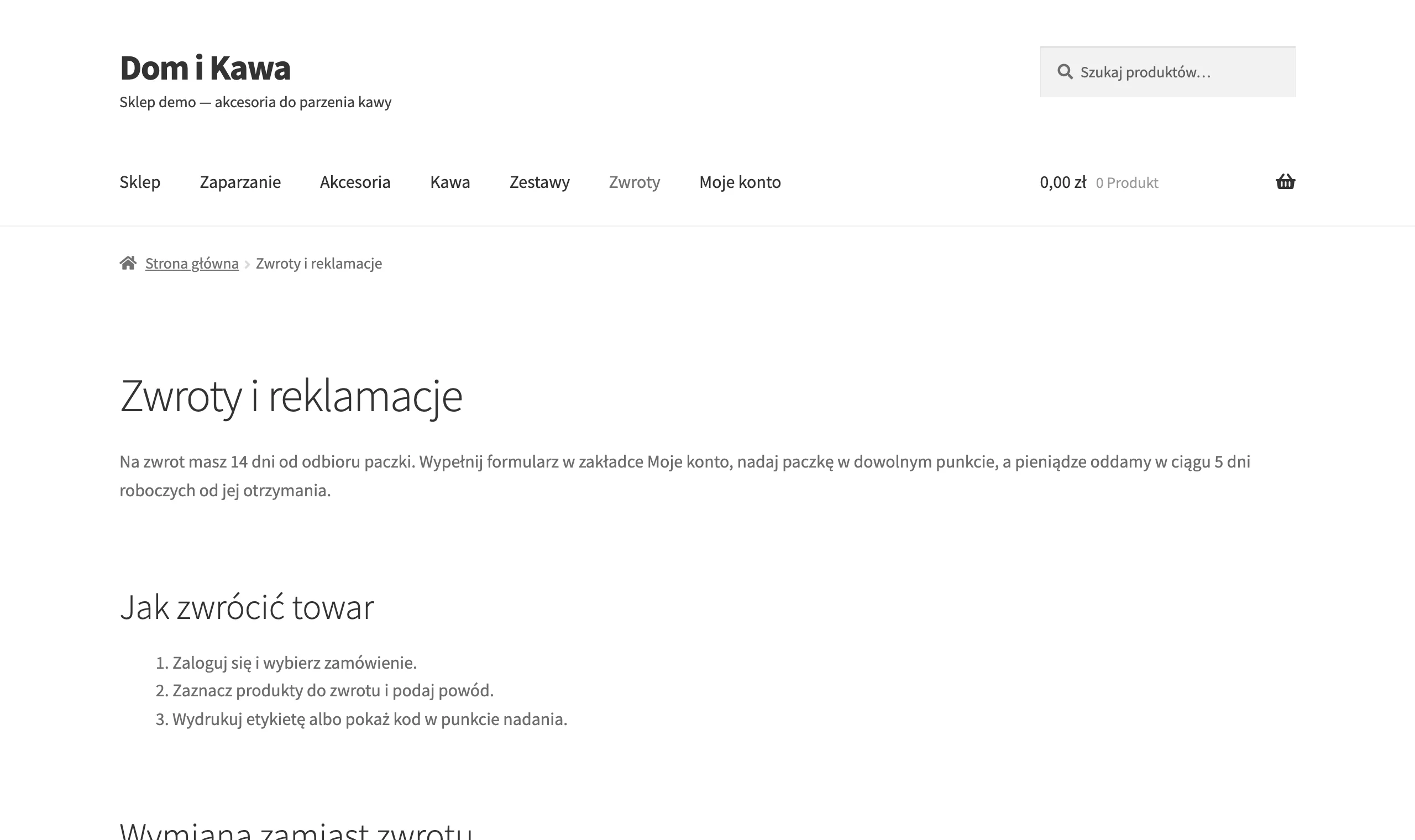
In practice, you need to clearly separate what comes from the law from what the brand offers additionally. If you offer a longer period or free returns, state it explicitly as an extra benefit. If some products cannot be returned, the list of exclusions must be specific and easy to find. Vague exceptions are one of the fastest ways to lose credibility.
Legal compliance also requires consistency across all return-related messages. The policy, basket, product page, FAQ and post-purchase messages cannot give different deadlines or conditions. The most damaging situations are those where the site promises a simple return, but the terms or support put up additional barriers. Such discrepancies undermine trust regardless of whether they result from an error or a failure to manage the process.
How the business model affects return conditions
The business model determines whether the returns policy is mainly meant to protect margin or also actively support sales. A store with a higher margin or strong competitive pressure can more often offer a longer period or free returns. This choice reduces customer concerns, but increases fulfilment costs. That is why return conditions should result from the economics of the product, logistics and customer expectations.
A restrictive policy can limit costs, but it often worsens the purchase decision already at the basket stage. The worst-performing wording is that which formally allows returns, but in practice makes them difficult. The customer quickly reads this as a signal that the store does not want to take responsibility for a purchase that turns out to be wrong. If the conditions are more demanding, they must be shown clearly and early enough.
The most sensible policy combines the marketing promise with real operational capabilities. There is no point communicating a fast refund if the team and process cannot sustain it. Similarly, free returns only make sense if their cost does not undermine profitability. Effective rules therefore come from a strategic decision, not from the mere need to sound good.
Key content elements of a returns policy
The key content elements of a returns policy are the details that allow the customer to immediately assess the time, cost and process of the entire procedure. Without them, the document remains formal, but does not help with the decision. The content should answer the customer’s questions in a natural order. This way the user does not have to look for missing rules in the terms and conditions, FAQ and post-purchase messages.
In practice, a returns policy should include:
- the exact return deadline, given numerically,
- information on who covers the cost of return postage,
- the available return methods, for example by courier, to a parcel locker or in store,
- the place and method for submitting a return,
- the return address, if needed,
- the required condition of the product when sent back,
- a specific list of products excluded from returns,
- the refund period,
- contact details for customer service.
The elements alone are not enough if they are described in general terms or inconsistently. The deadline should be unambiguous, the costs stated without equivocation, and the exceptions written as a specific list. You also need to explain what the customer has to do step by step, because the lack of a clear process quickly undermines trust. What matters most is that the customer understands not only their right to return, but also the full effort needed to carry it out.
Language, structure and UX as the key to trust
Language, structure and UX build trust when the customer finds the most important return terms within a few seconds and understands them without interpretation. Simple sentences, numbers and the names of specific actions work best. Instead of legal formulations, write what the customer should do, where to submit the return and who covers the shipping cost. If the user has to decode the wording on their own, the policy stops reassuring and starts raising suspicion.
The content layout should match the order of the customer’s questions, not the logic of a legal document. At the top of the page, it is worth giving a short summary of the most important rules: timeframe, cost, how to submit the request and the refund processing time. Only further down should you expand on exceptions, the required condition of the product and special cases. This order shortens the search for answers and helps the customer make a decision without contacting support.
A good structure does not end with the text itself. Short paragraphs, clear headings and restrained bolding make it easier to scan the page, especially on a phone. For more complex terms, a question-and-answer layout works well because it matches the natural way of reading. It is even better when the policy leads straight to action: the return form, instructions, the label and the status of the request.
The most common mistakes in a returns policy and how to avoid them
The most common mistakes in a returns policy destroy trust when the customer discovers a cost, exception or inconvenience only after purchase. Hidden return shipping charges, unclear exclusions and no specific timeframe for refunding money do the most damage. A tone that sounds like an attempt to discourage returns works just as badly. To avoid this, every condition should be written plainly and without room for assumptions.
In practice, it is worth regularly checking the policy for typical faults:
- different terms on the policy page, in the basket and in the FAQ,
- no clear information on who pays for the return shipping,
- exceptions described in general terms instead of as a specific list,
- no step-by-step instructions for submitting a return,
- making the policy available only as a PDF or in a format that is difficult to read.
Avoiding these mistakes requires not only correct text, but also consistency across the whole site. If a product card promises an easy return, the policy cannot impose additional conditions hidden further down. If you state a timeframe for issuing refunds, the operations team must be able to meet it. What does the most harm is not the strict condition itself, but the mismatch between the promise and the actual customer experience.
Even good content stops working when the return process itself is difficult to start or takes too long. The customer should get a simple submission path, clear instructions and information about what happens next. Missing status updates and long waits for the money quickly cancel out the earlier sense of security. That is why the policy must be tested together with the process, rather than treated as a separate document.
Metrics of return policy effectiveness
Metrics of return policy effectiveness show whether the rules really make purchasing easier and whether the store delivers on its own promises after the sale. The most important are indicators from two areas: the purchase decision and the efficiency of return handling. If the policy builds trust, the customer is less likely to abandon the basket and less likely to ask support about the basic terms. If the process works poorly, the problem shows up later in delays and lower satisfaction.
In practice, it is worth observing what percentage of users go from the basket to the returns policy and what they do afterwards. Traffic to this page on its own is not a bad thing, because it means the customer is looking for confirmation before buying. The problem appears when the basket abandonment rate increases after visiting the policy. Such a signal usually points to an unclear cost, unfavourable exceptions or an overly complicated process.
The second group of indicators is operational and contact data. The number of return-related questions sent to customer service shows whether the content answers the customer’s real doubts. The average time from receiving the returned parcel to refunding the money shows whether the company is fulfilling the most important part of the promise. When this time gets longer, a good policy stops protecting trust.
It is best to analyse this data together, not separately. An increase in conversion with a stable number of returns may mean that the policy is effectively reducing purchase risk. A fall in questions to customer service without an improvement in conversion, on the other hand, suggests that the content is clear, but the return offer is still too weak. Only this combined reading allows you to assess whether the problem lies in communication or in the terms and process themselves.
FAQ
Frequently asked questions
How do you write a returns policy so the customer immediately knows what they are agreeing to?
It is best to state the specific time limit, return shipping cost, how to submit the request and how long the refund will take. The customer should be able to assess within seconds whether the return is straightforward and how much it will cost them.
Does a returns policy have to comply with consumer law?
Yes, the returns description must accurately reflect the customer’s statutory rights and their limitations. Any additional store conditions must not obscure the buyer’s basic rights.
When is it worth clearly showing extra benefits in a returns policy, such as a longer period or free returns?
It is worth doing whenever the store offers terms better than the legal minimum. They should be described plainly as an additional benefit, not mixed in with the mandatory rules.
What should a returns policy include so that it is understandable to the customer?
It should include the return period, information on return shipping costs, available return methods, how to submit the request, the return address, the required condition of the product, a list of exclusions, the refund period and customer support contact details. General statements alone are not enough.
What mistakes in a returns policy most reduce trust?
Hidden fees, unclear exclusions, no specific refund period and language that discourages returns are the most damaging. Problems also arise from discrepancies between the policy, the basket, the FAQ and post-purchase messages.
How can you check whether a returns policy really works and builds sales?
It is worth monitoring basket abandonment after visiting the policy page, the number of questions sent to customer support, and the average refund time. Only combining these data points shows whether the problem lies in communication or in the terms and process themselves.