Let’s take a look at the types of organic keywords that everyone interested in SEO should know. They play very important roles in the whole process of search engine optimisation, after all. So it’s worth taking a closer look at them.
What are seed keywords?
Seed keywords (loosely translated as initial keywords) are words or phrases that you can use as a starting point in the process of searching for keywords in order to unlock as many of them as possible.
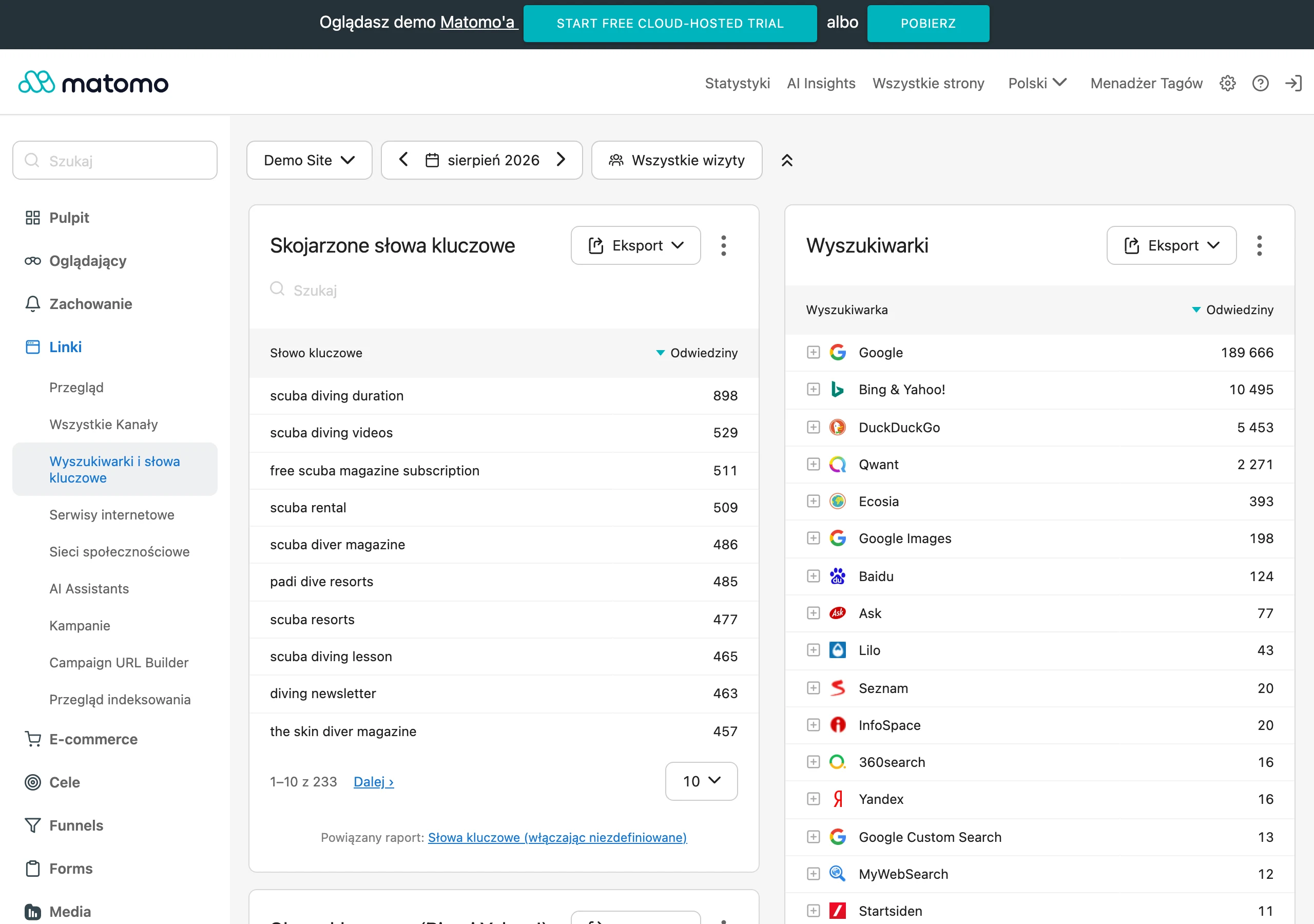
ExampleOrganic traffic broken down by search engines and phrases: you can see Google’s share versus the others, and how many queries remain undisclosed. Public Matomo demo (sample data), own screenshot
Attractive keywords are the result of the search, whereas seed keywords are the input data.
There are many ways to find good seed keywords:
brainstorming,
analysing competitors’ keywords,
observing website navigation menus,
observing the language people use on social media, etc.
SEO & bloggingWhat are seed keywords?
01Starting pointKeyword research
02Input dataUnlock new phrases
03Sources of inspirationBrainstorming, competitors, menus
04ResultsAttractive keywords
Seed keywords are the foundation for building an effective keyword strategy.
2. Keywords focused on search intent
Search intent is the reason why a query was created (it may take the form of a keyword phrase). Intent is what people expect when they enter a keyword into a search engine.
Broadly speaking, we can distinguish four basic types of intent-based keywords:
informational – the user is looking for information, e.g. “who invented the computer mouse”,
navigational – the intent is to find a specific website, e.g. “Facebook login”,
commercial – the searcher wants to buy a specific product, but still needs to look for more information about it, e.g. “Nike shoes reviews”,
transactional – typically related to buying, e.g. “buy iPhone 14”.
In addition, there are so-called high-intent keywords, which indicate that the user is close to making a purchase. They combine commercial and transactional keywords.
Search intent is not a feature of the keyword but of the SERP (search engine results page). Categorising keywords by intent is fairly common, but not entirely technically correct. This means that search intent can change over time, and search engines can show result pages with different intents.
The more general the keyword, the greater the likelihood of mixed intent appearing on the SERP. For example, if you type “coffee” into Google, you’ll see nearby cafés, several major coffee brands, and articles about coffee.
3. long-tail keywords (topical and supporting)
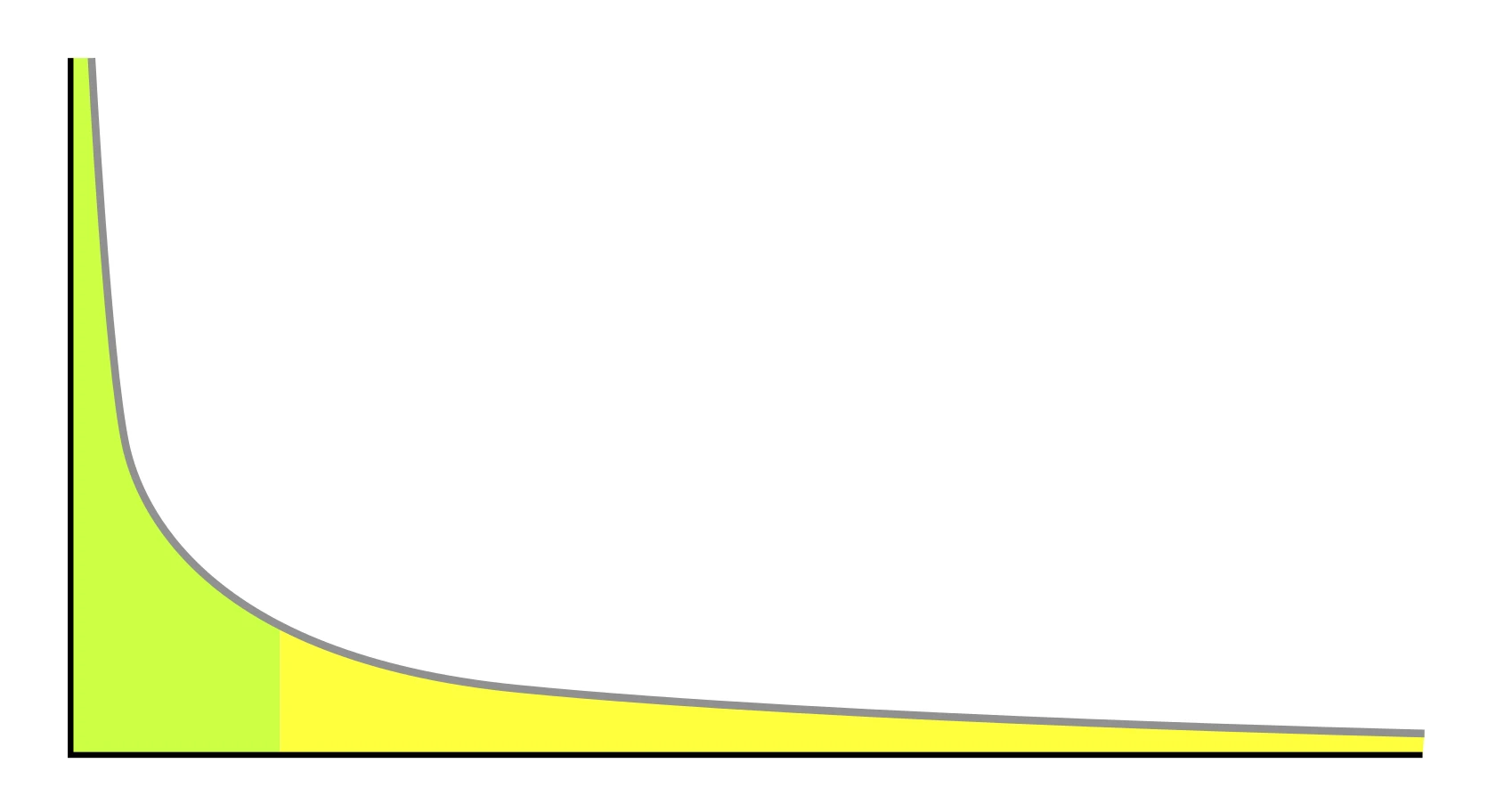
Long-tail keywords are queries that are searched for only a few times a month.
DiagramThe green section is the few popular phrases, the yellow one is the long tail: thousands of niche queries that together generate comparable or greater traffic.Source: User:Husky, Wikimedia Commons, public domain
Their name comes from the so-called search demand curve. In every topic, the most frequently searched are short-tail keywords (also known as head terms), followed by middle-tail keywords, and finally long-tail (so-called “long tail” phrases).
Targeting long-tail keywords is a fairly common tactic in SEO. Here are their key characteristics:
they are less competitive than short- and middle-tail keywords (however, SEO is not easy for long-tail keywords in every case),
there are many of them,
they are usually very specific, so they attract users with particular intentions.
There are two types of long-tail keywords. The first group consists of thematic long-tail phrases, which in themselves are topics. There are also supporting long-tile keywords, which are a less popular method of searching for thematic words.
The difference is significant, because it only makes sense to target thematic long-tail keywords. They should be thought of as a set of subsets.
SEO guide3. Long-tail keywords (thematic and supporting)
01Long tailPrecise, less popular.
02Demand curveShort → Mid → Long (tail).
03Two typesThematic and supporting.
04Thematic (main)Standalone topics; SEO goal.
05Supporting (secondary)Less popular methods.
Long-tail refers to precise, less-searched phrases; the key is to target the thematic (standalone) ones, not just the supporting ones.
4. Low-competition keywords
Low-competition keywords are usually easier to rank. They are able to deliver quick results in a short time. It is therefore no surprise that they are often recommended for new websites without solid backlink profiles.
5. Niche keywords
Niche keywords are clear and specific topics that are of interest to relatively small, specialised groups within a given industry or market.
DiagramThe related questions block expands short answers directly in the results — this is a hint as to which questions are worth covering in the content.Source: Google Search Central, CC BY 4.0
They usually tend to be easier to rank. Due to their specific nature, they may be keywords with high search intent. In other words, every niche keyword can deliver small but high-quality traffic in a short time. They can form the backbone of a long-tail business (selling small quantities of rare items).
An example keyword is “vegan soap for children”. It has a low search volume, but it is specific. Such a product is probably quite rare. There is therefore a good chance that the searcher already knows the industry and market for this product. In addition, ranking such keywords should be fairly easy.
Niche keywords are fairly similar to long-tail phrases. However, niche keywords are not related solely to search demand. They also take the market aspect into account, so you need to spend more time checking what a given word actually means.
SEO strategy5. Niche keywords
01Specific topicsSmall, specialised groups
02Easier rankingLess competition
03High intentHigh-quality traffic in a short time, the backbone of long-tail business
04Example“Vegan soap for children” — low volume, familiarity with the industry
Summary: Niche keywords generate less traffic, but more precise and higher-quality traffic, supporting the sale of rarer products in a long-tail model.
6. Branded and non-branded keywords
Ranking for non-branded keywords allows you to attract people who are looking for products or services related to your brand, but who at the same time do not necessarily know your brand.
Ranking for branded keywords allows you to attract people who are looking for information about your company.
If a keyword does not contain your brand or product name, we are dealing with a non-branded keyword.
7. Competitors’ keywords
Many website owners want to see their competitors’ keywords. Among other things, these keywords are a real treasure trove of topics that can be used on your own site. We can carry out such actions, for example, thanks to Senuto or Ahrefs, using the ContentGAP option.
By knowing your competitors’ keywords, you can:
target the same keywords,
use competitors’ keywords as seed keywords in your research.
8. Primary and secondary keywords (second keywords)
The primary keyword is the main topic of the page. It is also the single phrase for which the page is optimised or the reason for carrying out the keyword research process.
Secondary keywords are closely related to the primary ones that your page is targeted at. If the primary keyword is the title of a book, then the secondary keywords would be the chapter titles in it.
To find good primary keywords, you need to carry out research using Google search or other tools available online. Primary keywords should have the following characteristics:
have significant traffic potential,
show search intent aligned with yours,
provide business potential or other value to your site,
fit within your ranking capabilities (most of the time).
What else should you know?
Eight important types of keywords have been presented above. Here are a few other types that may not be the most important, but are worth keeping in mind:
zero-volume keywords – if you find an interesting keyword that has zero search volume, it may still be worth paying attention to if you believe its popularity will grow or it has business value for your site),
NORA (No Right Answer) – these are keywords with no right answer. They may become popular as AI search engines develop. Some believe that these types of keywords appear where AI-generated answers generate the most clicks from organic results,
meta keywords – it is worth knowing that they are no longer used by Google for ranking pages.
paid keywords – they are not used in SEO, but it is worth remembering them when running paid search advertising campaigns.
FAQ
Frequently asked questions
01
What are seed keywords and what are they used for in SEO?
These are foundational words or phrases that serve as a starting point for further keyword research. They help unlock additional, more specific phrases.
02
What are the basic types of keywords by search intent?
The article distinguishes informational, navigational, commercial and transactional phrases. It also mentions high-intent keywords, which combine commercial and transactional characteristics.
03
Why is search intent not a feature of the keyword itself?
According to the article, intent relates to the SERP, that is, the search results page, rather than the keyword itself. The same phrase can trigger different types of results over time.
04
Which long-tail keywords are worth choosing for SEO?
It is worth focusing on thematic long-tail phrases, because they are topics in their own right. Supporting long-tail phrases are less useful, because they are more of a less popular way of searching for topics.
05
Are low-competition keywords easier to rank for?
Usually yes, which is why they are often recommended for new sites without strong backlink profiles. However, the article notes that ranking for such phrases will not be easy in every case.
06
What are the differences between brand and non-brand keywords?
Brand phrases contain the name of a brand or product and attract people looking for information about the company. Non-brand phrases do not contain the brand name, but they help reach people looking for related products or services.