
Search engine optimisation is constantly changing because of the ongoing development of these online tools. A semantic SEO strategy can help to build an advantage over the competition. Since search engines are being adapted to deliver the best possible conversion results, the content on a website must also be adjusted accordingly. By understanding the basic principles, semantic SEO writing can be applied to any niche. Below are examples of effective strategies used on different websites, as well as insight into the results they have achieved.
Always use relevant topics and connections
This method involves building a “base” for a given topic area. It is worth carrying out a content audit to check what benefits the website. This makes it possible to identify strengths.
Next, you should thoroughly research the given topic area and stick to it. You need to avoid using unsuitable and irrelevant content.
- 01Content AuditFind the base, identify strengths
- 02Choose a topic areaResearch it thoroughly and stick to it
- 03Avoid irrelevant contentUse only appropriate materials
The key is to focus on quality and topical consistency, eliminating unnecessary elements.
Avoiding jargon and improving readability
In particular, websites focused on technical and technology-related topics contain plenty of jargon, specialist vocabulary and long, convoluted sentences. Of course, technical content is harder to read and understand, but this can be made easier for your users.
Very long and complex sentences are a problem both for readers and for Google, which has trouble understanding the relationships between words. As a result, the search engine loses confidence in the meaning of a given sentence. It is important to maintain precision, brevity and clear understanding, regardless of the topic.
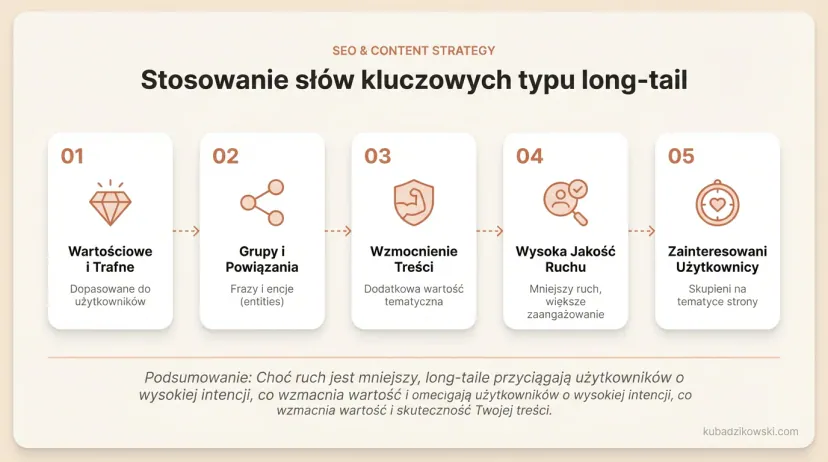
Using long-tail keywords
Long-tail keywords can be valuable if they are relevant to users. It is worth creating keyword groups and looking for other related keywords or entities (entities). This will help further strengthen the content.
Of course, the traffic generated from such keywords is lower, but its quality is certainly high, and the users acquired will be interested in the website’s topic.
Semantic SEO and its use in different niches
Of course, the principles and techniques associated with semantic SEO can be used in many important niches. Below are a few noteworthy examples.
A semantic approach to SEO in e-commerce
The principles of semantic SEO are important not only for websites of an informational or journalistic nature. They can be applied to practically any website, including online stores.
Semantic SEO in the online retail industry is based on checking category and product descriptions not only for uniqueness, but also for detail, providing users with useful and valuable information, as well as the structure of the text itself, which should be easy to read.
In online store content, you should describe the benefits of categories and individual products, and tell users what they can be useful for. This is important not only in terms of supporting real customers, but also for search engines. High-quality valuable content, the right structure and an internal linking strategy are absolute fundamentals in e-commerce.
- 01Understanding intentInterpreting language and context
- 02Knowledge graphGrouping entities and topics
- 03Relevant resultsThe most helpful answers
Technology that delivers the best answers thanks to a deep understanding of the meaning of words and their relationships.
Using semantic SEO in companies representing different industries
Unlike e-commerce stores, other companies’ websites usually do not contain dozens or thousands of subpages. Most often they contain only a few key subpages and possibly a blog with posts. As a result, the content, its value, and the right structure are crucial.
The text on such a website must provide essential information and be easy and pleasant to read. Breaking it up into short paragraphs and using main and subordinate headings is important. Synonyms, attention to different details and avoiding mistakes also matter.
Semantic SEO in the DIY sector
Working in the home and DIY industry involves, among other things, sharing knowledge related to this niche. Not everyone has it, and obtaining the right information can help them make the right purchases.
The basis is creating a page with answers to the most frequently asked questions (FAQ). Such a section should contain various questions and answers that are as specific and valuable as possible, covering the topic in full. However, the answers should not be long and complicated.
Another important issue is detailed guidance related to “DIY”. It should include not only products that need to be bought, but also detailed descriptions of how to make various items step by step. Rich and useful content supplemented with graphic and video elements will certainly be useful to many website users.
Semantic SEO in the technology sector
First and foremost, an important issue is a detailed description of how specific services are carried out and how products in the technology industry work. It is worth focusing on the specific queries characteristic of the industry and then creating content that is tailored to them. Sometimes this involves reworking existing content, and sometimes creating new content.
In technology content, it is important to use as little jargon as possible that only a narrow group of people familiar with technology would understand. Simple language is crucial when creating text that is easy to understand even for laypeople.
How does semantic search work?
Semantic search delivers the best results in response to users’ queries thanks to understanding their intent, as well as the language. Through machine learning and artificial intelligence, search engines are able to gain deep insight into the semantics (or meaning) of words and phrases and how they relate to one another.
Google understands entities and different types of topics and groups them using The Knowledge Graph (Knowledge Graph). This is a more sophisticated approach compared with the keyword matching used by search algorithms in recent years.
Today, semantic search engines are constantly improving their understanding of language, so they can provide the most relevant and helpful results for any query. This requires paying attention to search intent and the goals behind the content delivered to the user.
The main benefits of semantic search
Semantic search brings many benefits, both for users and for search engines. For users, they are as follows:
- The ability to get the sought-after answers more quickly, and even to get answers to further questions that would have been asked.
- User experiences related to search engines become much better thanks to receiving higher-quality results.
- Users can carry out the search process on different devices and in different ways and still receive results of the appropriate quality.
The benefits for search engines are as follows:
- They provide very useful services, which means that people will be more willing and more likely to use search engines, thus giving them more data needed to learn human language.
- They are able to handle many conversion-focused queries from devices such as smartphones and home equipment.
What is semantic content?
In linguistics, the concept of semantics means the study of meaning. In this context, semantic content means using words, phrases and sentences that create text with a specific meaning. Semantic text aims to use the connections between words, phrases, concepts and sentences to create a highly valuable information resource on a specific topic. In such a case, attention is paid to content details, from sentence structure to the overall structure of the page and many other elements.
Simply put, semantic content follows language rules and is specific and easy to read. It is aimed at giving topics the right context and avoiding unnecessary words. Deep, valuable content without complicated and hard-to-understand vocabulary is therefore essential.
In SEO, content creation for semantic content is important if you want to achieve a high ranking. Search engines use Natural Language Processing (NLP) to understand content, and this process evaluates the words used and the connections between them.
General principles of semantic SEO
Regardless of the type of website you run, there are certain general guidelines and principles related to semantic SEO that should be followed. They are as follows:
- Creating valuable, high-quality content allows you to build an expert image and gain an advantage over the competition. It is therefore worth refining your texts in every respect.
- Semantic SEO should also be included in your link acquisition strategy.
- The content should always focus on a specific topic.
- Quantity is not always what matters. Quality is what matters above all. However, it is important to consistently deliver valuable content to your audience.
Of course, the results of applying semantic SEO will not appear immediately after a few days. Usually, satisfactory results can be noticed after around 2-3 months.
FAQ
Frequently asked questions
How to use semantic SEO in e-commerce?
In online stores, unique, detailed category and product descriptions are important, as they are valuable for users and easy to read. Product benefits, information about their use, and an internal linking strategy are also important.
Does semantic SEO only work on informational pages?
No, it can be used on practically any website, including online stores and company websites. The article highlights that semantic SEO principles are useful in many different niches.
Why is it worth avoiding jargon and long sentences in technical content?
Because they are harder for readers to understand and can make it more difficult for Google to interpret the relationships between words. It is better to write precisely, concisely and clearly.
How should long-tail keywords be used in semantic SEO?
It is worth creating groups of related phrases and also looking for other related phrases and entities. Such queries usually have less traffic, but they attract more interested users.
What should semantic content on a company website look like?
It should be valuable, easy to read and well organised. Short paragraphs, main and subheadings, synonyms and avoiding mistakes are important.
When can you see the effects of semantic SEO?
They usually do not appear immediately after a few days. Satisfactory results can be noticed after around 2–3 months.