SEO is not always straightforward, but there are certain quick actions you can take to improve your site’s visibility in Google. Here are a few proven methods that will bring immediate benefits. So, please do read on!
Quick wins is a term often used in the SEO industry, referring to optimisation actions that can be implemented quickly and which bring immediate benefits in terms of a site’s visibility in search results.
In the context of the article below, quick wins are strategies and techniques that do not require long-term planning or resources, but can significantly improve a site’s position in Google in a short time. Very often, quick wins are associated with keyword optimisation for keywords ranking in positions 4-10 or 10-20 in the SERP.
Benefits of using quick wins in SEO
Possible immediate results – unlike many other SEO strategies that may take months or even years to deliver results, quick wins can bring rapid benefits, often visible within just a few days or weeks.
Cost efficiency – because quick wins often do not require significant investment or resources, they are a cost-effective way to improve a site’s visibility.
Improving user experience – many of the recommended actions, such as optimising images or removing intrusive ads, are aimed not only at improving SEO, but also at improving the overall user experience on the site.
Web developmentCheck 10 quick wins worth implementing on your site
01Content audit and strategyIdentify content gaps
02Quick answers & FAQOptimisation for quick answers
03Technical healthFix links and 404 errors
Key actions for improving your website’s visibility and usability in just a few steps.
Check 10 quick wins worth implementing on your site
1. Optimisation of title tags (meta title)
Proper title optimisation is key to success in SEO. The title is the first element a user notices in search results. That is why it is important to:
keep the title length within the optimum range of 50 to 60 characters to avoid it being truncated in search results.
create unique titles that stand out in search results and attract users’ attention. It is also worth adding a Call To Action or another incentive to visit (free delivery).
Presentation of meta title using a pluginSEO & search engine2. Structured data (for enhanced search results)
01Stand out in the resultsMore information, higher attention
02Higher CTRBetter position, more clicks
03Strengthen the leadersImprove the best, gain more
Key to improving the visibility and clickability of your pages in search results, especially those already ranking well.
2. Structured data (for enhanced search results)
Structured data help your site stand out in search results by presenting additional information such as ratings, prices or event dates. By implementing them:
you can increase your site’s CTR, which translates into higher rankings.
it is worth focusing on pages that are already performing well, in order to strengthen them even further.
Example of structured data in the form of a search query for Iphone 14 PRO Max and the display of reviews, price and stock availability
3. Image optimisation
Images are an important element of every website, but if they are not properly optimised, they can affect its performance. That is why it is worth:
adjusting image sizes to the width of the page, avoiding excessive load,
choosing the right file formats, such as webP or AVIF,
compressing images while maintaining a balance between quality and file size.
SEO4. Find keywords with low competitiveness
01Identify the competitionAnalyse industry leaders
02Check their keywordsDiscover low-competition phrases
03Create better contentWrite valuable articles
Quickly understand and make use of traffic potential, avoiding heavy competition.
4. Findkeywords with low competitiveness
The term low competitiveness refers to keywords that have high traffic potential but low competition. To make use of them:
identify the main competitors in your industry,
check which keywords they rank for in search results,
create better content than the competition, focusing on those keywords.
5. Update and republish old posts
Content that was once popular may lose its relevance over time. That is why it is worth:
regularly reviewing old posts and updating them by adding new information or improving existing content,
after updating, promoting those posts on social media and informing your community about the changes.
6. Add internal links to new (and old) pages
Internal links help with navigation on the site, but also strengthen its SEO. Therefore:
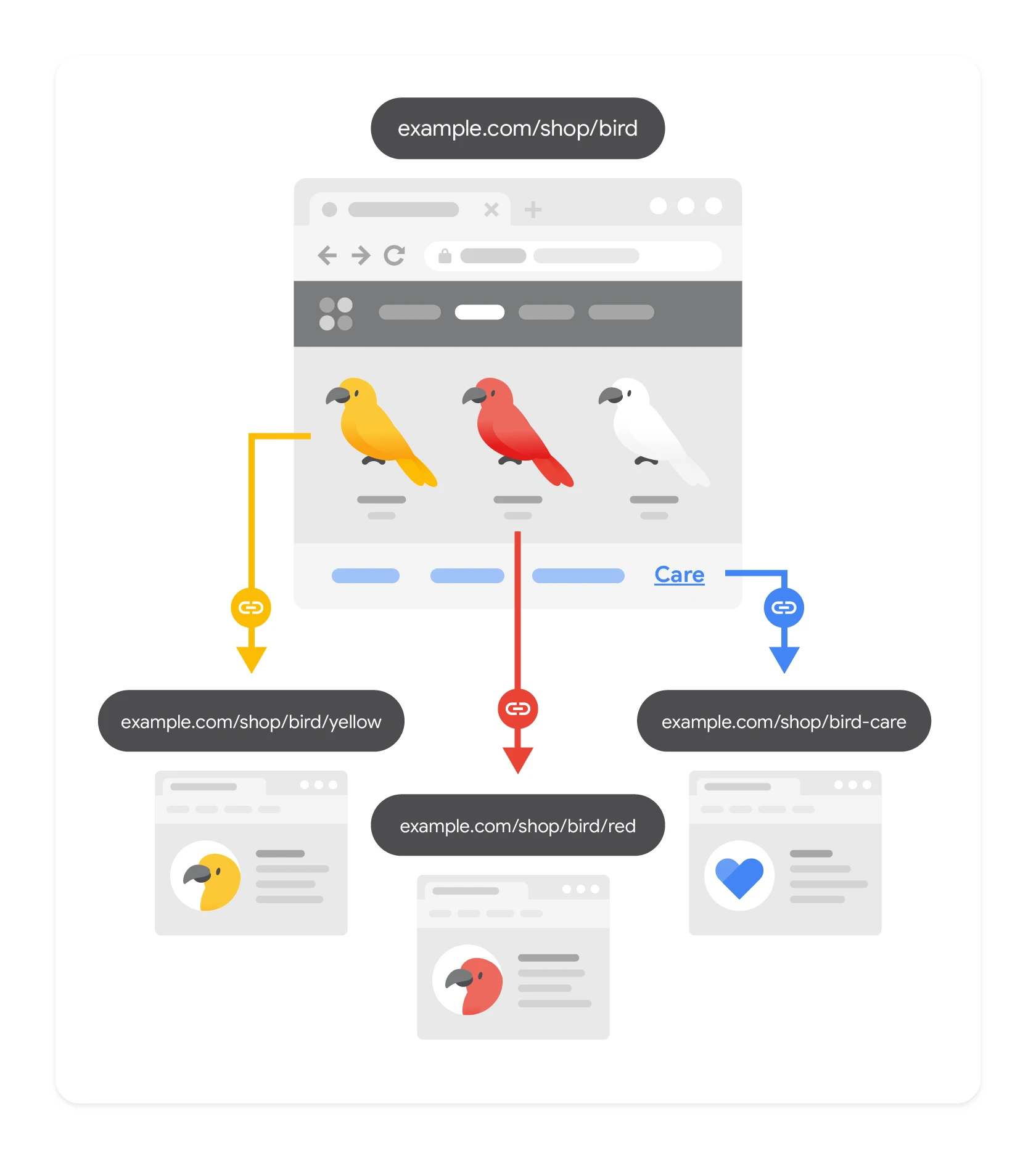
DiagramA category page links to detailed and related subpages — this is how crawlers discover new URLs and understand the relationships between them.Source: Google Search Central, CC BY 4.0
regularly add internal links to new content, pointing to articles that already exist on your site,
make sure the links are thematically related so that they are valuable for both users and search engines.
7. Implement breadcrumbs
Breadcrumbs are links that show the user where they currently are on the site in the context of its structure. By implementing them:
you make it easier for users to navigate the site, allowing them to easily return to earlier sections or the home page.
you help search engines understand the structure of your site, which can contribute to better indexing and higher positions in search results.
Example of breadcrumbs implemented for tyres. It all starts with the manufacturer, then the manufacturer with the season indicated, ending with a specific model
Transparency and authority are key to building trust among users. Therefore:
the “About us” subpage should tell the story of the company, its mission, values and team,
an author bio gives readers insight into the expertise and experience of the person writing the content, which can increase trust in the information presented.
10. remove pop-up ads
Although pop-up ads can be effective in increasing conversions, they can also disrupt the user experience and negatively affect SEO. Therefore:
avoid intrusive ads that cover the main content of the page, especially on mobile devices,
if you have to use pop-up windows, make sure they are optimised for UX and do not appear too often.
To sum up
SEO is about constant adjustment and optimisation. Although there is no single universal solution that guarantees success, focusing on the actions above can significantly increase your site’s visibility in Google. Remember that the key is to provide value for the user, and all SEO activities should be undertaken with that in mind.
FAQ
Frequently asked questions
01Which quick wins in SEO can quickly improve a site's visibility in Google?
These are actions that can be implemented quickly and without large resources, and their effects may be visible within just a few days or weeks. The article points to, among other things, optimising titles, images, internal links and structured data.
02Why is it worth optimising meta title tags?
The title is the first element visible in search results, so it has a major impact on clicks. It is worth placing the keyword at the beginning, keeping the length to 50–60 characters and creating unique titles.
03How do structured markup tags help with SEO?
They help make a site stand out in search results by showing additional information such as ratings, prices or event dates. They can increase CTR, which translates into better ranking results.
04How do you find low-competition keywords?
You need to identify your main competitors, check which keywords they rank for, and create better content than they do. It is best to look for keywords that have traffic potential but low competition.
05Can updating old posts improve SEO?
Yes, because content that was once popular loses relevance over time. It is worth refreshing it regularly, adding new information and promoting it again on social media after publication.
06Which elements of a site are worth improving to make navigation easier for users and Google?
Internal links, breadcrumbs and descriptive anchor texts help with this. The article also highlights the importance of the “About us” page, author bios and removing intrusive ads.