
The user rarely gets to know a brand in one place. Usually, they form an opinion from several touchpoints at once, because they may first see a post, then visit the blog, and only later check the service page. When they get a different language, different promises and a different “next step” in each of these places, the path simply falls apart. The problem is that it is usually not a lack of content, but a lack of shared logic between channels. Consistent communication works best when each channel does something different, but all of them are built on the same core offer and arguments. This not only organises marketing, but also makes editorial decisions easier and reduces the number of materials that generate traffic without a business effect.
What consistent communication between the website, blog and social media is
This is a content production model in which the website, blog and social media use one communication core, but perform different functions. The user should see the same logic of the offer, a similar benefit-led language, the same main arguments and sensible transitions between channels. It is not about identical copy. It is about consistency in what the brand promises, how it explains it and where it ultimately leads.
In practice, this area is broader than tone of voice or visual consistency alone. What matters is how the messaging architecture is built, what the topic map looks like, what roles the channels are given, what the linking rules are, the publication templates and the content approval process. These are the elements that decide whether the team delivers consistency or only a “similar style”. Consistency does not mean copying the same post to the blog, the website and Instagram, but consciously adapting one message to different formats and user intent.
The website usually organises the offer and closes the decision. The blog answers questions and search intent, while social media shorten the distance by adding context, an example or proof. This division matters because each channel works differently and at a different stage of the journey. But beware, one mismatch can ruin the whole thing. If a post promises a specific result, but the landing page talks about something else or uses different terminology, the clarity of the entire journey drops.
The core of consistent communication is a shared messaging framework. It includes audience groups and their problems, the value proposition, proof points, the most common objections, industry vocabulary, the main CTAs and priority offers. This means the team does not create every piece of content from scratch. Instead, it uses one set of decisions and does not have to reinvent how to describe the same service each time.
The result of this work is not a single text, but an operating system. It usually ends with a source communication document, a topic matrix, a set of templates, publication rules and a list of fixes for existing materials. That sounds “process-driven”, but the fact is that without this, consistency does not scale by itself. And that is why it matters particularly when there are several offers, several personas, regular SEO and a parallel presence on social media.
What the main stages of implementing consistent communication are
Consistent communication does not start with inspiration. It starts with an audit of what already works, and ends with measuring transitions between channels and a series of improvements. This is not a one-off writing exercise, but an organisation of the entire way the brand talks about the offer, the promise and the proof. First, real messages are collected from different places, and only then is one version agreed that is to apply on the website, blog and in social media. The question is simple: are these channels all pulling in the same direction, or is each one pulling its own way.
- Audit of assets and touchpoints involves reviewing service pages, landing pages, blog posts, social profiles, bio, CTA, forms, links and lead magnets. The goal is specific: to check where communication stays on one line, and where the brand describes the same thing in several different ways, once “casually”, once “corporately”.
- Message inventory organises all versions of the description of the offer, benefits, target groups, sales arguments, case studies, FAQ and phrases used in the content. And this is usually where the crux of the problem emerges: conflicts, mental shortcuts and content gaps that later come back to bite in sales conversations.
- Audience and intent analysis answers the question of what different user groups are looking for and what language they actually use. In practice, this takes into account customer questions, objections, search data, comments and messages, as well as content that genuinely supports contact or sales, instead of just “looking nice”.
- Building the communication core creates one base for all channels. The key is that it should contain the main promise, benefits language, proof, promise boundaries, tone of voice, glossary of terms, forbidden simplifications and basic CTAs, in other words, what later keeps everything in line.
- Assigning roles to channels sets out exactly what the website, blog and social media are meant to do. This ensures the website does not duplicate the blog, the blog does not write in isolation from the offer, and social media does not stop at reach without directing the user onwards, to where the decision is made.
- Topic and flow map links blog topics with specific services, social media formats, keywords, social proof and target URLs. This is the stage that turns loose publishing into a plan based on the function of each piece of content, not on the whims of the calendar.
- Execution standardisation introduces templates for articles, posts, carousels, video descriptions, hero sections, CTA blocks, internal linking, UTM tags and content update rules. The result is simple: quality does not depend solely on the person who happens to be publishing, but on the agreed standard.
- Workflow implementation organises responsibilities. You need to define the communication owner, the SEO person, the editor, offer approval, the place for briefs, the publication calendar and the way materials are versioned, because without that even a good plan falls apart after the first quarter.
- Measurement and optimisation check whether communication really works across channels. You analyse transitions from social media to the blog and service pages, clicks on CTA, content visibility, conversion-supporting paths and places where the promise does not match the page content, in other words, those quiet “leaks” in the funnel.
This order matters. Because when you skip the earlier stages, it almost always ends up with treating symptoms rather than the cause. The brand publishes more, yet still does not have one version of the offer, one glossary and clear transitions between channels. Then even genuinely good individual pieces of content do not add up to a coherent system.
To implement this, you most often need a CMS, a content inventory spreadsheet, web analytics, Search Console, social media stats, a publication schedule and a simple system for approving tasks. It sounds technical, but it is simply a set of tools that keeps order and facts in check. Without measuring transitions between channels, it is hard to assess whether the blog and social media support the offer or merely generate activity. And the problem here is that “traffic” can look like progress, even when it is not. That is why the reporting stage is not an add-on, but an integral part of the whole working model.
Why communication consistency is key for a brand
Communication consistency determines whether the user gets the point straight away. It makes it possible to understand quickly what the brand offers, who it is for and what the next step should be. When the website, blog and social media talk about the same value in different, but aligned, ways, the journey becomes clear. The user does not have to reinterpret the offer from scratch in each channel every time. This shortens the path from interest to decision.
In practice, the biggest friction appears when a post promises one thing, an article develops something else, and the service page uses yet another language. This mismatch does not always reduce traffic immediately, but it consistently undermines trust and makes conversion harder. The user gets the impression that they have landed at a different brand than the one they saw a moment earlier. And the question is: why should they take the risk, if the message contradicts itself. This is especially damaging for services, expert offers and longer decision-making processes.
Consistency also works operationally. It organises team work and reduces editorial chaos, which usually stems from a lack of a shared base. If there is one communication core, it is easier to prepare an article, a post, a landing page and an advert without reinventing the offer from scratch. As a result, the content is not only stylistically similar, but above all consistent in promise, arguments and CTA. And that translates into fewer publications that generate attention but do not lead to a valuable next step.
From the perspective of SEO and analytics, consistency raises the quality of the whole journey, not just a single piece of content. The blog can answer questions and capture informational intent, but it must lead to a page that develops the same topic in the context of the offer. If that connection is missing, the number of entrances without meaningful further movement grows, and the report starts to resemble a nice table without meaning. Good consistency is not about copying the same content, but about maintaining one logic of messaging across different formats.
For a brand, this means one more thing: greater predictability when scaling communication. First come new services, then more people publishing, customer segments or language versions, and a lack of rules very quickly turns into chaos. A coherent communication model acts like a decision-making filter. It shows what not to publish, how to name the offer and where to direct the user next.
What tools support communication processes
Communication processes are supported by tools. The thing is, tools only make sense when they keep track of one source of truth, a smooth flow of content and measurement of transitions between channels, instead of living their own lives. The key is for them to be built into the real workflow, not set up side by side “just in case”. A stack of apps on its own will not save the situation if the brand does not have an established communication framework. First come the rules, and only then the tools to enforce them.
- CMS – organises publishing on the website and blog, makes it easier to update content, implement CTA blocks, internal linking and sections related to the offer.
- Content inventory spreadsheet – gathers existing pages, posts, social posts, service names, CTAs and communication gaps in one place, without digging through folders and email histories.
- Web analytics tool – shows where users come from, which content supports the path to the offer and where traffic simply drops off.
- Google Search Console – lets you check which queries the blog is visible for and whether the content attracts the right search intent, rather than random visits.
- UTM parameters and reporting dashboard – make it easier to assess which social media publications actually drive traffic to the right pages, instead of inflating “nice” statistics.
- Task management tool – organises briefs, approvals, responsibility for publishing and content updates, i.e. the things that usually get lost in the rush.
- Asset library – stores graphics, templates, snippets, descriptions and proof materials so that the team does not produce several versions of the same message.
- Social media platform analytics – help distinguish reach-driven content from content that genuinely supports transitions to the blog or service page.
In practice, what is most often missing is not a publishing tool, but a tool for controlling consistency. That is why a simple source document with service names, promises, audience groups, proof points and acceptable CTAs works well. Such a document should be kept up to date and available to everyone creating content, with no exceptions. The question is: how many times have you seen three different descriptions of the same offer in one company. If the team uses several versions of the offer description, inconsistency will return regardless of the quality of the system.
It is also worth implementing solutions that shorten the path from idea to publication. But be careful, not at the expense of control. This is about article templates, post templates, ready-made hero sections, a link-building standard and a pre-publication checklist, i.e. small “guardrails” that keep things on course. This is especially important when several people create content or when the brand moves fast on social media. Then it is easy to end up with a message that is eye-catching but detached from the landing page.
The best toolset is simple in principle. It should make it possible to answer three questions: what are we publishing, what does it lead to and does it work. If you cannot check which posts are driving visits to service pages or which articles are genuinely supporting contact, the system is simply incomplete. Tools therefore need to support not only content production, but also its evaluation after publication. Only then can communication be improved on the basis of data, rather than gut feeling.
The most common mistakes in communication between channels
The most common mistakes in communication between channels stem from a mismatch: the offer, the language and the user’s “next step” between the website, blog and social media. In practice, the brand then does not have one communication core, but several parallel versions of the same message. The user sees one promise in a post, another in an article and yet another on the service page. This does not have to reduce reach straight away, but it very often lowers understanding of the offer and makes the decision harder.
The most costly mistake. Using different names, benefits and arguments for the same service. If social media talk about a “growth strategy”, the blog about a “content plan”, and the sales page about “marketing support”, the user does not know whether this is one service or three different entities. The problem is that this kind of chaos is particularly damaging when someone comes across the brand for the first time and starts comparing offers.
The second common problem looks harmless. In social media we promise something that the landing page does not expand on or confirm. A short format easily simplifies the message, but when the claim is not backed up by the page content, it creates an impression of exaggeration or an omission. Every strong message from a post should have its expansion, proof or clarification on the website or blog.
- Missing a single source document describing the offer, audiences, benefits, proof points and CTA.
- Running a blog without linking it to specific services, categories and search intent.
- Mechanically copying the same content to all channels instead of adapting it to the role of the channel.
- Lacking a defined next step after an article or post: visit a service page, sign up, contact, download material.
- Not updating older content after a change in the offer, naming or brand positioning approach.
- Lacking a process owner, which means several people publish content according to different briefs and criteria.
Another mistake is treating all channels identically. The website is meant to organise the offer and close the decision, the blog is meant to answer questions and support SEO, and social media are meant to attract attention, show context and direct people further. Let us look at it another way: when each channel tries to do everything at once, usually none of them does its proper job.
Many brands lose efficiency because of the mundane lack of a linking map and the lack of regular review of old materials. Articles do not lead to services, posts do not direct users to the right resources, and the landing page does not take over traffic from informational content, even though it should close that path. If channels do not pass the user on consciously, they operate alongside each other, not together.
How to measure the effectiveness of consistent communication
The effectiveness of consistent communication can be seen in whether the user moves smoothly between channels and whether those transitions support business goals. Impressions or likes alone are not enough, because they do not show whether the message actually leads to the offer. The question is: does content from social media and the blog really drive visits to the right pages, interactions with the CTA and contact? Good consistency is visible when the user journey becomes shorter, more logical and less random.
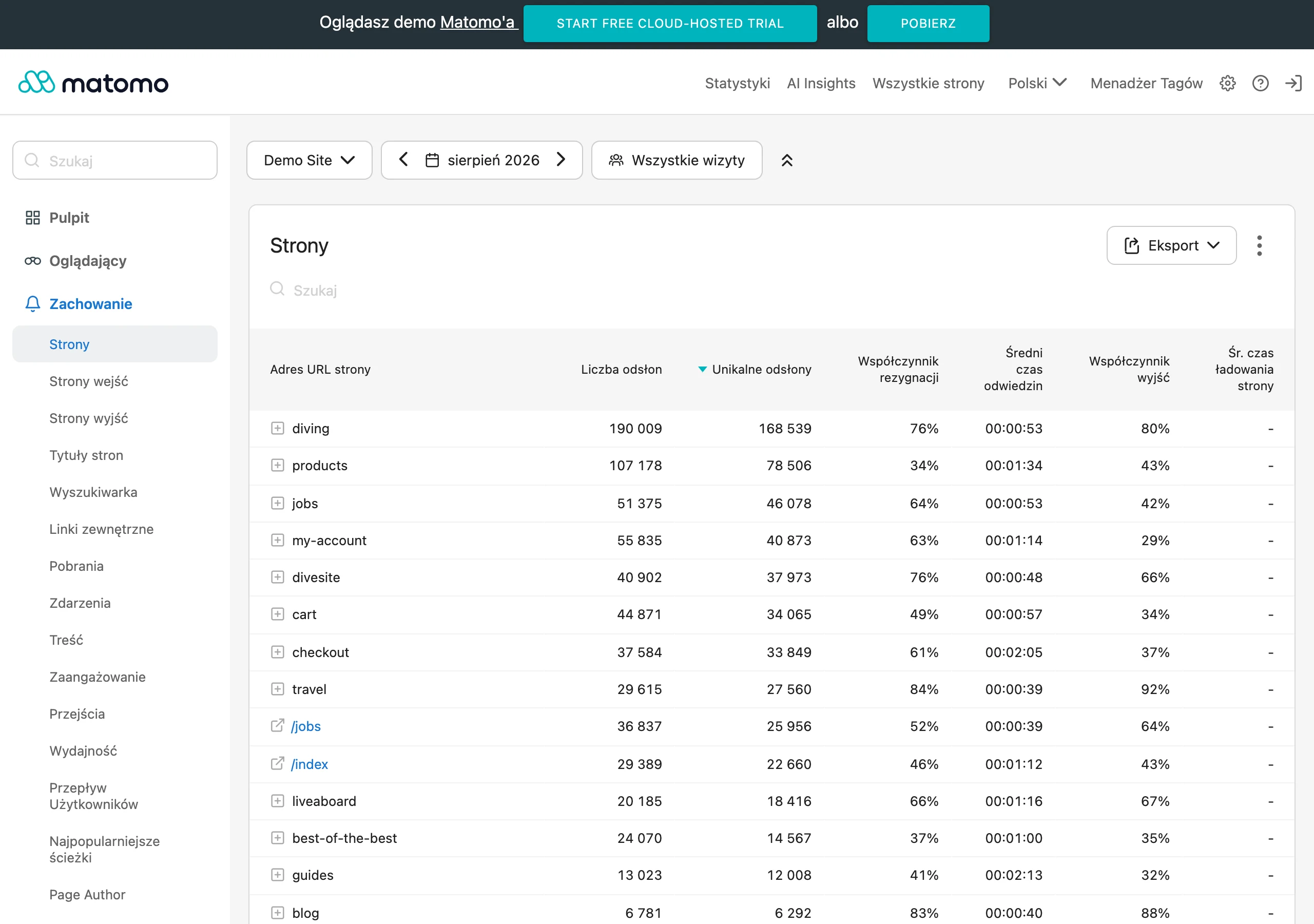
At page and blog level, it is worth measuring specifics. Visibility for queries aligned with the offer, visits to articles linked to services, clicks on contextual links and transitions from posts to landing pages tell you more than “nice” metrics. What happens after the visit also matters a great deal: does the user read more content, move on to the FAQ, the form, the pricing or the offer section? If an article attracts traffic but does not generate any meaningful next step, it usually means the topic or the CTA is poorly aligned with the offer.
In social media, reach is not the only thing that matters. Traffic and the quality of transitions matter too, meaning whether clicks actually trigger anything further. In practice, you look at clicks on links, visits tagged with UTM, visits to specific service pages after a content campaign and which formats most often initiate conversion-assisted journeys. A post with a smaller reach that regularly sends users to the right page can be more valuable than viral content with no connection to the offer.
The simplest way to measure it is at three levels: message alignment, user flow and business result. You assess message alignment qualitatively by comparing promises, wording and CTAs across channels, because this is not about a “similar tone”, but about the same promise. You check user flow in analytics, and you see the business result in the number of enquiries, sign-ups, downloads or other micro-conversions linked to a given path.
- Visits from social media to the blog and service pages with UTM tagging.
- Clicks on CTAs in blog posts and landing pages.
- The share of articles that lead to transitions to offers, rather than just attracting traffic.
- Queries in Search Console that bring users to content aligned with transactional or problem-solving intent.
- Conversion-assisted paths: which channels and content appear before contact or sign-up.
- Drop-off points: quick exits, no further transitions, low scroll depth or no interaction after arriving on the landing page.
It is a good idea to regularly check where the promise diverges from what is actually waiting on the page. In short: consistency comes at a cost, or it costs you. If a post or article promises a specific result, but the landing page responds with vague language or a completely different tone, analytics will usually show lower engagement and fewer clicks deeper into the site. This is not fixed by publishing more content, but by adjusting the message and aligning the landing content with the promise.
The most practical working model is a simple dashboard that combines data from web analytics, Search Console and social media statistics. It is not about a report with dozens of slides, but about quickly spotting which messages actually drive traffic, which transitions lead to the offer and where the user loses the sense of the journey. If you do not measure transitions between channels, you can see activity in the channels, but you cannot see the operation of the whole system.
What benefits a unified communication strategy brings
A unified communication strategy shortens the path from first contact to decision, because in every channel the user encounters the same meaning of the offer. They see the same benefits, similarly structured arguments and a logical next step, instead of piecing the message together from random fragments. The key benefit is simple: the brand becomes easier to understand, and that directly affects traffic quality and sales conversations.
In practice, this means fewer situations where a post grabs attention, but the page does not close the topic. The problem is that users have no patience for guesswork. If the blog develops the reader’s question and the service page uses the same benefit-led language and the same offer logic, the chances of moving further increase. This works not through the aesthetics of communication alone, but through alignment between the promise and the landing content.
The second benefit is better use of content in SEO and distribution. The blog can answer specific search intents, social media can reinforce one thread or one proof point, and the site can take over traffic that is ready to act. As a result, each channel does its own part of the work, but does not compete with the others for the user’s attention.
It is also a very concrete operational saving. The team does not produce successive variants of the same offer from scratch, but works from a shared communication core, templates and established terminology. Briefs become shorter, approvals move faster, and the risk of publishing content that conflicts with the offer drops noticeably. And that is not a cliché, it is simple work arithmetic.
A unified strategy also improves analytics and decision-making. When offer naming, CTAs and transition paths are organised, it is easier to check which topics attract valuable traffic and which formats actually lead to contact or sales. Without a consistent system, it is hard to distinguish a channel problem from a problem with the message itself.
Another benefit comes to the fore when scaling efforts. The question is: how do you grow without adding chaos. A brand with multiple services, customer segments or languages first needs shared principles, and only then adaptation to the channel and audience. This structure allows you to grow without chaos, because new content is created within one model rather than as separate, inconsistent initiatives.
In the longer term, brand credibility also grows. The user does not have to learn about the company from scratch every time, because regardless of the entry point they get similar clarity, the same weight of arguments and equally solid evidence. This is particularly important where the decision requires comparing offers, time and trust, rather than an impulsive click.
FAQ
Frequently asked questions
How does consistent communication between the website, blog and social media work?
It is based on one communication core, but each channel serves a different function. The website structures the offer and closes the decision, the blog answers search queries, and social media adds context and shortens the distance.
Does consistent communication mean copying the same content across all channels?
No, it means adapting one message to different formats and user intent. The content should be aligned in the promise, arguments and CTA, but not identical.
Why does a lack of consistency between channels reduce marketing effectiveness?
Because the user gets different promises, different language and a different next step at each brand touchpoint. That throws the journey off, reduces the clarity of the offer and makes conversion harder.
What should a shared messaging framework include?
It should cover audience groups and their problems, the value proposition, proof points, the most common objections, industry vocabulary, the main CTA and priority offers. That way, the team works from one base rather than creating each piece of content from scratch.
What does implementing consistent communication look like step by step?
First, carry out an audit of the content and touchpoints, then an inventory of messages, audience analysis and building the communication core. Next, assign roles to channels, create a topic map, execution standards and a workflow, and measure transitions between channels.
What are the most common mistakes in communication between the website, blog and social media?
Most often, it is different names, benefits and arguments for the same service, and post promises that the landing page does not develop. Another problem is the lack of a single communication core and guiding the user without a clear next step.