

In many companies the problem is not that there is too little content. The problem is that there is too much of it and it is being produced without a clear plan, so the blog grows, guides are added, landing page, FAQ, newsletter and sales materials follow, and after a while nobody can say what is really delivering results. The sheer number of publications is not a strategy if you do not know what purpose each piece of content serves and how it is meant to support the user’s next step. The side effect is predictable: costs rise, the team gets distracted, and SEO starts to suffocate because topics duplicate each other or compete with one another. On top of that, the data usually sits in different places, scattered between CMS, GA4, Search Console and CRM, so assessing the effect becomes blurry. This article shows how to recognise that moment and distinguish content activity from a real strategy.
What the problem with too much content without a strategy looks like
The company publishes more than it can justify. You can see activity, but you cannot see the logic, because it is unclear which materials are meant to attract traffic, which to educate, which to support sales, and which to overcome objections. As a result, content becomes an operating cost, not an asset that works towards results.
The key question is: does every asset have a business goal, a user intent, a stage in the customer journey and a way to measure its impact. If the answer is “no” for most URLs, then there is usually no strategy, only a publication calendar that is meant to look like a strategy. Content without an assigned role very often generates page views, but does not support the purchase decision or the next step on the site. And then the convenient excuse appears: “people are reading it”, so everything must be fine. But is it really.
This is not just a problem with the blog. The same applies to landing page, category pages, guides, FAQ, lead magnets and other assets, because each of them affects SEO, UX and sales, sometimes more than an article does. A good diagnosis therefore does not throw “content” into one bucket, but breaks it down and looks at each part separately: what its purpose is, where it leads and whether it should stay, be improved, be combined with something else or removed.
A typical warning sign is a situation in which the team publishes regularly. The trouble is that it cannot point to which pieces of content really generate demand, support the offer or fill users’ information gaps. Then the classic pattern kicks in: topic duplication, keyword cannibalisation, orphaned content and chaos in internal linking. If, after reading a piece, the user is not given a clear path for what to do next, then even good content can waste intent.
The solution is not to start writing even better texts immediately. Instead, you need to organise the entire content ecosystem, because without that each new piece only adds another brick to the mess. First comes an inventory of assets, then assigning them a status and role, and only at the end making decisions. Only then can you sensibly decide what to keep, what to update, what to merge and what no longer needs developing.
The current market context and its impact on content
Today, advantage no longer comes from content production alone. Writing and publishing have simply become easier and faster, so the number of materials is growing in almost every industry. The side effect is simple: the winner is not the one who publishes most often, but the one who gets the topic right, delivers real usefulness and ties the content to the offer. Volume alone has stopped being a currency.
In SEO, it is no longer the site with “more texts” that triumphs. What matters is matching search intent, full topic coverage, sensible internal linking and the technical health of the site. The problem is that when a company publishes a series of similar articles with closely related intent, it often spreads its own potential instead of strengthening it. More does not mean better, and sometimes it means worse.
From the user’s perspective, one thing is crucial. Content is rarely consumed linearly, from the first sentence to the last full stop. The reader lands on a specific URL, assesses its usefulness within seconds and decides whether to continue, return to the search results or go to the offer page. Do we really want that moment to end in a dead end. Good content does not end with an answer, but leads to the next sensible step.
In practice, analytics also make assessment more difficult. Data is scattered across different systems: CMS shows publications, GA4 traffic and behaviour, Search Console queries, CRM leads and sales, and each of these sources tells only part of the story. On top of that, many companies plan blog, social media, newsletter and sales materials separately, without a shared topic taxonomy and shared KPIs. And then a large number of publications acts like a smokescreen, because it easily masks the lack of a real strategy.
How the content audit and optimisation process works
An audit and content optimisation is not a “blog review”, but a series of decisions. The process starts with gathering business goals and ends with a list of concrete actions for each asset. At the outset, you need to establish which products or services the company genuinely wants to sell, which audience groups it has, where its traffic comes from and which conversions really matter. Without that, even a well-written text will be assessed in a vacuum, that is, in a world without consequences. Each URL should have one dominant goal, not several general functions at once.
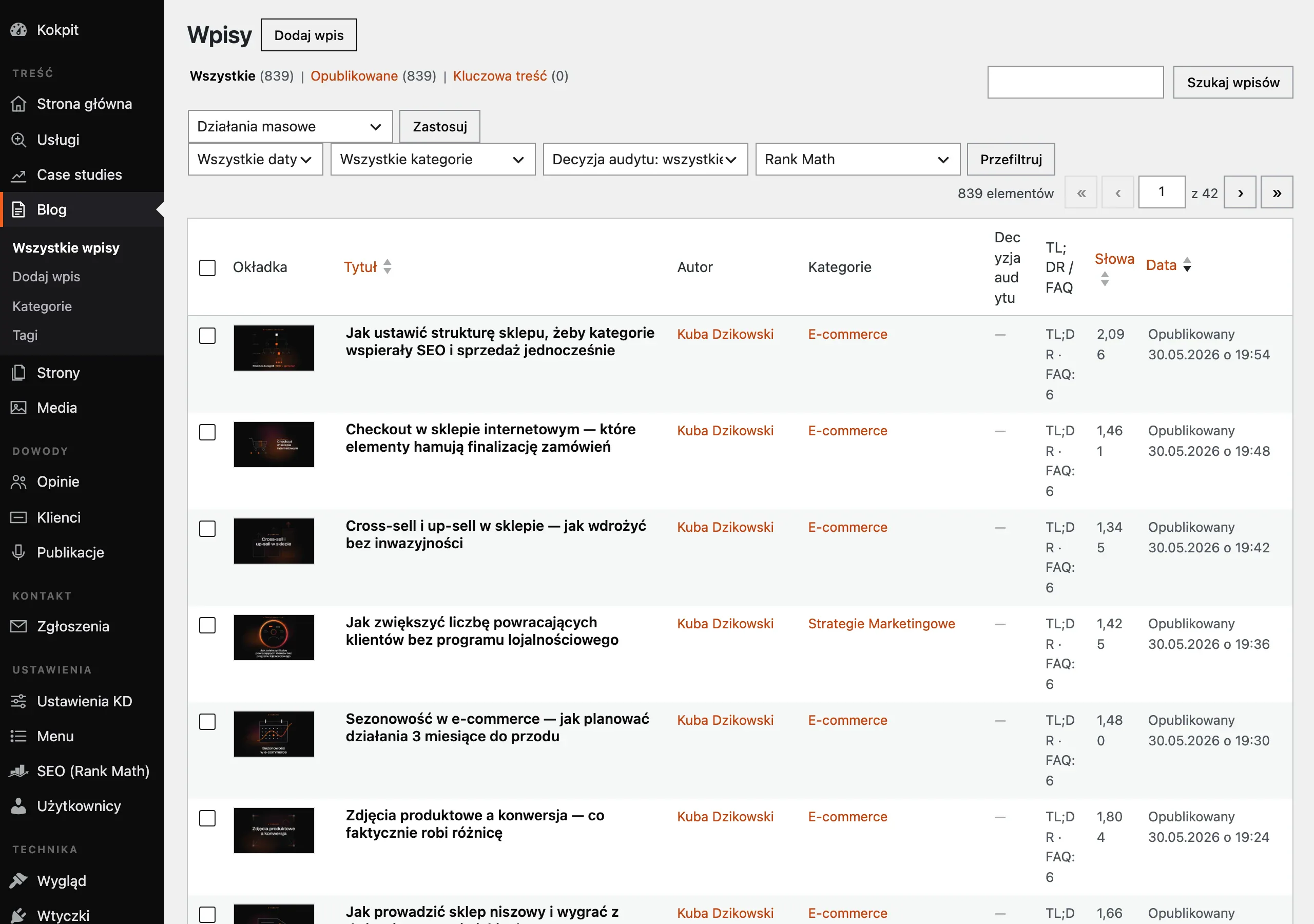
Then comes the inventory of all assets. In practice, that means exporting URLs from the CMS and data from an SEO crawler, so you have a complete list of articles, landing pages, categories, FAQ, guides and downloadable materials. For each item, it is worth immediately adding the content type, publication date, last update, indexation status and basic information about internal linking. That sounds technical, but without this “map” the rest of the audit is guesswork.
The next stage is to combine data from different sources into one narrative. Page views alone are not enough, so you need to compare data from GA4, Google Search Console, CRM and forms. Only then can you see which pieces of content attract queries with purchase intent, which lead to the offer, and which only inflate traffic without a further step. The biggest mistake is assessing content solely on page views.
Then each piece of content is mapped to the user intent, the stage of the customer journey and the offer. It is a short truth test. That is when it becomes clear whether the company has an excess of educational materials for the early stage of the funnel, and at the same time too little content that helps compare solutions, address objections or simply encourage contact. In many websites, the problem is exactly here: the content exists, but it does not form a logical journey.
After mapping, structural problems are easier to spot. And this is not a detail. Most often you can see topic duplication, keyword cannibalisation, orphaned content without internal links, no connection to the offer, out-of-date information and too many materials on the same broad topic. At the same time, you need to assess the quality of the answer itself: does the content really explain the problem, match the search intent, include examples and lead the user further on.
At the end, each asset gets an editorial decision and an implementation priority. Here, enthusiasm does not win, order does. The point is not to improve everything at once, but to start with the content with the greatest business potential and the fastest scope for improvement. Typical decisions look like this:
- keep as is, if the content has a clear function and works,
- update, if the topic is important but the information or structure is weak,
- merge, if several URLs answer the same intent,
- rewrite, if the topic is relevant but the execution does not support SEO or conversion,
- redirect or remove, if the content has no value for the user or the offer,
- expand or create a new format, if a clear gap is visible in the customer journey.
The result of the audit should not be just a report, but an action plan. Fireworks in slides do not sell anything. A good outcome is a topic map, a list of quick wins, rules for briefing new materials, an internal linking plan and a measurement model after implementation. If the audit does not end with a decision on who does what and according to which priority, then it was only a content review, not an optimisation.
Practical steps to implement an effective content strategy
An effective content strategy starts with answering the question of what specific change the content is meant to trigger in the audience. Without that, we are groping in the dark. For some materials, the aim will be to attract traffic from search, for others to educate before a sales conversation, support the offer or handle objections after contact with sales. If you cannot say it in one sentence, the content most often does not yet have a well-defined role.
In practice, it is worth first stopping the overproduction of new materials and tidying up what already exists. It is a difficult decision, but usually more profitable than adding more articles to the information mess that is spreading across the site. It is not worth publishing new materials if you do not know which existing pieces duplicate each other, compete with one another or do not support sales.
The next step is to agree on the minimum set of information that every piece of content must have before publication and during review. Simple. Such a standard organises the work of marketing, SEO and sales, because everyone is pulling in the same direction and looking at the same document. The minimum should include:
- the business objective of the content,
- the main audience or problem to solve,
- the user intent and funnel stage,
- the main queries or core topic,
- the CTA and expected next step,
- the content owner and date of the next review,
- the KPI that will show whether the content works.
Then you need to bring together the SEO, UX and sales perspective. And that is where the problems begin. A text may rank very well, but not lead to the offer. It may also help salespeople, but not be discoverable in search. Good content does not end with answering the question; it should also make the user’s next move easier.
Next, topic clusters and internal linking are built around real customer problems. Let us look at it another way. This approach is simply better than a calendar built solely around keyword volumes, because you are not chasing numbers, you are guiding a person. Topics need to be arranged so that the user can naturally move from educational material to solution comparison, the offer, FAQ or the contact form.
Equally important are clear criteria for the update, merge and remove decisions. Without that, the team goes round in circles. If content is outdated, does not answer the current intent, does not take part in conversion paths or duplicates a topic better covered elsewhere, it needs to be named and a decision made. Not improve it indefinitely, but close the topic. This way the team does not discuss every page from scratch and does not revive materials that no longer have a business rationale.
Finally, you implement a review and measurement cycle. The key is not to stop at traffic alone. After publication and after every major update, it is worth checking not only visits, but also queries, CTR, transitions to offers, user behaviour and the impact on leads. A good brief must answer not only the question “what are we writing about”, but also “how will we know it is working”.
Implementation will go more smoothly if the basic systems and decision-makers are available from the outset. The fact is this: without access to data, everything turns into opinion. Most often you need access to the CMS, GA4, Google Search Console, lead data or CRM, the list of offers and the current site architecture. If the historical data is weak, the offer changes often or the organisation operates across multiple domains and languages, the strategy can still be implemented, but note: you need to arrange priorities more simply and accept more quickly that not everything will be measurable straight away.
The most common mistakes and how to avoid them
The most common content sins are simple. Publishing without a defined objective, measuring results too superficially and failing to decide what to do with existing materials. In practice, it looks like this: the team publishes regularly, but cannot identify which URLs genuinely support the offer, leads or sales. This approach quickly drives up production costs and blurs the picture of results. If content does not have a defined role in the customer journey, it most often becomes just another URL on the site.
Traffic can be seductive. A very common mistake is assessing content solely by page views or organic traffic, even though that is only the tip of the iceberg. High traffic does not yet mean value if the user does not go further, does not click through to the offer, does not leave contact details and does not return at the buying decision stage. The question is: so what if someone landed there, if nothing comes of it. To avoid this, you need to combine SEO data, user behaviour and sales signals into one whole, instead of looking at each area in isolation.
The second problem is the lack of a strategic brief. Then several people write about a similar topic from different perspectives and the mess begins: duplicated intent, keyword cannibalisation and chaos in internal linking. This is not a detail, but a real cost. A minimum brief should include the content goal, the main user intent, the funnel stage, the related offer, the CTA and the success criterion.
After publication, silence often falls. The content lands on the site, but no one is responsible for updating it, developing it, merging it with other materials or removing it when it no longer makes sense. The problem is that without an owner everything “sort of” carries on until it starts getting in the way. A good practice is to assign an owner to each important asset and a review date, because the lack of a content owner almost always means there is no decision about when something needs to be improved or withdrawn.
Another mistake is separating SEO, content and sales into three independent processes. The result is often predictable: texts are produced that are polished for queries but weakly support the offer, or vice versa — commercially excellent, but invisible in the search engine. Let’s look at it differently: it is worth planning the topic around the real questions of the customer and immediately designing the next step after reading. The reader is not interested in a “nice article”, only in a sensible path forward. Content without a CTA or without a logical transition to the next action loses a large part of its user and business value.
Requirements and constraints when carrying out a content audit
A content audit without access to data is hamstrung. It requires access to systems and decision-makers, because otherwise the analysis quickly becomes fragmented and the conclusions are more opinion than diagnosis. The foundations are usually CMS, GA4, Google Search Console and CRM or another source of data on leads and sales. On top of that there is information about the offer, site architecture, business priorities and sales plans. The data speaks clearly: only combining traffic, intent and conversion provides material for decisions, not for slides. The better the data on traffic, intent and conversion is connected, the more accurate the decisions for specific URLs will be.
Technical access alone is not enough. You also need organisational readiness, meaning someone on the company side who takes on the burden of decisions. That person confirms priorities, adds context for individual pieces of content and resolves disputes between SEO, marketing and sales. Who is supposed to coordinate it if not a designated topic owner. Without this, the audit may accurately name the problems, but implementation will get stuck exactly where it usually does, at the stage of slides and “findings to consider”.
Usually it is the mundane things that block us. Poor-quality historical data, no conversion tagging, frequent changes to the offer, multiple language versions, and dispersed domains or subdomains can turn analysis into painstaking puzzle-solving. In such conditions you can still work, but the conclusions need to be read more carefully, and priorities should be based not on “averages” but on business potential and the quality of the content itself. And that is crucial, because with weak data it is easy to mistake noise for signal. If, on top of that, the approval process in the company drags on for weeks, it is better to split the topic straight away: instead of one big implementation — quick fixes to start with and changes requiring broader agreement in the second step.
In practice, the scope of an audit always depends on the scale of the assets and the maturity of the organisation. You work differently with several dozen URLs and differently with several thousand pieces of content in multiple languages, where every mistake multiplies by the number of variants. A good audit is therefore not about checking everything equally deeply, but about setting the scope so that you first organise the areas with the greatest impact on visibility, user experience and business outcome. The question is what will actually move the numbers, and what only looks nice in the report.
FAQ
Frequently asked questions
How do you spot that a company has too much content but too little strategy?
If publications keep increasing, but nobody can say which materials attract traffic, educate, support sales or overcome objections, then there is usually no strategy. Other signals are topic duplication, keyword cannibalisation and chaos in internal linking.
Can the number of publications alone indicate a good content strategy?
No, because the number of texts alone does not yet show whether the content has a defined business goal and supports the user’s next step. High activity may only mask the lack of a real strategy.
Why does content without an assigned goal start to hurt SEO?
Because topics start to duplicate or compete with each other, which weakens the site’s potential. As a result, SEO “chokes” instead of strengthening the visibility of one well-positioned piece of content.
Which data do you need to combine to assess content effectiveness?
The article points to data from the CMS, GA4, Google Search Console, CRM and forms. Only after combining them can you see which pieces of content generate enquiries, lead to the offer, and which only drive traffic.
When is it worth keeping, updating or removing content?
After an audit, every piece of content should receive an editorial decision: keep it if it works and has a clear function; update it if the topic matters but the information is weak; merge, rewrite, redirect or remove it if it adds no value. The choice depends on the role of the content, its quality and its relationship to the offer.
What should the minimum brief before publishing content include?
It should define the business goal, the audience or problem, the user intent and funnel stage, the CTA and the expected next step. It is also important to include the content owner, the date of the next review and the KPI that will show whether the material is working.