

In eCommerce, misguided thinking dominates. Many people believe that customers will land on the homepage or a category page and then find a product page. This assumption is wrong and represents a missed opportunity.
Product pages often gain substantial organic traffic from visitors who are already ready to buy. If your product pages do not play a key role in your SEO strategy, then you are missing your opportunity. It is therefore worth getting more information on optimising product pages and improving SEO performance.
Why is product page optimisation complicated?
Search engines assess the whole store. The whole is greater than the sum of its parts. Page optimisation of product pages requires focusing on such pages without neglecting the broader view of how product pages work together and the rest of the site.
When it comes to the broader view, you should consider, among other things, the following issues:
- category pages and product pages competing with each other for the same queries,
- very similar product variants,
- products available in multiple categories,
- products that have been discontinued.
- 01Overall store assessmentSearch engines assess the whole
- 02Internal competitionCategory pages and products compete
- 03Product complexityVariants, multi-categories, discontinued products
Conclusion: success of product pages requires balancing optimisation of individual pages with the broader context of the whole store.
Product page optimisation and sales potential
Products can, however, change at different frequencies. That is why many owners assume that it is not worth spending time on them, because they generate organic traffic thanks to category subpages. However, this may lead to losing some traffic from long-tail phrases, which can also generate sales very effectively.
A user who finds a subpage for a given product while looking for a specific model will most likely make a purchase, because they have found exactly what they were looking for. This is an important argument that should encourage store owners to invest in product page optimisation.
It is also worth remembering that the content found on product pages is often imported directly from the database of a particular manufacturer or distributor. It is therefore not hard to guess that the pages of such online sellers are integrated with that supplier.
What does this mean from an SEO perspective? Nothing other than duplicate content, regarded as one of the most serious SEO mistakes, which has an adverse effect on the ranking of a given subpage in search results.
As for the most important advantages of product page optimisation, they are as follows:
- increasing the visibility of new product phrases (long-tail),
- using organic channels to reach users interested in a specific product,
- improving the sales conversion of a given product,
- eliminating errors that may negatively affect SEO results.
How to optimise product pages?
Fortunately, there are specific product page optimisation practices. They are as follows:
- 01Adapting product namesInclude the brand, model, attributes (e.g. colour)
- 02Implementing keywordsAdd them in the name, meta and URL
- 03Avoiding cannibalisationOptimise only for product queries
The key to success is uniquely matching the content to queries for a specific product, while avoiding competition with categories.
Adapting product names to the keyword strategy
Adapting product names to target queries is a long-term process. You need to take into account the brand name, product name, model number and useful product attributes such as colour, size, etc.
An example could be running an online store selling backpacks and wanting to achieve a high ranking for the Osprey Kyte 46 women’s backpack. First and foremost, keywords should be included in the product name, meta information and URL.
You should avoid product pages competing with the category page. Therefore, each product page should be optimised exclusively for product-specific queries, not for queries relating to the brand or the brand and product category.
Descriptive and consistent product URLs
A good URL structure helps visitors and search engines understand the structure of the page. You are likely to get more clicks on your description beneath the Google search result when the visitor sees a URL that reflects their query.
A good URL structure has the following characteristics:
- it is descriptive,
- it is concise,
- it uses lowercase letters,
- it is consistent,
- it is easy to read.
When it comes to product pages, the last part of the URL is important, namely the so-called URL slug.
In the case of a product page such as the Osprey Kyte 46 pack Women’s backpack (eng. Osprey Kyte 46 pack Women’s), the ideal URL slug will be osprey-kyte-46-pack-womens. The complete URL will look like this, for example: https://example.com/backpacks/hiking/osprey-kyte-46-pack-womens/.
Meta information: title tag and meta description
When talking about “meta information” in SEO, we mean both the title tag and the meta description. Both of these elements play a key role in the ranking of a product page and in how it is presented to searchers.
A good title has the following characteristics:
- it is easy to read,
- it has important keywords at the beginning,
- it is unique,
- its length falls within the range of 285 to 575 pixels (that is, from 30 to 60 characters respectively).
The same applies to a good meta description, except that the recommended length falls within the range of 430 to 920 pixels (respectively from 70 to 155 characters). It is also recommended to use a call to action.
Especially in the case of larger online stores, manually creating titles and meta descriptions for every single product is impossible. That is why it is recommended to work with templates that will allow such titles and descriptions to be generated automatically. In addition, there should be the option to manually edit and save automatically generated titles and meta descriptions.
This way you can quickly create decent titles and meta descriptions. In addition, they can always be modified to achieve perfection.
Descriptive headings
Headings help visitors and search engines quickly see what a given page is about and what its structure is. It is recommended to use an H1 heading for the product name. Then H2 headings should be used for the most important sections, such as:
- product features,
- technical specifications,
- reviews,
- questions and answers (Q&A).
You can try to weave the product name into one of the H2 headings in a natural way. However, if this could negatively affect the user experience and feel, it is better not to do so.
In the backpack example above, the heading structure would look as follows:
- H1: Osprey Kyte 46 pack Women’s
- H2:
- Features,
- Technical specifications,
- Reviews or Reviews of Osprey Kyte 46 pack Women’s,
- Questions and answers.
Including and linking product attributes
Including product attributes will improve the ranking for product-related queries. You should include the brand name, series name, model name and SKU identifier.
Linking these product attributes is also an excellent way to improve the internal linking structure.
The examples are as follows:
- linking the brand name to the general page describing the brand,
- linking the series to the page describing the product series,
- linking the gender for which a given backpack is intended to a general overview of similar backpacks,
- linking the capacity to the range in which the backpack falls, e.g. 40 – 60L.
Creating engaging product descriptions
Well-written product descriptions persuade visitors to make a purchase. Make them tailored to specific people and engaging. They should explain the advantages and features of the products. At the same time, they must be concise, because nobody is interested in long descriptions.
You can also include closely related queries in the descriptions where competition is low. However, you should not overdo it.
First and foremost, you should include the key features. For example, in the case of the Osprey Kyte 46 pack Women’s backpack, you need to pay attention to the following issues:
- what a given backpack is best suited for,
- whether a rain cover is included,
- the backpack’s capacity,
- whether the backpack is compatible with a reservoir (“water bladder”).
In addition to describing the product, it is recommended to include a list of its features, such as size, colour and weight, in other words everything that a visitor may search for on Google.
Including high-quality images
Including high-quality product illustrations shows the products in detail, which translates into higher conversion rates. In the case of backpacks, you should show an illustration with a person wearing the given backpack, preferably in a natural setting.
An example could be a close-up of the backpack pocket or a photo of a person travelling with a backpack against some kind of landscape.
In addition to improving conversion rates, optimised illustrations also affect the product page’s effectiveness in terms of SEO.
Best practices in this area are as follows:
- including the product name in the illustration file name and in the alt attributes,
- uploading illustrations in the correct formats — it is best to upload files in JPG or WebP format, which is becoming increasingly popular,
- placing illustrations at the right size,
- compressing illustrations to reduce file size,
- including illustrations in the XML sitemap,
- making sure the illustration loads quickly and does not slow down the overall page load speed.
Including breadcrumb navigation
Good Breadcrumbs navigation is beneficial both for visitors and for search engines. Users can quickly understand the shop hierarchy and move to the category page using Breadcrumbs. In addition, such actions make it possible to provide the relevant internal links needed for search engines.
However, there are different structuring methods. Below is an example of bad Breadcrumbs structure that is not helpful to anyone:
Home > travel backpacks for women
Here is an example of breadcrumbs with a good structure:
Home > Backpacks > travel backpacks > travel backpacks for women
It is important to mark up Breadcrumbs in Schema. This makes it possible to indicate them even more clearly and ensure they are correctly interpreted by machines.
Using product Schema with reviews
As mentioned in the introduction, the battle for search result clicks is fierce. When running an eCommerce business, you need to use every measure necessary to stand out.
By creating Schema markup for products and reviews, it is possible to provide search engines with additional content about products. In this way, you can improve the snippets under the search results. With Schema markup, you can describe which products are sold and how they are rated by customers.
As for the backpack example, below you can find the product Schema:
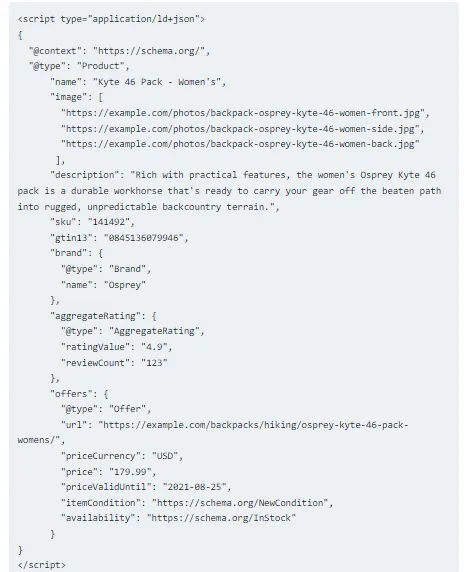
You should always check carefully whether the Schema markup is correct before validating it. You can do this using the Google Rich Result Test tool.
Avoiding cannibalisation of near-identical product variants
To understand the problem with product variants, it is worth using an example. It could be trainers offered in many styles and sizes.
In the case of 17 sizes and 10 styles, we are dealing with as many as 170 product variants. Creating separate product pages for each variant can lead to many instances of duplicate content.
In the case of the earlier backpack example, sales may include, for example, the Osprey Kyte 46 for women, available in black, blue, yellow, red and green. Apart from the colour, the other product attributes are the same. In this case, should indexable product pages be created for each colour?
There are two factors that affect the final decision:
- whether there is sufficient search demand,
- whether you have the resources to write unique product descriptions.
Even if the answer to both questions is yes, you still need to do some calculations and checks. If search demand is low and you will not achieve a positive ROI from creating unique pages with unique descriptions for each colour, then you should choose the main variant and canonicalise the remaining variants. This way, the pages will not compete with each other in the rankings. This is known as keyword cannibalisation.
Use rel=canonical when creating unique product pages is impossible
Let us assume that in this example the main variant is the red backpack. You should make sure that it has a self-referencing canonical URL informing browsers that this is the canonical version that should be indexed. The green and blue variants will have canonical URLs pointing to the red variant.
This configuration makes it possible to communicate indexing preferences clearly and also has an impact on visitors. They can, for example, share and save the variants they are looking for.
Many people wonder what may happen if canonicalisation is not carried out, but instead three almost identical, indexable product pages are created. In such a case Google may decide on its own to canonicalise the product variants. They will be marked in the Index Coverage report in Google Search Console in the Duplicate section. Usually Google chooses a different canonicalisation status than the user.
However, if you think you can achieve a positive ROI from creating separate, indexable product pages for each colour, because there is significant search demand, then it is worth doing. You should, however, use unique SKU/GTIN numbers, create unique product descriptions and include illustrations appropriate to the given product variant.
Promoting products that are no longer sold
Many shops do not make use of the potential of products that are no longer sold. These are products that are temporarily or permanently unavailable. Perhaps they are no longer in stock, a given product line is no longer continued, or their sale has been discontinued by the shop. Whatever the reason, they should be handled with care, because pages with products that are no longer sold still have considerable value!
By “value” we mean the following features:
- the pages still generate (organic) traffic,
- links from other pages point to them.
If the product is to be available in stock later, you should keep its online page and carry out the following actions:
- include it in the XML sitemap and in the on-site search,
- place the words “out of stock” or a similar label on the product image,
- hide the product price and disable the option to add it to the basket,
- show alternative products that are likely to meet the visitor’s needs,
- remove the Offer property from the product Schema markup to prevent Schema penalties,
- notify visitors that the product will be available soon or offer them the option to receive a notification when the product is back on sale,
- suspend all active PPC campaigns directing customers to the product page.
If these pages have value, then it is a good idea to take care of one of the following issues:
- keeping each product online until search demand remains high and displaying alternative products. It is recommended to remove internal links leading to such products and remove the products from the XML sitemap and store search. It is also important to add the noindex directive in the Robots.txt file,
- using these URLs for other, very similar products,
- implementing 301 redirects to the most relevant alternative products.
You must not allow orphan pages to be created in product pages
With a large assortment that changes all the time, it is easy to lose control of products. Some product pages may become so-called orphan pages when their parent category page is removed.
Orphan pages are not part of the site structure and therefore do not have internal links. This leads to poorer ranking positions and sometimes causes Google to decide to stop indexing products altogether. That is why it is worth monitoring the site constantly and watching out for such situations.
FAQ
Frequently asked questions
How to optimise a product page for SEO to improve visibility in Google?
You need to take care of the product name, descriptive URL, title tag, meta description, headings, description content, images, breadcrumbs and Schema data. It is also important to avoid cannibalisation between the product page and the category page, as well as between similar variants.
Do product pages matter in an online store’s SEO strategy?
Yes, because they often generate organic traffic from people who are already close to buying. If they are not properly optimised, the store loses an opportunity for sales and traffic from long-tail keywords.
Why does duplicate content on product pages harm SEO?
Many product descriptions are copied from the manufacturer or distributor, which means the pages have duplicate content. This is one of the more serious SEO mistakes that can negatively affect the page’s ranking in search results.
What should good URLs for product pages look like?
They should be descriptive, concise, consistent, easy to read and based on lowercase letters. It is worth ensuring that the URL reflects the user’s query and contains a clear product slug.
What should be included in the title and meta description of a product page?
The title and meta description should be unique, clear and start with important keywords. A call to action is also recommended, and for larger stores it is worth generating them automatically from templates and then correcting them manually.
When should rel=canonical be used for product variants?
When variants are almost identical and there is no point creating separate indexable pages for them. In that case, one variant is indicated as canonical and the others point to it via canonical to avoid keyword cannibalisation.