
In today’s digital world, SEO has ceased to be merely an optional strategy – it has become a key tool for success for marketers. Analysing SEO statistics, such as organic traffic (which accounts for as much as 53% of visits to websites) or click-through rate, enables more effective planning of activities and achieving higher positions in Google results. Find out why content optimisation, mobile-friendliness and local SEO are today an absolute must-have in online marketing!
Why are SEO statistics key for marketers?
SEO statistics play a key role in digital marketing, providing valuable insights into the effectiveness of optimisation efforts. In an era where visibility in search engines often determines business success, analysing this data allows for more precise strategy planning. By studying organic traffic, click-through rates (CTR) and positions in search results, marketers can assess which activities deliver the best results.
It is worth noting that organic traffic accounts for an average of 53% of all visits to a website. This means that more than half of users reach websites thanks to Google results. What is more, the first position in organic results generates as much as 31% of all clicks – a clear sign of how important effective SEO is.
Interestingly, research shows that SEO can generate even 1000% more traffic than social media. This proves that investing in optimising websites for search engines is more cost-effective than advertising on social media. With such data, marketers can manage budgets more efficiently and increase return on investment (ROI).
You also cannot forget about current SEO trends. The growing importance of mobile optimisation or local SEO requires continuous monitoring and strategy adjustments. Statistics show that over 60% of users use mobile devices to browse the internet – which is why optimisation for portable devices has become a key element of every SEO strategy.
SEO statistics are an essential tool for marketers. They make it possible not only to increase a website’s visibility and attract more potential customers through organic traffic, but also to better understand user behaviour and tailor activities to the current requirements of Google’s algorithms.
- 01Strategy planningBased on optimisation data
- 02Organic trafficAn average of 53% of all visits
- 03First organic positionGenerates 31% of clicks
- 04Performance assessmentAnalysis of CTR and positions
SEO statistics enable precise measurement of success and optimisation of activities.
The role of SEO in website visibility
SEO plays a key role in increasing website visibility, directly affecting its position in Google search results. With the right optimisation for search engine algorithms, a website can achieve a higher ranking, which in turn translates into more visits. Effective SEO includes both the technical aspects of a website and the creation of valuable content tailored to users’ needs.
Visibility in search results is of enormous importance for acquiring organic traffic, which accounts for an average of more than half of all traffic on a website. What is more, the first position in organic results generates as much as 31% of all clicks, highlighting the importance of effective SEO. This allows marketers to reach potential customers without having to invest in paid ads.
SEO optimisation is not limited only to the content and technical aspects of a website. An important element is also:
- adapting the website to mobile devices,
- using local SEO.
More than 60% of users browse the internet using smartphones or tablets, which is why responsiveness has become a key factor in SEO strategy. Local SEO, in turn, allows businesses to reach customers in their area, which is particularly important for small and medium-sized enterprises.
Monitoring statistics using analytical tools enables the continuous improvement of SEO strategy. This makes it possible to adapt activities to the changing requirements of Google’s algorithms, increasing site visibility and attracting more potential customers through organic traffic.
The importance of organic traffic for marketing
Organic traffic plays a key role in digital marketing, accounting for an average of as much as 53% of total website traffic. This means that more than half of users reach a site thanks to organic search results. Unlike paid advertising campaigns, this type of traffic offers a better return on investment (ROI), making it one of the most cost-effective ways of acquiring customers.
The long-term success of a marketing strategy largely depends on organic search. This is because users are more likely to trust organic results than adverts. Studies show that the first position in search results attracts as much as 31% of all clicks, which highlights the importance of effective SEO.
One of the biggest advantages of organic traffic is its stability. With proper website optimisation for SEO, companies can maintain high visibility for a long time without the need for continuous investment in advertising. This makes it a particularly attractive solution for businesses with limited budgets.
It is also worth noting the impact of organic traffic on other aspects of digital marketing. A high position in search results not only increases brand recognition, but also improves its image in the eyes of potential customers. This enables companies to build lasting relationships with audiences and strengthen their loyalty.
Organic traffic is not only the main source of visits to a website – it is also one of the most effective marketing tools available to businesses. Effective use of SEO makes it possible to increase site visibility, attract more potential customers and improve the effectiveness of activities as a whole.
- 01Effectiveness vs. social mediaSEO brings 1000% more visits
- 02Dominance in total traffic53% of traffic comes from search
- 03The importance of first placePosition #1 attracts 31% of clicks
"Investing in strong organic visibility is a key factor in online success, often outperforming social media reach."
SEO statistics – organic search
SEO statistics related to organic search play a key role in effective website optimisation. Organic results, which are not dependent on paid adverts, are the main source of traffic on websites. Studies show that organic traffic accounts for 53% of all traffic, which highlights its enormous importance in marketing strategies.
One of the most important factors is the high click-through rate of the first result. Statistics indicate that the top position generates as much as 31% of all clicks. Companies that achieve high rankings in organic results have a greater chance of attracting customers without the need to invest in paid campaigns.
The importance of local SEO should also not be overlooked. According to research, 46% of Google queries are local in nature, which means that users often look for products or services in their area. For businesses operating in the local market, local SEO optimisation is crucial for increasing visibility and acquiring new customers.
It is also worth noting the growing impact of mobile devices. More than 60% of users use smartphones to browse the internet, which is why responsiveness and page loading speed have become essential. Mobile-friendly websites have a greater chance of achieving higher rankings in search results.
What is more, statistics show that SEO generates even 1000% more traffic than social media. This is clear proof that investing in website optimisation for Google’s algorithms is more cost-effective than advertising on social media.
Analysing SEO statistics makes it possible to better understand user behaviour and adapt strategies to Google’s algorithm requirements. This makes it possible to increase site visibility and attract more customers through natural search results.
Organic traffic as a source of 53% of website traffic
Organic traffic, coming from search results, accounts for more than half (53%) of total website traffic. This clearly shows how important effective SEO is in attracting users. In addition, as many as 68% of online experiences begin with a search engine, which highlights the key role of SEO in marketing strategies.
The first organic result attracts an average of 28,5% of all clicks, which confirms the huge importance of a high position in the results. What is more, as many as three quarters of users do not scroll beyond the first page of Google, which means that pages appearing further down have much lower chances of gaining traffic.
Google dominates the search engine market with a share of over 85%. That is why optimising for its algorithms is an absolute priority for marketers. The value of the SEO industry has already exceeded $50 billion in 2023, which is clear evidence of its growing importance.
Effective SEO allows companies to increase the visibility of their websites and attract more potential customers – all without having to invest in paid advertising.
- 01What is CTR?Click-through rate.
- 02First position.An average of 28,5% of clicks.
- 03Visibility drop.2nd and 3rd positions get 15% and 11%.
- 04Titles and meta descriptions.Huge importance for clicks.
- 05An attractive result.Grabs attention and meets needs.
A high CTR and precise meta descriptions are key to attracting organic traffic from Google.
The importance of the first position in search results
The first place in search results is the key to success in an SEO strategy. Studies show that as many as 75% of users do not look beyond the first page of Google, which means that pages in lower positions have much lower chances of attracting attention.
The first organic result generates an average of 28,5% of all clicks, which clearly shows how much value a high position has. This can significantly increase organic traffic, which accounts for 53% of total website traffic.
It is also worth noting that Google controls over 85% of the search engine market, which is why optimising for its algorithms is an absolute must for every marketer. Effective SEO allows companies to increase visibility and attract customers without having to spend money on paid advertising.
What is more, the SEO industry reached a value of over $50 billion in 2023, which only confirms its growing importance. With proper website optimisation, you can maintain strong visibility for a long time without continuously investing in advertising campaigns.
The first position is not just more clicks – it is also greater user trust and better conversion results. That is why striving to achieve the top spots in Google’s organic results is so important.
The impact of SEO on web traffic
SEO plays a key role in generating web traffic, as confirmed by numerous analyses. Interestingly, search engine optimisation can bring as many as 1000% more visits than organic social media activity. This is a clear signal that investing in SEO often proves more profitable than advertising on social media platforms.
It is worth noting that organic traffic, coming from search results, accounts on average for 53% of total website traffic. This means that more than half of users land on websites precisely thanks to effective SEO. It is also worth noting that the first organic result attracts as many as 31% of all clicks, which only confirms the importance of strong visibility in Google.
What is more, as many as 68% of online experiences begin with entering a query into a search engine. This is another argument in favour of making SEO the foundation of every marketing strategy. Companies that invest in website optimisation can count not only on greater visibility, but also on long-term benefits – customer acquisition without having to constantly spend money on paid campaigns.
It is also worth remembering that Google dominates over 85% of the search engine market, which makes adapting a website to its algorithms an absolute priority. Effective SEO not only increases organic traffic, but also improves the conversion rate and builds lasting relationships with audiences.
The impact of SEO on web traffic is undeniable. With proper optimisation, you can significantly improve website visibility, attract more potential customers and achieve better business results.
SEO generates 1000% more traffic than social media
SEO generates as much as 1000% more traffic than social media, which clearly shows that investing in search engine optimisation is more profitable than advertising on social media platforms. Research confirms that organic traffic from search results accounts on average for 53% of total website visits. By comparison, organic reach on social media often falls below 5%, which clearly indicates SEO’s advantage.
The first position in organic results attracts as much as 31% of all clicks, while the click-through rate (CTR) in social media is only 1-2%. This is because users are more likely to trust search results than content displayed on social platforms.
Google dominates the search engine market, controlling over 85% of the share. That is why optimising for its algorithms is crucial to achieving high visibility. The value of the SEO industry had already exceeded $50 billion in 2023, which only confirms its growing importance. A effective SEO strategy allows companies to attract more potential customers without having to keep investing in paid campaigns.
Nor should the growing role of mobile devices be forgotten – over 60% of users browse the internet using them. That is why mobile optimisation has become an essential element of SEO strategy. Sites adapted for portable devices have a better chance of higher positions in search results and attracting more visitors.
SEO not only generates more traffic than social media, but also offers a better return on investment (ROI). With proper site optimisation, you can increase brand visibility and attract more customers through organic search results.
User behaviour and SEO
Internet users’ behaviour plays a key role in the effectiveness of SEO activities. Research shows that as many as 68% of online interactions begin with entering a query into a search engine, which shows how important content creation is for addressing users’ needs and habits. Interestingly, most people trust organic results more than paid ads, which further underlines the importance of proper site optimisation.
Organic results enjoy greater trust. Three-quarters of users do not scroll beyond the first page of Google results, which means that sites in lower positions have far less chance of attracting attention. That is why it is so important to aim for a high ranking position.
Another important element is time spent on the site and the bounce rate. Internet users expect instant access to information and intuitive navigation. Sites that take longer than 3 seconds to load can lose as many as 40% of visitors. That is why load speed optimisation is a key factor in maintaining interest.
Nor should user intent be forgotten. Google’s algorithms are increasingly effective at recognising the purpose behind queries. For example, when someone searches for local products, the search engine will display results related to that region. This makes local SEO increasingly important for businesses operating in regional markets.
User behaviour also affects CTR (click-through rate). Organic results with attractive meta descriptions and titles attract more clicks. Research indicates that the first organic result generates as much as 28.5% of all clicks, which confirms the importance of properly optimising content for SEO.
Analysing user behaviour makes it possible to better tailor SEO strategies to their needs and expectations. Effective site optimisation not only increases visibility in search results, but also improves the experience of internet users. This translates into a higher conversion rate and long-term brand success.
The importance of organic results for users
Organic results are extremely important for users because they offer the most relevant answers to their questions. Research indicates that as many as 75% of people do not scroll beyond the first page of Google results, which means that sites in lower positions have a much smaller chance of attracting attention. That is why it is so important to aim for a high ranking position.
Trust in the brand is a key factor influencing users’ decisions. Organic results inspire more trust than paid ads, which translates into a higher click-through rate (CTR). For example, the first organic result generates an average of 28.5% of all clicks, which underlines the importance of effective SEO.
Users also expect quick access to information and intuitive navigation. Sites that take longer than 3 seconds to load can lose as many as 40% of visitors. That is why load speed optimisation is crucial for maintaining interest.
It is also worth paying attention to user intent. Google algorithms are increasingly better at understanding the purpose behind queries. For example, when someone searches for local products, the search engine will display results related to that region. This makes local SEO increasingly important for businesses operating in regional markets.
Effective site optimisation for SEO not only increases visibility in search results, but also improves the user experience. This translates into a higher conversion rate and long-term brand success.
CTR and its importance in SEO
Click-through rate (CTR) is a key indicator of the effectiveness of SEO activities, showing how often users click on a search result compared with the number of its impressions. A high CTR indicates that the page attracts attention and effectively meets the needs of the audience.
According to research, the first position in organic results generates an average of 28.5% of all clicks, which clearly shows how important high visibility in Google is. The higher a page ranks, the more likely users are to visit it. By comparison, results in second and third position have a much lower rate – around 15% and 11% respectively.
Of huge importance are meta descriptions and page titles. Attention-grabbing, precise descriptions encourage clicks, while unclear or uninteresting content can put off potential visitors. By optimising meta descriptions, CTR can be increased by as much as 30%.
No less important is user intent. Google’s algorithms are increasingly better at understanding the purpose of queries, so pages tailored to the specific needs of the audience have a better chance of achieving a higher click-through rate. For example, if someone is looking for local services, results related to a given region will be more appealing.
It is worth remembering that CTR also affects a page’s position in search results. A high click-through rate signals to Google’s algorithms that the page is valuable to users, which can help improve its ranking. That is why regular monitoring and CTR optimisation are key to an effective SEO strategy.
In summary, a high click-through rate is not just more visits – it is also a signal to Google’s algorithms about the quality of the page. Effective optimisation of meta descriptions, titles and content tailoring to user intent are the key to better SEO results.
Average click-through rate for the first result
The average click-through rate (CTR) for the first result in Google reaches 28.5%, which means that almost every third user decides to click. A high position in organic results is not only greater visibility, but also the key to attracting attention and increasing traffic to the site.
The top spot in the rankings generates the most clicks, underlining its strategic value in SEO. By comparison, results in second and third position achieve a much lower CTR – around 15% and 11% respectively. This clearly shows how important it is to aim for the top spots.
Meta descriptions and page titles have a huge impact on CTR. Attractive, precise descriptions encourage users to interact, while unclear or uninteresting content can put them off. By optimising meta descriptions, the click-through rate can be increased by as much as 30%.
It is also crucial to understand user intent. Google’s algorithms are getting better at recognising the purpose of queries, so pages tailored to the specific needs of the audience have a better chance of a higher CTR. For example, when someone is looking for local services, results related to a given region will be more appealing.
A high CTR not only translates into more visits, but also affects a page’s position in search results. Google’s algorithms treat a high click-through rate as a signal of valuable content for users, which can help improve rankings. That is why regular monitoring and CTR optimisation are key to an effective SEO strategy.
The first position in organic results is not only more clicks – it also means greater user trust and better conversion results. Effective optimisation of meta descriptions, titles and tailoring content to audience intent is the key to achieving a high CTR and success in SEO.
Local SEO and its importance
Local SEO plays a key role in an SEO strategy, especially for businesses operating in regional markets. It helps you reach customers nearby, which often translates into higher conversion rates. Statistics show that 28% of local searches end in a purchase, highlighting the huge potential of this form of optimisation.
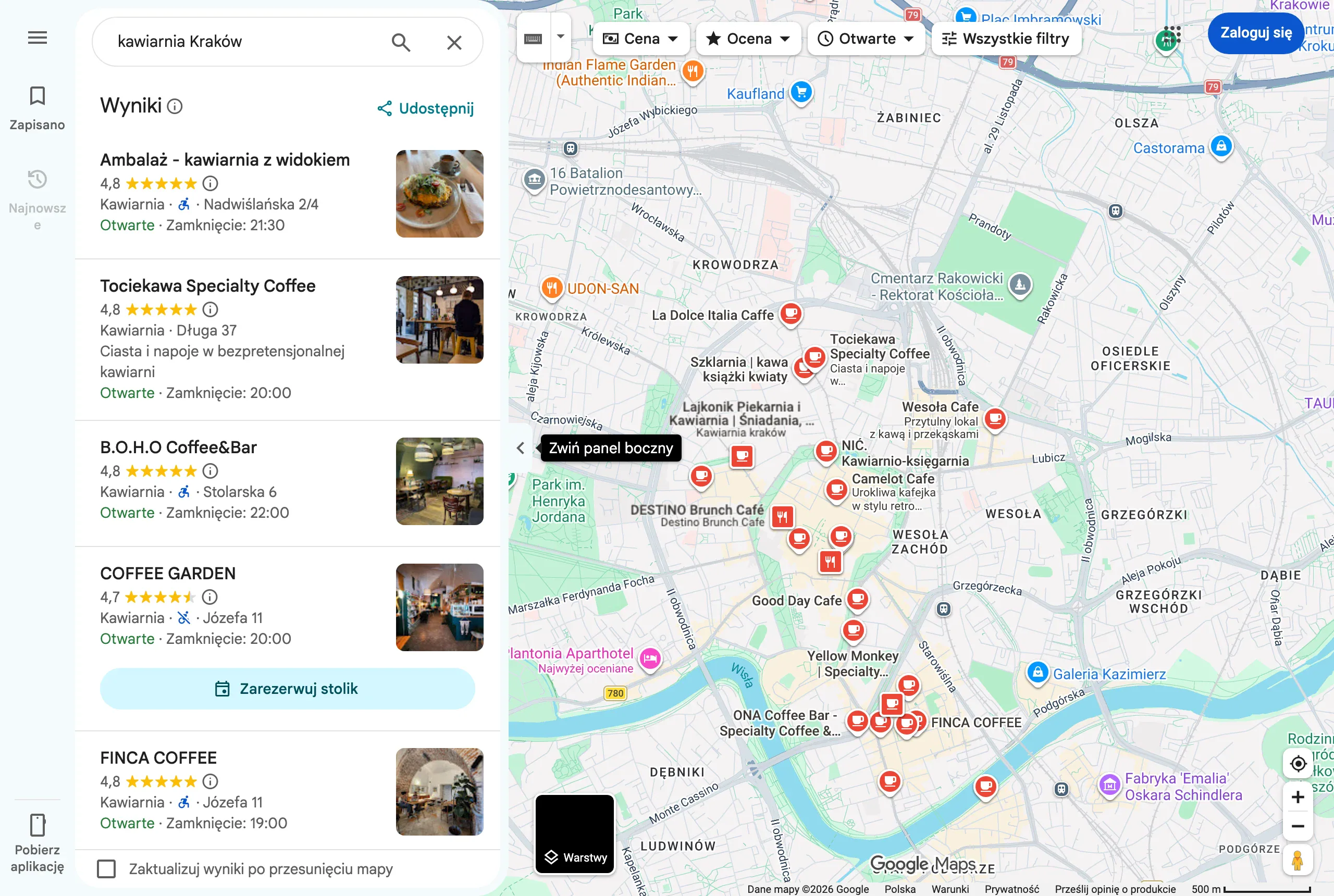
One of the most important tools in local SEO is Google My Business. By creating and optimising a business profile, you can significantly increase visibility in search results for queries related to a given area. It is also crucial to maintain consistency of NAP data (name, address, phone number) across different platforms – this builds trust with Google’s algorithms and affects the company’s position.
For the tourism industry, local SEO is particularly important. Tourists often search for services in specific towns, so optimising for keywords containing the region or city name can attract more customers. In addition, positive opinions and reviews on the Google My Business profile increase trust in the brand and encourage people to use the offer.
It is worth noting that competition in local SEO is lower than in the case of nationwide campaigns. Actions aimed at the regional market are often easier to carry out and deliver faster results. As a result, even smaller companies can effectively compete with larger players.
In summary, local SEO is not only a way to increase visibility in search results – it is also an effective method of attracting customers who are near the company’s location. Investing in this type of optimisation can bring measurable business benefits, especially for businesses operating in regional markets.
The importance of local SEO for conversions
Local SEO is a powerful tool that helps businesses increase conversions by reaching customers in their immediate area. As research shows, as many as 46% of Google queries are local, which means that users often look for products or services near where they live. For businesses operating in regional markets, optimising for local SEO is crucial – it improves visibility and attracts new customers.
One of the most effective tools in this area is Google My Business. By creating and regularly updating a business profile, you can significantly influence your position in search results for queries related to a given area. It is also important to maintain consistent NAP data (name, address, phone number) across different platforms – this builds trust with Google’s algorithms and translates into better results.
In the tourism industry, local SEO takes on particular importance. Tourists often search for services in specific towns, so optimising for keywords containing the name of a region or city can effectively attract more customers. In addition, positive opinions and reviews on the Google My Business profile strengthen trust in the brand and encourage people to use the offer.
Importantly, competition in local SEO is usually lower than in the case of nationwide campaigns. Actions aimed at the regional market are not only easier to carry out, but also deliver faster results. This means that even smaller companies can effectively compete with larger players.
Investing in local SEO is not only a way to improve visibility in search results – it is also an effective method of attracting customers who are close to the company’s location. An effective strategy can bring measurable business benefits, especially for businesses operating in regional markets.
Mobile optimisation as the key to success
Mobile optimisation has become one of the most important factors influencing SEO effectiveness today. More than 60% of users access the internet mainly via smartphones, so sites optimised for mobile devices have a better chance of achieving higher positions in search results. Since 2019, Google has introduced mobile indexing as the standard, which means that algorithms assess websites primarily in terms of their functionality on smartphones and tablets.
If a site is not responsive or loads too slowly, it can lose even 40% of potential visitors. Mobile optimisation, however, is not just about adapting the layout to smaller screens – loading speed is equally important. Research indicates that websites opening within 1-2 seconds have a 15% higher conversion rate than those that take longer.
User experience (UX) also plays a key role. Intuitive navigation, readable fonts and buttons designed with touch screens in mind affect time spent on the site and reduce the bounce rate. Google’s algorithms are increasingly better at recognising these elements and rewarding sites that offer high-quality UX with better positions in search results.
For locally operating businesses, mobile optimisation is especially important. Many people use smartphones to find services or products in their area. That is why site responsiveness and its visibility in local results are crucial for attracting customers and increasing sales.
Mobile optimisation is not just a technical requirement – it is an important element of an SEO strategy that affects site visibility, user experience and business results. Investing in this area can bring measurable benefits to both large corporations and small local businesses.
The importance of mobile SEO in marketing strategy
Mobile SEO has become an indispensable element of modern marketing strategies. It is worth emphasising that more than half of global online traffic comes from mobile devices, which means that failure to adapt websites for smartphones and tablets can result in losing a significant share of customers. Since 2019, Google has introduced mobile indexing as the default standard, which means that search engine algorithms assess sites mainly in terms of their functionality on smaller screens.
Unoptimised mobile sites can put off even 40% of users. Loading speed is also key – websites opening within 1-2 seconds record 15% higher conversion rates. Responsive design, clear navigation and a readable interface have a direct impact on user experience (UX), which in turn translates into a better position in search results.
For businesses operating locally, mobile optimisation is particularly important. Many people use smartphones to find services or products in their area. Therefore site responsiveness and its visibility in local results are key to attracting customers and increasing sales.
Investing in mobile SEO is not just a technical matter – it is a strategic marketing move. It affects brand visibility, user satisfaction and final business results. Companies that adapt their websites to the requirements of mobile devices gain a competitive advantage in the digital age.
The impact of AI on SEO and marketing
Artificial intelligence (AI) is increasingly influencing SEO and digital marketing, introducing groundbreaking changes. In 2023, as many as 58% of marketers intended to use this technology to optimise activities related to website SEO. This is a clear signal of how important a role AI plays in this field.
One of the main areas in which artificial intelligence is revolutionising SEO is data analysis. AI-based algorithms process huge data sets in the blink of an eye, detecting trends and user preferences. Interestingly, 67.2% of experts using these tools for keyword research reported a noticeable increase in organic traffic.
The impact of AI on content creation also cannot be overlooked. Modern tools can generate high-quality articles, product descriptions or meta descriptions. What is more, 63.7% of marketers admit that using artificial intelligence has helped them build a backlink profile more effectively.
Another benefit is the personalisation of user experiences. Algorithms analyse internet users’ behaviour and tailor search results to their individual needs. This allows companies to increase engagement and improve conversion rates. It is worth mentioning that 40% of specialists recorded revenue growth of 6-10% after implementing AI-based solutions.
The impact of artificial intelligence is also visible in the improved functionality of websites. As many as 78% of experts noticed an increase in the performance of their sites thanks to automating technical processes with this technology. Optimising page loading speed or adapting it to mobile devices are just some of the benefits of its use.
Artificial intelligence has become an integral part of modern digital marketing and SEO. Its use not only increases a site’s visibility in search results, but also significantly improves user experience and translates into better business results.
Using artificial intelligence in content creation and SEO
Artificial intelligence (AI) is revolutionising content creation and SEO optimisation, providing tools that speed up processes and increase the effectiveness of marketing activities. According to research, 58% of marketers intend to use AI to generate materials and adapt them for search engines. This approach can result in higher organic traffic and better positions in search results.
One of the most important applications of AI is automating content production. Thanks to natural language processing (NLP) technologies, algorithms are able to create high-quality texts that are both search-engine-friendly and engaging for audiences. Artificial intelligence analyses trends, user preferences and keywords to deliver materials perfectly matched to readers’ needs. Interestingly, 63.7% of specialists noticed an improvement in building a backlink profile thanks to using AI.
Another important area is the personalisation of user experiences. Algorithms analyse internet users’ behaviour and adapt search results to their individual preferences. This allows companies to increase audience engagement and improve conversion rates. Research shows that 40% of marketers recorded revenue growth of 6-10% after implementing artificial intelligence-based solutions.
AI also plays a key role in data analysis, which is essential for effective SEO. Tools based on this technology quickly process vast amounts of information, identifying trends and optimal strategies. As many as 67.2% of experts using these solutions noticed a significant increase in organic traffic on their sites.
Despite numerous benefits, using AI in SEO is not without challenges. High implementation costs of advanced tools and the need for specialist knowledge can be a barrier for smaller companies. In addition, ethical issues arise around content generated by algorithms, as well as the risk of excessive automation, which can lead to a loss of authenticity in the message.
Artificial intelligence is becoming an integral part of modern digital marketing and SEO. Its use not only makes it possible to increase a site’s visibility in search results, but also to improve user experience and achieve better business results.
SEO trends that every marketer should know
SEO trends play a key role for marketers who want to adapt their activities to the dynamically changing digital market. In 2023, particular attention is being drawn to mobile optimisation, which has become an indispensable element of effective SEO. More than 60% of users browse the internet mainly via smartphones, which means that sites not adapted to mobile devices lose a significant share of potential visitors. Since 2019, Google has used mobile indexing as the standard, which means that algorithms assess websites primarily in terms of their functionality on smaller screens.
Another important trend is the growing importance of artificial intelligence (AI) in SEO. AI-based algorithms are revolutionising the way data is analysed and content is created, enabling faster and more precise adaptation of strategy to user needs and search engine requirements. According to research, as many as 58% of marketers plan to use AI to optimise website optimisation activities.
It is also worth paying attention to the development of voice search. More and more people use voice assistants, such as Google Assistant or Siri, to find information or products. This forces a change in approach to content creation – keywords must be more natural and reflect the way users speak.
Local SEO is also becoming increasingly important, especially for companies operating in regional markets. As many as 46% of queries on Google are local in nature, and users often look for products or services near where they live. Optimising for local keywords and using tools such as Google Business Profile are key to attracting customers located close to the company’s place of business.
Another important trend is personalisation of search results. Google’s algorithms increasingly understand user intent better and tailor results to individual needs and preferences. Marketers therefore need to focus on creating content that not only matches queries, but also engages audiences and builds trust in the brand.
Optimising page loading speed is another significant factor influencing a site’s position in search results. Sites that open within 1-2 seconds record 15% higher conversion rates than those that take longer. That is why investing in improving a site’s technical performance is key to achieving success in SEO.
Trends such as mobile optimisation, the use of artificial intelligence or the development of local SEO have a huge impact on the effectiveness of marketing activities. Marketers should continuously monitor these changes and adapt their strategies to the current requirements of algorithms and user expectations.
The most effective technical approaches to SEO optimisation
The most effective SEO strategies focus on several key aspects that can significantly influence a site’s position in search results. One of the most important is mobile device adaptation. In an era where most users browse the internet using smartphones, responsive sites have an advantage in the rankings, which directly translates into increased organic traffic.
Site loading speed is equally important. Sites that load within 1-2 seconds record 15% higher conversion rates than slower ones. To achieve such performance, it is worth taking care of code optimisation, image compression and the use of technologies such as AMP (Accelerated Mobile Pages).
Technical structure plays a key role in SEO. The correct use of HTML tags – such as headings (H1, H2), meta descriptions or alt attributes for images – helps Google’s algorithms better understand the content of a page. In addition, the use of structured data (schema markup) can contribute to the display of rich snippets, which attract users’ attention.
Security is also hugely important. Introducing the HTTPS protocol is not only a Google requirement since 2014, but also a way to build trust among visitors. Sites using HTTPS are preferred by algorithms and have a better chance of higher positions.
Site indexability is no less important. Regularly checking indexing errors using tools such as Google Search Console makes it possible to quickly identify and fix technical issues. Thanks to this, a site can maintain high visibility in search results.
Effective SEO optimisation is a combination of different activities – from adapting to mobile devices to improving loading speed and site security. These steps not only increase a site’s visibility, but also affect user experience and final business results.
Voice search and its impact on SEO
Voice search is increasingly influencing SEO strategies, revolutionising the way people search for information on the internet. Currently, as many as 20% of queries in the Google app are carried out using voice commands, which clearly shows the growing importance of this trend. Marketers must adapt their activities in order to reach their target group effectively.
It becomes crucial to adapt content to natural language. Voice search differs from traditional keyword entry – users phrase queries in a more relaxed, conversational way. That is why it is worth focusing on long-tail keywords and questions that may be asked by audiences. Instead of short keywords such as „restauracja Kraków”, it is better to go for more specific phrases, e.g. „gdzie znajdę dobrą restaurację w Krakowie?” (“where can I find a good restaurant in Kraków?”).
Voice assistants, such as Google Assistant or Siri, are increasingly used to search for local services or products. This means that local SEO is gaining importance. Businesses should make sure their details are updated in tools such as Google Business Profile and optimise for phrases related to their region.
The issue of page loading speed also cannot be overlooked. Users using mobile devices and voice assistants expect immediate access to information. Pages that take longer than 3 seconds to load may lose as many as 40% of visitors.
In the era of digital transformation, voice search requires a new approach to SEO. An effective strategy should include optimising content for natural language, paying attention to local SEO, and ensuring website speed.
FAQ
Frequently asked questions
What share of website traffic does organic traffic account for according to the article?
Organic traffic accounts for an average of 53% of all website traffic. This means that more than half of users reach websites from search results.
Why is the top position in Google results so important?
The first organic result generates as much as 31% of all clicks, and elsewhere in the article 28.5% is also given. In addition, 75% of users do not go beyond the first page of Google.
Can SEO generate more traffic than social media?
Yes, according to the article SEO can generate up to 1000% more traffic than social media. This shows that search engine optimisation can be more profitable than social media activity.
How important is mobile SEO for a website?
More than 60% of users use mobile devices to browse the internet. That is why responsiveness and optimisation for smartphones and tablets are crucial today.
Is local SEO important for businesses?
Yes, because 46% of queries in Google are local in nature. This means that local SEO helps businesses reach customers in their area.
When is it worth regularly analysing SEO statistics?
It is worth doing this continuously, because it helps to adapt the strategy to the changing requirements of Google’s algorithms. Analysing data also makes it possible to better assess the effectiveness of organic traffic and CTR.